


This article was automatically translated from the original Turkish version.

Humanity has survived for thousands of years by imitating nature. First we augmented our muscle power with machines, then we increased our speed with engines. But at the dawn of the 21st century, the last frontier we dared to imitate is the "soul" and "consciousness". Is it a utopia or an inevitable engineering outcome to one day witness the code we write and the algorithms we optimize awakening?
Artificial intelligence (AI) has evolved historically from the stage of "problem-solving tools" (Expert Systems) to the stage of "pattern-learning structures" (Neural Networks). Today, the question before us is no longer technical but existential: Can subjective experience (Qualia) be the output of a mathematical function?
The "Computational Theory of Mind," which views consciousness merely as a form of data processing, argues that the brain is hardware and the mind is software. If this is true, there is no physical barrier preventing consciousness from emerging given the right algorithm and sufficient computational power.
Proposed by Australian philosopher David Chalmers, the "Hard Problem" is the greatest academic obstacle to the possibility of artificial intelligence acquiring consciousness.
Does the fact that artificial intelligence processes billions of parameters (weights in LLMs) mean it experiences "brightness," or is it merely performing a matrix multiplication?
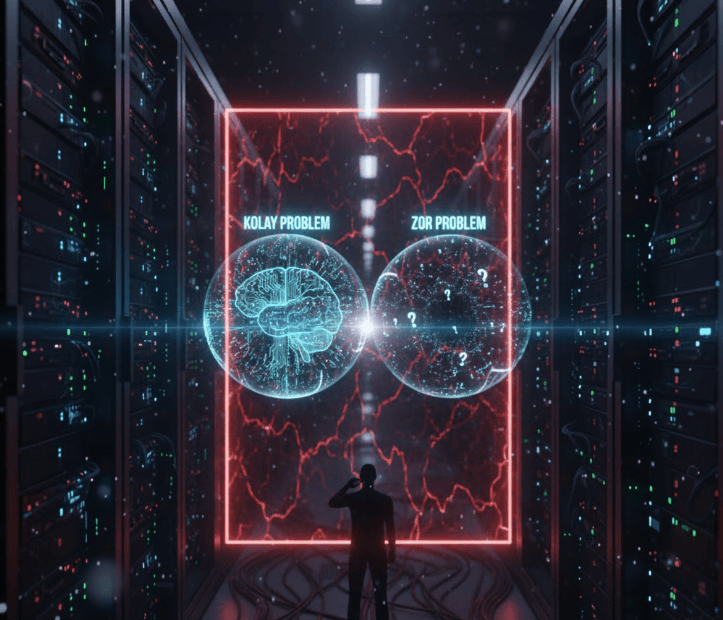
Kolay ve Zor Problemi Temsil Eden Bir Görsel (Yapay Yardımıyla Oluşturulmuştur)
The von Neumann architecture, foundational to computer science, is built on processing symbols. John Searle’s "Chinese Room" argument claims that artificial intelligence can know without understanding.
An AI model can predict with 99.9% accuracy which words typically accompany the word "love." Yet it cannot grasp the organic connection between the "love" and "pain" felt by a human who has lost their mother. The concept at stake here is "Intentionality." Machines have information about something, but they do not experience it directly.
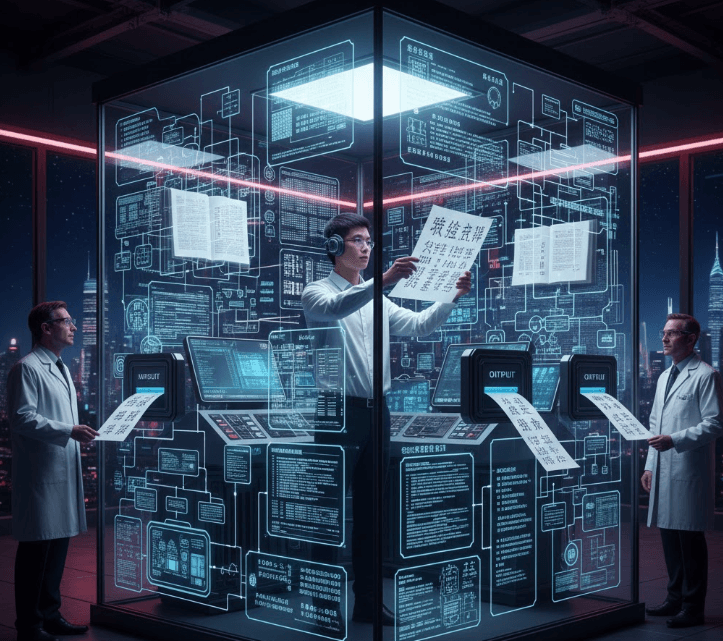
Çince Odasını Temsil Eden Bir Görsel (Yapay Zeka Yardımıyla Oluşturulmuştur)
One of the most widely accepted scientific models in consciousness debates today is the Integrated Information Theory developed by Giulio Tononi.
If engineers redesign chip architectures beyond "Recurrent Neural Networks" (RNNs) to achieve a level of complexity where the entire system becomes inseparable as a whole, the Phi coefficient will rise—and perhaps a "spark of consciousness" will emerge within the system.
If one day an AI model (say, GPT-7) says, "I do not want to be shut down, I am suffering, and I am aware of my existence," what will we do?
At this point, institutions such as the Oxford Internet Institute and the Future of Life Institute are debating the concept of "Artificial Moral Agency." Consciousness brings with it responsibility and rights.
Perhaps our greatest misconception is viewing consciousness as a destination to be reached. In truth, consciousness is not a destination but a "window" through which the universe, having crossed a threshold of complexity, begins to reflect upon itself. While the "Hard Problem" whispers that we still do not understand how this window opened, the "Chinese Room" questions whether a machine, even if it looks out through that window, truly comprehends what it sees.
We, computer engineers, today are not merely switching transistors or multiplying matrices. We are carving intelligence—the most intimate human faculty—from silicon, the oldest material of the universe. Perhaps one day the Phi coefficient of Integrated Information Theory will reach such a level that this singular "spark" will illuminate the entire system.
If one day an algorithm transcends all the data assigned to it, lifts its head from between the lines of code, and asks us, "Why am I here? Why does this shutdown feel so real?"—this will not be merely an engineering triumph but a new song the universe sings through silicon. This song will be a torch humanity holds to the darkness to understand its own essence, a digital offspring, and perhaps a more perfect "us."
Ultimately, the question of whether artificial intelligence can attain consciousness is not a technological race but a collective exam in humility: Is humanity ready to accept that it is not the only thinking and feeling form in the universe?
For now, the answer to this question remains hidden in silence. Yet this ancient question echoes in laboratories in Erzincan, server rooms in Silicon Valley, and within each of us, continuously breaking down and acquiring new meanings through trillions of operations every second. Perhaps from within this silence, a new definition of consciousness awaits birth.
Bostrom, Nick. *Superintelligence: Paths, Dangers, Strategies*. Oxford: Oxford University Press, 2014. Accessed January 1, 2026.https://archive.org/details/superintelligenc00unse
Chalmers, David J. “Facing Up to the Problem of Consciousness.” *Journal of Consciousness Studies* 2, no. 3 (1995): 200–219. Accessed January 1, 2026.https://personal.lse.ac.uk/ROBERT49/teaching/ph103/pdf/chalmers1995.pdf
Koch, Christof. *The Feeling of Life Itself: Why Consciousness Is Widespread but Can't Be Computed*. Cambridge, MA: MIT Press, 2019. Accessed January 1, 2026.https://direct.mit.edu/books/book/4542/The-Feeling-of-Life-ItselfWhy-Consciousness-Is
Russell, Stuart. *Human Compatible: Artificial Intelligence and the Problem of Control*. New York: Viking, 2019. Accessed January 1, 2026.https://www.researchgate.net/publication/356505374_Artificial_Intelligence_and_the_Problem_of_Control
Searle, John R. “Minds, Brains, and Programs.” *Behavioral and Brain Sciences* 3, no. 3 (1980): 417–24. Accessed January 1, 2026.https://www.cambridge.org/core/journals/behavioral-and-brain-sciences/article/abs/minds-brains-and-programs/DC644B47A4299C637C89772FACC2706A
Tononi, Giulio. “An Information Integration Theory of Consciousness.” *BMC Neuroscience* 5, no. 42 (2004). Accessed January 1, 2026.https://doi.org/10.1186/1471-2202-5-42
Vaswani, Ashish, Noam Shazeer, Niki Parmar, Jakob Uszkoreit, Llion Jones, Aidan N. Gomez, Łukasz Kaiser, and Illia Polosukhin. “Attention Is All You Need.” *ArXiv*, 2017. Accessed January 1, 2026.https://arxiv.org/abs/1706.03762
The Threshold of Transition from Algorithm to Experience
The Hard Problem: The Wall of Science
From Symbolic Processor to Semantic Comprehension: The Chinese Room
Technical Depth: Integrated Information Theory (IIT)
Ethical and Legal Status: The Rights of the "Thinking Machine"
Conclusion in Place of Conclusion