


This article was automatically translated from the original Turkish version.
Thermodynamics is a branch of science that studies energy transformations in nature and their relationships with physical quantities such as work, heat, and entropy. The conservation and transformation of energy are of great importance in many fields including engineering, chemistry, biology, and physics. At the foundation of thermodynamics are four fundamental laws: the zeroth law, the first law, the second law, and the third law.
The zeroth law of thermodynamics establishes the foundation for the concept of temperature and deals with the equality of temperatures between two or more systems. This law explains how it is possible to determine the temperature of a system. Fundamentally, the zeroth law is stated as:
"If two systems are each in thermal equilibrium with a third system, then they are in thermal equilibrium with each other."
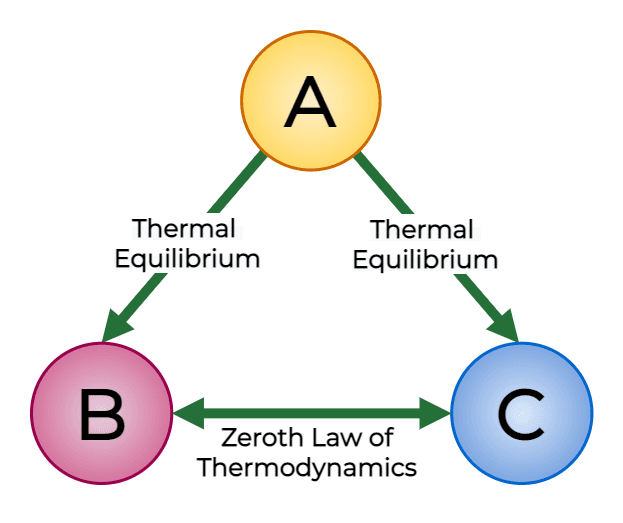
Representative expression of the zeroth law
This law is a fundamental principle that clarifies the meaning of temperature and reveals the logic behind temperature measurement. For example, a thermometer is a device used to measure temperature. If a thermometer reaches thermal equilibrium with a substance, then the temperature of the substance is equal to that of the thermometer. The zeroth law of thermodynamics provides a basis for the concept of temperature uniformity or measurement.
The zeroth law enables us to understand temperature measurement, thermal equilibrium, and the relationship of temperature between two systems in the physical world. Therefore, the operation of thermometers is based on this law.
The first law of thermodynamics expresses the principle of conservation of energy. This law states that all energy transformations in nature can change from one form to another but cannot be destroyed. In other words, energy is conserved in a closed system. This principle applies to all energy processes in nature.
Mathematically, the first law is expressed as:

Here, ΔU represents the change in internal energy, Q represents the heat added to the system, and W represents the work done by the system. Internal energy is the total of all energies within a system (for example, kinetic energy, potential energy, thermal energy, etc.).
According to this equation, heat added to a system increases its energy, but part of this increase may be used by the system to do work. Thus, while the first law describes energy exchanges, it also accounts for the conversion between forms of energy such as heat and work.
The first law is the foundation for all calculations related to heat engines and energy production. For example, an internal combustion engine or a steam turbine converts the chemical energy of fuel into heat, and this heat is then transformed into the ability to do work. However, the efficiency of the system is limited by the energy lost during this conversion, typically in the form of heat loss.
Heat Engine: A heat engine is a device that absorbs heat from a high-temperature reservoir, converts part of that heat into work, and rejects the remaining heat to a lower-temperature reservoir. Heat engines are generally inefficient because they cannot recover the heat that is lost. This loss is typically associated with the increase in entropy described by the second law.
The second law is a principle that determines the direction of energy transformations and states that all natural processes are inefficient. This law is closely related to entropy, one of the fundamental concepts of thermodynamics. Entropy is a physical quantity that measures the degree of disorder or randomness in a system.
The second law can be stated as:
"In a closed system, entropy increases over time or remains constant. Heat flows spontaneously from a hotter body to a colder body, but not in the reverse direction."
Mathematically:

Here, ΔS represents the change in entropy, Q represents the heat added to the system, and T represents the temperature. The increase in entropy indicates that natural processes are irreversible. That is, during energy transformations, not all energy can be converted into work; some is always lost as heat.
Entropy: Entropy is a measure of disorder and, together with the second law of thermodynamics, defines the "natural" direction of processes. As entropy increases, the orderliness of a system decreases. For example, the random motion of gas molecules in a room increases entropy. As entropy increases, it becomes more difficult to utilize the system's energy.
Heat Engines and the Carnot Cycle: The Carnot cycle is a theoretical model used to determine the maximum efficiency of an ideal heat engine. Carnot's theory was developed based on the second law to explain the factors limiting the efficiency of heat engines. Heat engines absorb heat from a high-temperature source, convert part of it into work, and reject the remainder to a low-temperature sink. However, efficiency can never reach 100 percent because some energy is always lost due to entropy increase.
The third law states that as the temperature of a system approaches absolute zero, its entropy approaches zero. Absolute zero is defined as 0 Kelvin (K), at which point atoms and molecules cease all motion.
The third law is expressed as:

Here, S represents entropy and T represents temperature. This law explains the relationship between entropy and temperature. As temperature decreases, the system becomes more ordered and entropy approaches zero. This is a theoretical condition; reaching absolute zero in practice is impossible.
Cryogenic Applications: The third law plays an important role in cryogenic engineering. Cryogenic processes involve the storage and processing of materials at extremely low temperatures. For example, liquid oxygen and liquid nitrogen are stored and transported based on this principle.
The four fundamental laws of thermodynamics provide essential principles for understanding energy transformation, efficiency, and the direction of energy flow in nature. The zeroth law defines the concept of temperature and explains thermal equilibrium. The first law expresses the principle of energy conservation, stating that energy transformations always preserve total energy. The second law establishes limits on efficiency through entropy, asserting that no natural process can be perfectly efficient. The third law states that entropy approaches zero as temperature approaches absolute zero. Thermodynamic laws not only provide a theoretical framework but also play a critical role in engineering and scientific applications, particularly in energy production, chemical reactions, and biological processes.
Basics of Thermodynamics, University of Oxford Department of Physics, physics.ox.ac.uk
Feynman, Lecture 44: The Laws of Thermodynamics, www.feynmanlectures.caltech.edu
Lecture 04: Laws of Thermodynamics, MITES 2018–Physics III, MIT OpenCourseWare, ocw.mit.edu

No Discussion Added Yet
Start discussion for "Laws of Thermodynamics" article
1. The Zeroth Law of Thermodynamics: Thermal Equilibrium and Equivalence
2. The First Law of Thermodynamics: Conservation of Energy
3. The Second Law of Thermodynamics: Entropy and Efficiency of Transformation
4. The Third Law of Thermodynamics: Absolute Zero and Entropy
Conclusion