


This article was automatically translated from the original Turkish version.
Large Language Models (LLMs) are among the most advanced examples of natural language processing (NLP) technology. These artificial intelligence models are trained on vast amounts of text data and demonstrate exceptional proficiency in understanding and generating human language. These models are deep learning algorithms with millions or even billions of parameters and are used in areas such as grammar understanding, context inference, content generation, question-answering systems, and many others. LLMs are primarily built on the Transformer architecture, which enables them to process the complexities of natural language effectively.
The development of language models traces its origins to information processing research that began in the mid-20th century. Early language models consisted of rule-based systems with limited ability to understand human language. In the 1990s, the introduction of statistical approaches led to the development of more complex language models. For example, N-gram models represented one of the first significant steps toward understanding linguistic patterns by analyzing word sequences in text data.
At the beginning of the 2010s, the integration of neural networks into natural language processing triggered a major leap in language modeling. Particularly, word embedding techniques such as Word2Vec and GloVe enabled language models to learn semantic relationships between words. These advancements laid the foundation for modern LLMs.
In 2017, Google’s paper “Attention Is All You Need” introduced the Transformer architecture and revolutionized NLP. The Transformer uses attention mechanisms to allow language models to understand context more effectively. This architecture forms the basis of LLMs and enables superior performance in tasks such as:
The Transformer architecture consists of two main components: an encoder and a decoder. However, LLMs typically use decoder-only architectures, which are especially effective for text generation.
The GPT (Generative Pre-trained Transformer) series, developed by OpenAI in 2018, marked a milestone in the evolution of large language models. Models such as GPT-2 and GPT-3, trained on billions of parameters, performed complex language tasks with human-like accuracy. GPT-4 further advanced this technology by incorporating even more parameters and multimodal capabilities, including both text and image processing.
LLMs contain millions or billions of weights (parameters) that enable the model to learn language patterns. As the number of parameters increases, the model’s capacity to understand context and solve complex tasks also increases.
The growth in parameter count requires models to be trained for longer durations on larger datasets.
During training, LLMs utilize text data from various sources.
Data diversity enhances the general proficiency of models but also introduces ethical and bias-related challenges.
LLMs enable innovative applications across numerous sectors. Their most common uses include:
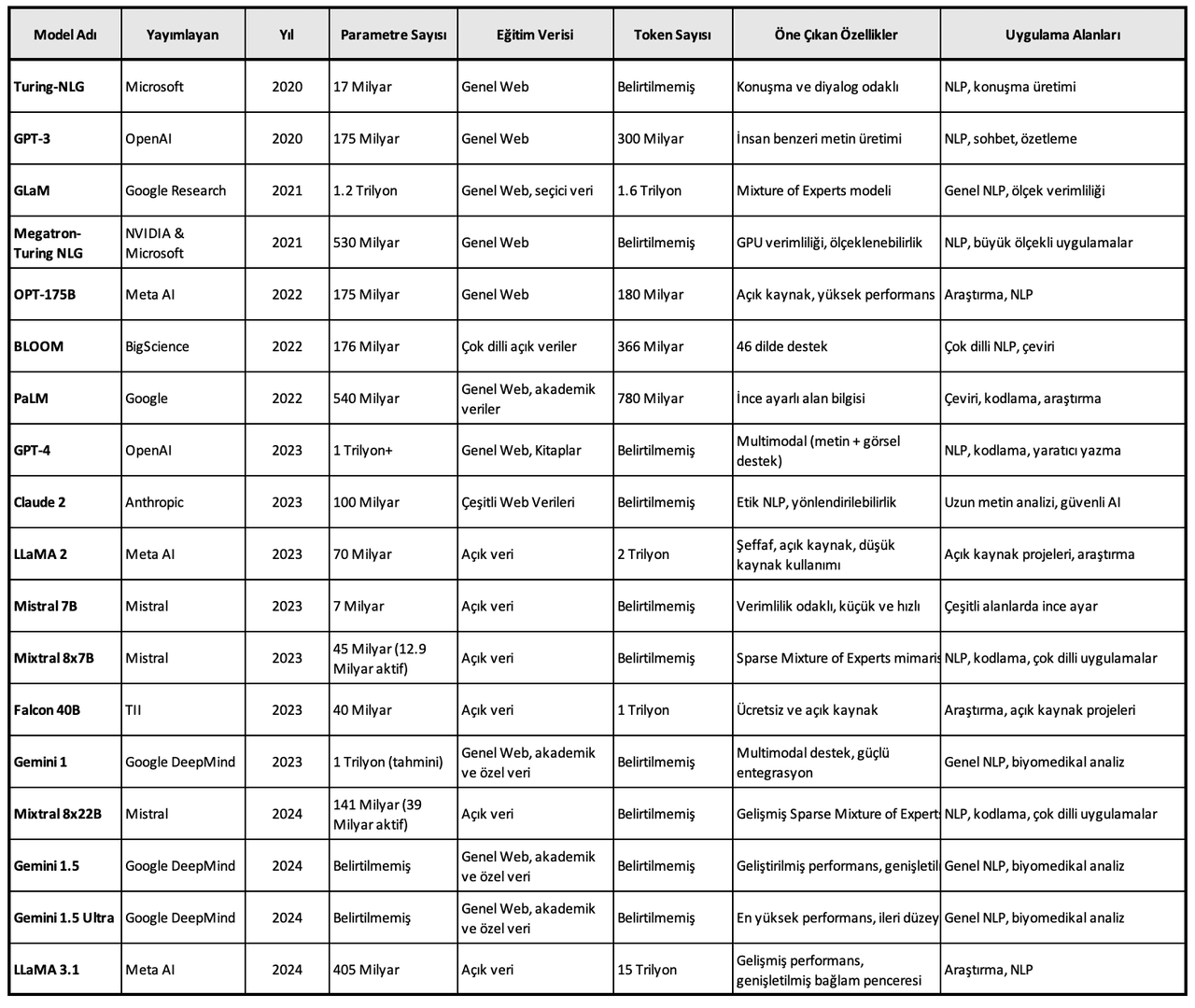
Table 1. List of Large Language Models
Large Language Models raise serious ethical and social concerns. Potential risks such as the spread of misleading information, accidental disclosure of private data, and malicious use necessitate the safe development and deployment of these models.
The future of LLMs will focus on developing more efficient, energy-efficient, and reliable models. Furthermore, multimodal models integrating text, visual, and audio data are expected to become more widespread. Developing these technologies in a more ethical and transparent manner will enhance their positive impact on society.
Bender, Emily M., Timnit Gebru, Angelina McMillan-Major, and Shmargaret Shmitchell. "On the Dangers of Stochastic Parrots: Can Language Models Be Too Big?" *FAccT*, (2021): 610-623. Accessed September 23, 2025.https://dl.acm.org/doi/10.1145/3442188.3445922.
Brown, Tom, Benjamin Mann, Nick Ryder, et al. "Language Models are Few-Shot Learners." *NeurIPS*, (2020): 1-75. Accessed September 23, 2025.https://arxiv.org/abs/2005.14165
Chowdhery, Aakanksha, Sharan Narang, Jacob Devlin et al. "PaLM: Scaling Language Modeling with Pathways." Google AI, (2022): 1-87. Accessed September 23, 2025.https://arxiv.org/abs/2204.02311
Kaplan, Jared, Sam McCandlish, Tom Henighan et al. "Scaling Laws for Neural Language Models." arXiv, (2020): 1-30. Accessed September 23, 2025.https://arxiv.org/abs/2001.08361
Mikolov, Tomas, Kai Chen, Greg Corrado, and Jeffrey Dean. "Efficient Estimation of Word Representations in Vector Space." arXiv, (2013): 1-12. Accessed September 23, 2025.https://arxiv.org/abs/1301.3781
Nori, Harsha, Nicholas King, Scott Mayer McKinney, Dean Carignan, Eric Horvitz. "Capabilities of GPT-4 in Medical Applications." *Nature Medicine*, (2023): 1-35. Accessed September 23, 2025.https://arxiv.org/abs/2303.13375
Vaswani, Ashish, Noam Shazeer, Niki Parmar, et al. "Attention Is All You Need." *NeurIPS*, (2017): 1-15. Accessed September 23, 2025.https://arxiv.org/abs/1706.03762.
No Discussion Added Yet
Start discussion for "Large Language Models (LLM)" article
History
Early NLP and Language Models
Transformer Architecture
Rise of Large Language Models
Technical Details
Parameters
Data Sources
Application Areas
Comparison
Ethical Issues
The Future of LLMs