


This article was automatically translated from the original Turkish version.
Natural Language Processing (NLP) is a subfield of artificial intelligence (AI) that enables computers to analyze, process, and understand natural languages used by humans. This technology aims to make human-computer interaction more natural and efficient. The complexity of natural language, including semantic ambiguities and polysemy, such as these challenges, constitute important research topics in natural language processing.
The origins of natural language processing extend back to the early years of computer science and artificial intelligence. In 1950, Alan Turing's paper titled "Computing Machinery and Intelligence" introduced the Turing Test, a concept that questions whether machines can think like humans. This test aims to distinguish between a human and a machine based on their ability to engage in dialogue using natural language.
Between 1950 and 1960, NLP relied on rule-based systems. These systems attempted to interpret sentences by applying grammatical rules and syntactic analysis. In 1954, the Georgetown-IBM Experiment, conducted by IBM and Georgetown University, presented a prototype of an automated translation system using a very limited vocabulary. This demonstration generated significant enthusiasm about the potential of NLP at the time.
However, the late 1960s and 1970s ushered in a period known as the "AI Winter," during which academic and financial support declined due to the limitations of NLP systems and their failure to meet expectations. In the 1980s, new approaches emerged, placing greater emphasis on knowledge representation, semantics, and pragmatic analysis.
Starting in the 1990s, statistical approaches to natural language processing gained prominence. During this period, models such as Hidden Markov Models (HMM), Naive Bayes, and decision trees became widely used. These statistical methods began offering more flexible solutions in language processing by learning from data.
Beginning in the 2010s, deep learning-based approaches transformed the field of NLP. In particular, Google's Transformer architecture and models built upon it—such as BERT and GPT—sparked a major advancement in NLP applications. These models opened the way for advanced systems capable of understanding contextual meaning and performing syntactic and semantic analysis simultaneously.
Today, NLP is actively used across various domains in both academia and industry, playing a central role in human-computer interaction, information retrieval, and text-based decision making.
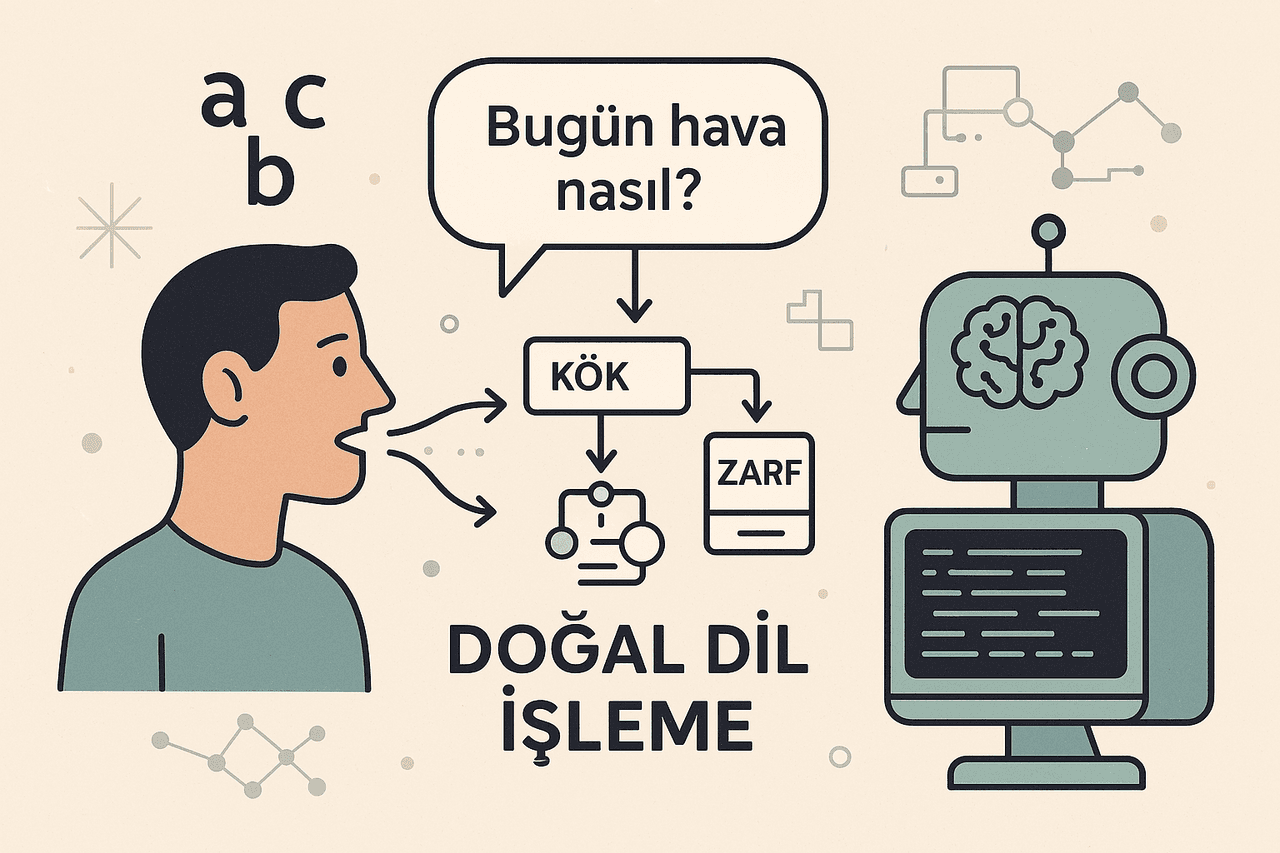
AI-generated representative image of "Natural Language Processing".
For NLP systems to function successfully, they must perform analysis across multiple layers designed to translate the structural and semantic complexity of natural language into a form computers can process:
Each of these analyses works in tandem to help computers better understand language. In particular, deep learning approaches have enabled systems to learn many of these analyses simultaneously.
The methods used in natural language processing have evolved and diversified over time. These methods can be broadly categorized into four main groups:
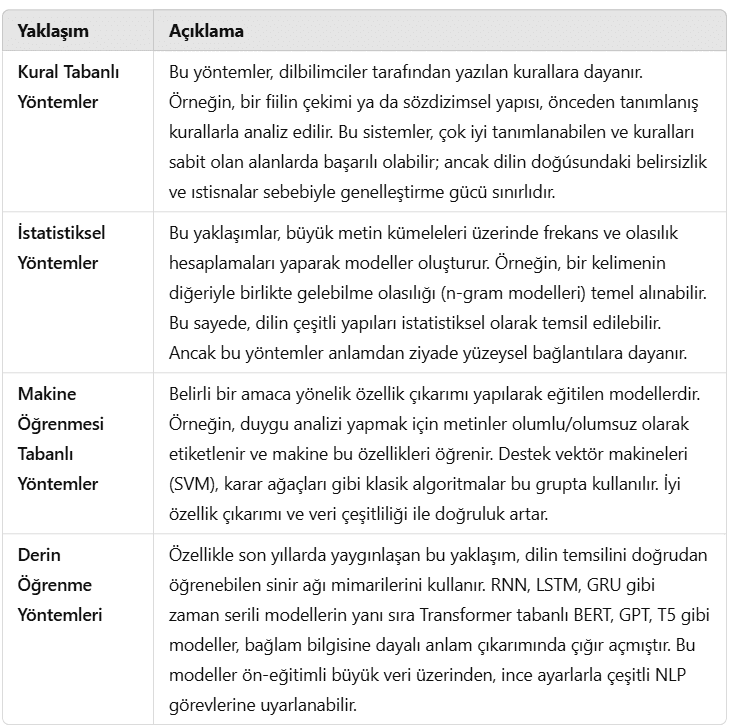
Generated by AI.
Each method has its own advantages and limitations. Rule-based systems are transparent and controllable, while deep learning models are more comprehensive but have a "black box" structure. Depending on the application, these methods can be combined to create hybrid systems.
Natural language processing technologies have moved beyond being purely academic and have become integral parts of daily life, commerce, education, and public services. Below are the major application areas of NLP, described in detail:
These application areas continue to expand each year as technology and models improve. In the near future, more comprehensive language understanding systems are expected to enable even more effective applications in fields such as law, psychology, and creative writing.
Processing natural language with computers may appear simple at first glance, but the structure, meaning, and usage of language are complex. This complexity introduces several challenges in NLP applications:
Despite these challenges, advanced modeling techniques, pre-trained language models, and enriched data cultures are helping to mitigate these problems and develop more successful systems.
Behind the rapid development in NLP are open-source libraries and developer-friendly platforms. These tools are widely used in both academic research and industrial applications:
Thanks to these libraries, developers can build rapid applications using pre-trained models rather than training models from scratch. Particularly with transfer learning and fine-tuning techniques, more original applications can be developed.
A sequence of operations applied to a simple text sample:
Turkish text sample:
Code:
Output:
Original Text: Bugün hava çok güzel, güneş parlıyor ve kuşlar ötüyor. Dün ise yağmur yağdı ve hava soğuktu.
1. Cleaned Text: bugün hava çok güzel güneş parlıyor ve kuşlar ötüyor dün ise yağmur yağdı ve hava soğuktu
2. Tokens: ['bugün', 'hava', 'çok', 'güzel', 'güneş', 'parlıyor', 've', 'kuşlar', 'ötüyor', 'dün', 'ise', 'yağmur', 'yağdı', 've', 'hava', 'soğuktu']
3. After Stopword Removal: ['bugün', 'hava', 'güzel', 'güneş', 'parlıyor', 'kuşlar', 'ötüyor', 'dün', 'yağmur', 'yağdı', 'hava', 'soğuktu']
4. Lemmatized: ['bugün', 'hava', 'güzel', 'güneş', 'parlıyor', 'kuşlar', 'ötüyor', 'dün', 'yağmur', 'yağdı', 'hava', 'soğuktu']
5. Bag of Words Matrix:
[[1 1 1 1 1 1 1 1 1 1 1 1]]
Words: ['bugün' 'dün' 'güzel' 'güneş' 'hava' 'kuşlar' 'ötüyor' 'parlıyor' 'soğuktu' 'yağdı' 'yağmur']
6. Machine Learning Model Trained.
Sample Prediction: Test Text: 'hava güzel' -> Prediction: positive
Akın, Ahmet, and Mehmet Akın. “Doğal Dil İşleme (Natural Language Processing).” *YBS Ansiklopedi*, 2015.https://ybsansiklopedi.com/wp-content/uploads/2015/09/ybs_ddi_nlp.pdf.
Eryiğit, Gülşen. “Açık Kaynak Türkçe Doğal Dil İşleme Kütüphaneleri.” *Journal of Computer and Education Research* 8, no. 15 (2020): 294–314.https://dergipark.org.tr/en/download/article-file/1573501.
Karagöz, Bülent, and Hüseyin Polat. “Doğal Dil İşleme (Natural Language Processing).” *Akademik Bilişim Konferansı*, 2016.https://dergipark.org.tr/tr/download/article-file/207209.
Yıldız, Olcay. “Doğal Dil İşleme Üzerine Genel Bir Bakış.” *Sakarya Üniversitesi Fen Bilimleri Enstitüsü Dergisi*, 2016.https://dergipark.org.tr/tr/download/article-file/207207.
Özdemir, Fatih, and Emre Yılmaz. “Doğal Dil İşleme Uygulamaları ve Kullanılan Yöntemler.” *Uluslararası Yönetim Bilişim Sistemleri ve Bilgisayar Bilimleri Dergisi* 1, no. 2 (2021): 11–24.https://dergipark.org.tr/en/download/article-file/1036257.

No Discussion Added Yet
Start discussion for "Natural Language Processing" article
History and Evolution of Natural Language Processing
Core Components of Natural Language Processing
Fundamental Concepts in Natural Language Processing
Methods Used in Natural Language Processing
Applications of Natural Language Processing
Challenges in Natural Language Processing
Popular NLP Libraries and Tools
Natural Language Processing Application