


This article was automatically translated from the original Turkish version.
+1 More
Lahmacun is one of the beloved dishes of Middle Eastern and Mediterranean cuisine. It is prepared by spreading a mixture of minced meat, onion, parsley, garlic, tomato, pepper, and spices onto thinly rolled dough and baking it quickly in a high-temperature oven. Although known in Europe as “Turkish pizza,” the origin and preparation method of lahmacun distinguish it from other dough-based dishes.
The history of lahmacun is believed to date back many centuries. Archaeological findings from Mesopotamia provide evidence that various ingredients were spread over bread-like dough and baked. Since ancient times, this type of dish has influenced various culinary traditions including Ottoman and Arab cuisines.
In its modern form, lahmacun became especially widespread in southeastern regions of Türkiye such as Gaziantep, Şanlıurfa, and Adana, from where it spread to other parts of the world. Often regarded as a “folk dish,” lahmacun has been commonly chosen for special occasions such as weddings and holidays as well as for everyday meals.
The preparation of lahmacun requires properly rolling out the thin and crisp dough and evenly distributing the topping.
A traditional lahmacun recipe can be summarized as follows:
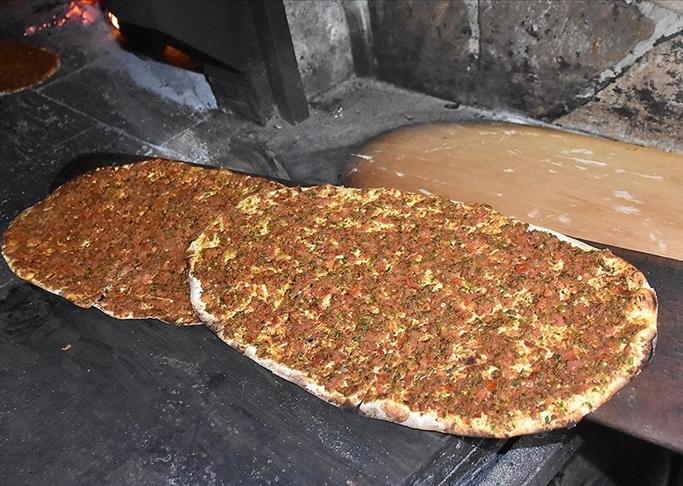
Fırında lahmacun. (AA)
Gaziantep and Şanlıurfa exhibit differences in lahmacun preparation. In Gaziantep lahmacun, parsley, tomato, meat, pepper, and garlic are preferred, whereas in Şanlıurfa lahmacun, onion is used predominantly. Additionally, Şanlıurfa lahmacun is typically round, while Gaziantep lahmacun is oval in shape.
Lahmacun is a nutritionally balanced dish. The minced meat provides protein and iron, while tomato, pepper, and parsley supply vitamin C and antioxidants. However, its consumption should consider calorie content, fat ratio, and portion size.
Lahmacun is not merely a dish in Türkiye and the Middle East but also a social instrument. As a popular street food, it is sold in restaurants and street stalls and is typically served with ayran. Thanks to its consumption by Turkish diaspora communities abroad, lahmacun has gained international recognition.
Anadolu Ajansı. “Gaziantep ve Şanlıurfa’nın Paylaşamadığı Tescilli Lezzet: Lahmacun.” Anadolu Ajansı, November 7, 2022. Accessed April 21, 2025.https://www.aa.com.tr/tr/sehirlerin-lezzet-rekabeti/gaziantep-ve-sanliurfanin-paylasamadigi-tescilli-lezzet-lahmacun/2709209
Durmaz, H., Altun, S. K., & Aydemir, M. E. (2018). Farklı çözdürme yöntemlerinin lahmacunun mikrobiyolojik kalitesi üzerine etkisi. *Harran Üniversitesi Veteriner Fakültesi Dergisi*, 7, 33–36.https://dergipark.org.tr/en/download/article-file/604608
T.C. Ministry of Culture and Tourism. "Gaziantep Lahmacunu." Türkiye Kültür Portalı. Accessed May 6, 2025.https://www.kulturportali.gov.tr/turkiye/gaziantep/neyenir/lahmacun.

History of Lahmacun
Preparation of Lahmacun
Regional Variations
Nutritional Value
Cultural Significance