This article was automatically translated from the original Turkish version.
+2 More
Type | Urban light rail system | ||||||||
|---|---|---|---|---|---|---|---|---|---|
Operator | Konya Metropolitan Municipality | ||||||||
Number of Lines | 2 main lines (T1 - T2) | ||||||||
Line Length | ~41 km | ||||||||
Number of Stations | 44 | ||||||||
Line Spacing | 1435 mm | ||||||||
Electrification | 750 V DC (overhead catenary) | ||||||||
Transport Capacity | Daily average of 110,000 passengers | ||||||||
Konya Tramway, is a light rail transit system operating in the city of Konya, Türkiye. It became operational in 1992 as the first modern tramway system serving the Anatolian region.【1】 The system currently spans approximately 41 kilometers and serves a total of 44 stations across two main lines.【2】 Operated by the Intelligent Public Transport System (ATUS) under the Konya Metropolitan Municipality, the tramway forms the backbone of the city’s public transportation network.
The roots of tramway transportation in Konya extend back to the Ottoman period. The city’s public transport history began with horse-drawn trams and evolved into today’s modern electric system.
Konya’s first tramway project was proposed in 1906. Yusuf Mazhar, a constructor from the İzmir Electric Tramway Company, along with Yaruba Kapulu and German citizen August Iztor, submitted a proposal to the Konya Municipality. The proposal included the construction of a 30-kilometer electric tramway line and the provision of electricity to an area with a 20-kilometer radius, in exchange for a 99-year concession, alongside the establishment of a power plant near the Government House.【3】
With the favorable opinion of the Konya Municipality and provincial administration, the project was submitted to the Ministry of Trade and Agriculture and the Ministry of Public Works. The official process continued after reviews by the Grand Vizierate and the State Council, culminating in approval by the Council of Ministers. The project was approved by Sultan Abdulhamid II on 1 March 1906. However, this initiative, which was Konya’s first electric tramway and lighting project, was soon canceled due to high costs.
Following the cancellation of the first electric tramway project, in 1917, under the initiative of Konya’s governor and Grand Vizier Avlonyalı Ferit Paşa, the horse-drawn tramway system from Thessaloniki was relocated to Konya.【4】 The horse-drawn tramway operated on a route starting at the Atatürk Monument, passing through Gazi High School, and terminating at the old Park Cinema. A second line departed from the Government House and extended to Sultan Selim Mosque.
However, in the early 1920s, the newly established Automobile Company introduced two small buses to operate between the station and the Government House. This development reduced public interest in the tramway, and in 1924, the horse-drawn tramway system was officially discontinued by the then-mayor. The trams were scrapped, and the rails were melted down and repurposed as electric poles.
Sixty-three years after the discontinuation of the horse-drawn tramway, in 1986, the need for a modern light rail system arose due to the city’s expansion and the relocation of Selçuk University’s campus away from the city center. The existing bus network could no longer handle passenger demand, and rising fuel costs for campus access provided the primary justification for the tramway project.
On 9 July 1987, a credit agreement worth 38 million Deutsche Marks was signed between the German state institution Kreditanstalt für Wiederaufbau (KfW) and the Republic of Türkiye. The foundation of Konya Rail System Operation was laid on 13 July 1987 by the then Prime Minister. Under the project, the German firm Obermeyer-Rail Consult provided consulting services, and the consulting contract was signed on 23 October 1987.【5】
Construction of the Konya tramway system began in 1987. The first of 16 trams ordered under the tender was transported from Cologne, Germany, starting on 25 November 1988. These trams were second-hand vehicles purchased from the Cologne Public Transport Authority (KVB), manufactured by Düsseldorf DÜWAG between 1963 and 1967 as Duewag GT8 models.
On 15 April 1992, the first movement of tram number 104 was conducted between the depot and Cumhuriyet Station after electrification of the system. The official inauguration took place on 23 April 1992, followed by trial runs and driver training. After completion of training and testing, the first phase of the line—the 10.5-kilometer Alaaddin-Cumhuriyet section—was opened to the public on 28 September 1992. The system initially operated free of charge but soon transitioned to a fare-based model.
After completion of construction and installation of the second phase—an 8-kilometer extension from Cumhuriyet to Campus—trial runs began on 21 December 1995, and the line was officially inaugurated on 19 April 1996 in a ceremony attended by then President Süleyman Demirel.【6】
All assembly and construction work for the main line of the Konya tramway system, which is approximately 18.5 kilometers long, was carried out by teams of the Konya Metropolitan Municipality. The electro-mechanical equipment used in the system was sourced from Germany, while the railway sleepers were purchased from TCDD’s Afyon Sleepers Factory.
The track gauge used on the railway is the standard 1435 millimeters. The overhead catenary system operates at 750 volts direct current and is fed from six substations. Grooved rails were used at intersections and parts of the depot area, while standard S49 rails were installed elsewhere. The rails are continuously welded by municipal staff using Aluminothermic welding.
Following the initial 16 trams, an additional 25 trams were purchased between 1995 and 1996 to meet rising demand. In anticipation of future lines planned for 2001, another 26 vehicles were acquired, with the first ten entering service on 11 October 2001.
The original trams used in the system are Duewag GT8 models manufactured in Cologne between 1963 and 1967. These are unidirectional, eight-axle, two-articulated vehicles. Each tram is 30 meters long and 2.5 meters wide, with a total passenger capacity of 331, including 83 seated. Each tram is equipped with two 150-kilowatt direct current motors and has a maximum speed of 67 kilometers per hour.
In 2009, the KonyaRay project was planned as a critical milestone for Konya’s rail system, initiating efforts to renew the existing fleet of 60 Duewag GT8 trams. In 2012, an agreement was reached with Škoda, and an order was placed for 60 new Škoda Tramcar 28T trams.
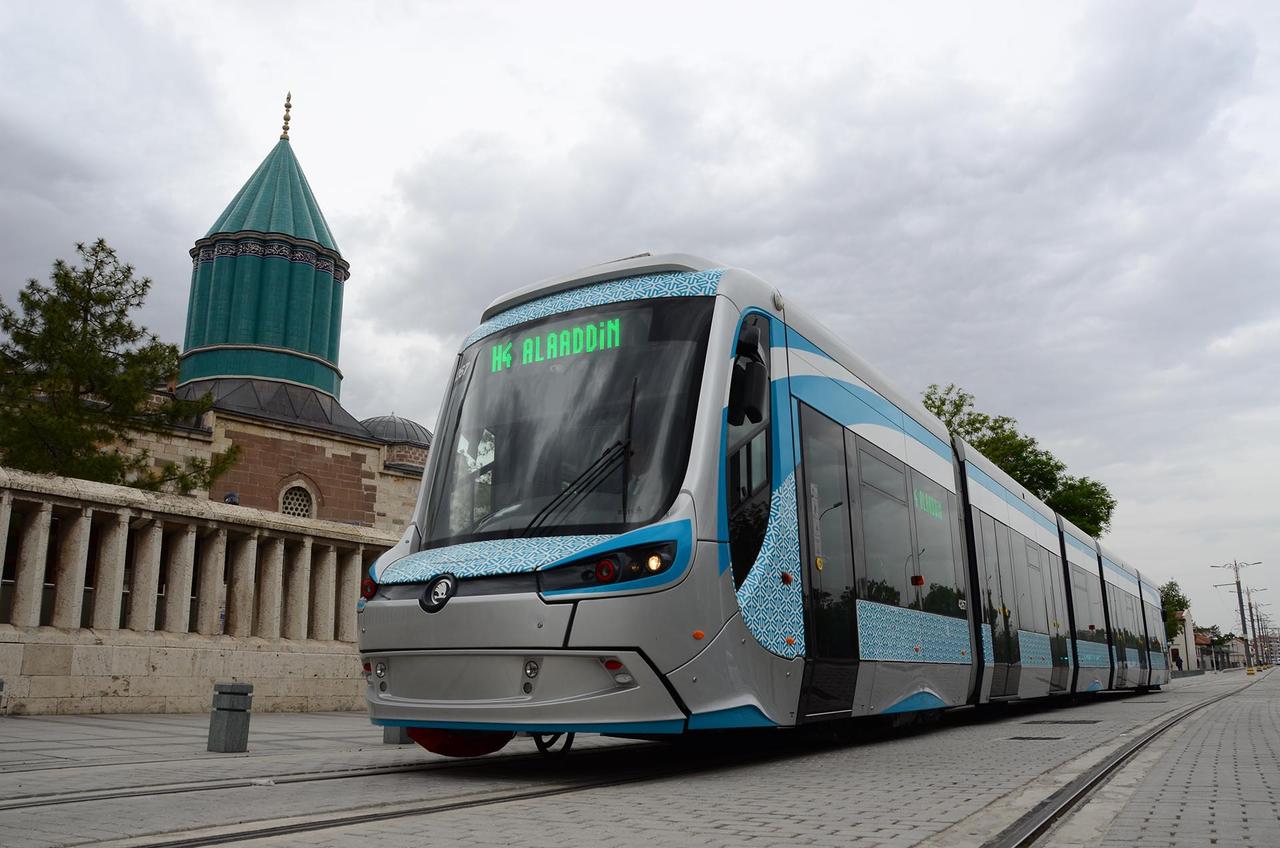
These fully low-floor modern trams have a capacity of 364 passengers. They are 32.5 meters long and 2.55 meters wide, feature doors on both sides, WiFi connectivity, and the ability to couple with other units. The first of these trams arrived in Konya in October 2013 and entered service in February 2014 after testing. Their maximum speed is 70 kilometers per hour, and they operate on a 750-volt DC electrical system.【7】
The Konya tramway system currently operates across two main lines.
This line entered service in 1999 and is 36.7 kilometers long with 35 stations. It begins at Alaaddin Station in the city center and extends to Selçuk University campus. Key stops along the route include Zafer, Kule, Kunduracılar, Eski Sanayi, Otogar, Erenkaya, Yazır, Sancak, Bosnia and Herzegovina, and several faculty stops within the campus.
The T1 line is of great importance as it serves Bosna-Hersek, one of the city’s most densely populated neighborhoods, and provides essential access for university students and staff. The line operates regularly from 06:00 to 24:00, with additional night services.
The T2 line, whose foundation was laid in 2013 and which entered service in 2015, is 4.4 kilometers long and has nine stations. It was constructed to serve the Karatay district of the city. In a first for Türkiye, the section between Alaaddin and Mevlana stations was built without overhead catenary wires.
This approach eliminated visual pollution from overhead wires and poles, preserving the aesthetic silhouette of the historic city center surrounding the Mevlana Tomb. Transfers to the T1 line are possible at Zafer and Alaaddin stations.
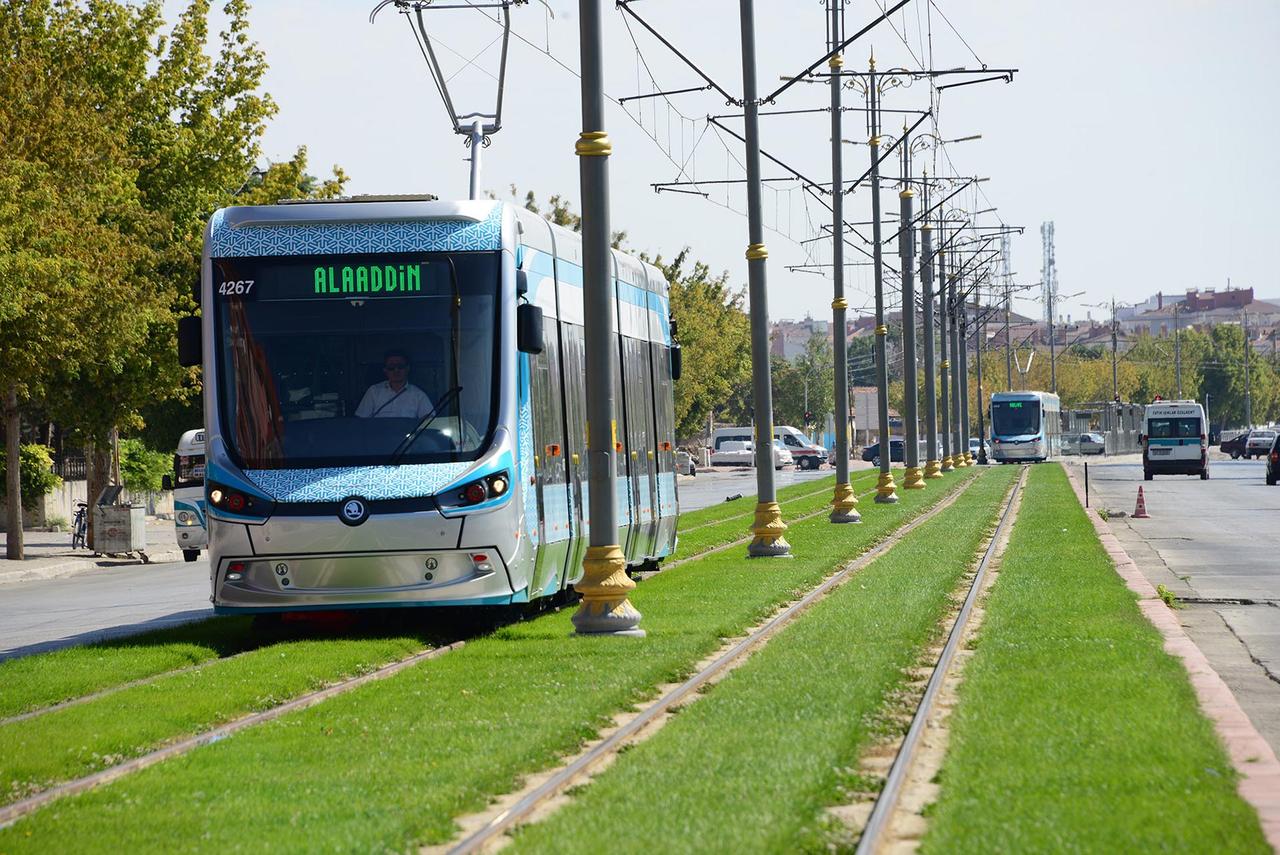
Konya tramway (Konya Metropolitan Municipality )
In 2005, a protocol was signed between the Konya Metropolitan Municipality and Selçuk University to extend the tramway line into the campus. As part of this project, the tramway was extended by 3.5 kilometers, and in the 2006–2007 academic year, stops serving the Faculty of Medicine, Faculty of Engineering, Faculty of Letters and Sciences, and Faculty of Law were opened to service.
The Konya tramway system operates in integration with the Konyakart system developed by the Konya Metropolitan Municipality. Passengers can pay using electronic Konyakart cards or contactless bank cards.
The electronic card system, introduced in 2001, was initially used alongside paper tickets but eventually replaced them entirely. Transfers made on other lines within the same time window are free with the Konyakart. A second journey made within a specified time frame on other lines receives a 40 percent discount.
The system also offers a monthly unlimited pass. With a personalized Konyakart, users can travel unlimitedly on all buses and trams within Konya for 30 days.
The Konya tramway system is operated by the Intelligent Public Transport System (ATUS), affiliated with the Konya Metropolitan Municipality. ATUS maintains a workshop and depot facility covering 6,385 square meters. Approximately 60 staff members work in technical and administrative roles, including five engineers.
The system has a capacity of 12,000 passengers per direction and serves an average of 110,000 passengers daily. Passengers can track tram schedules, routes, and real-time vehicle locations via the ATUS website and mobile application.
In 2020, the Konya Metropolitan Municipality achieved a first in Türkiye in line with its “Bicycle City Konya” vision. Two of the long-serving Duewag GT8 trams were redesigned and reintroduced in September 2020 as “Bicycle Trams.” These special trams feature dedicated bicycle storage areas, enabling seamless integration between cycling and tram transport.
Additionally, in response to the expected increase in passenger demand following the opening of Konya City Hospital, plans are underway to refurbish and modernize heritage German-made trams that have been in service since 1992 for renewed operation.
Under the Konya Metropolitan Municipality’s “2030 Transport Master Plan,” the rail network is targeted for substantial expansion. The launch of the KonyaRail suburban project in 2023 has opened the way for new tramway investments in the city.
The current 27-kilometer rail network is planned to expand beyond 100 kilometers with the addition of new tram and suburban lines.【8】 One line is currently under construction, and two more are in the planning stage.
The planned extension to Konya City Hospital involves extending the Adliye-Alaaddin line so that its final stop becomes the hospital. This project aims to improve access to healthcare services and strengthen public transport connectivity to the hospital.
The Konya tramway forms the backbone of the city’s public transport system, serving an average of 110,000 passengers daily. It is a critical transit link for students and staff of Selçuk University and residents of densely populated neighborhoods such as Bosna-Hersek. The tramway facilitates easy access to key landmarks including the Mevlana Tomb, Alaaddin Hill, Selçuk University, and the city center, easing mobility for both local residents and visitors. As the pioneer of modern tramway transport in Anatolia, the Konya tramway has served as a model for rail transit projects in other Anatolian cities.
Anadolu'da Bugün. "Konya tramvay durakları ve saatleri." Accessed December 30, 2025.https://anadoludabugun.com.tr/konya-haberleri/konya-tramvay-duraklari-ve-saatleri/230899
Demiryolu.net. "Türkiye – Konya Tramvay Hatları ve Güzergah Haritası." Accessed December 30, 2025.https://www.demiryolu.net/demiryolu-haritalari/tramvay-haritalari/turkiye-konya-tramvay-hatlari-ve-guzergah-haritasi.html
Konya Büyükşehir Municipality. “Şehir Hastanesi-Yeni Sanayi Tramvay Hattı.” Accessed December 30, 2025.https://www.konya.bel.tr/proje/sehir-hastanesi-yeni-sanayi-tramvay-hatti
Konyapedia -Konya Ansiklopedisi. "Atlı Tramvay." Accessed December 30, 2025.https://www.konyapedia.com/makale/254/atli-tramvay
Küçükdağ, Yusuf, Cevat Arabacı, and M. Serhat Yenice. “Tarihî Süreç İçinde Konya Şehrinin Fiziki Gelişimi.” *Karatay Sosyal Araştırmalar Dergisi*, no. 5 (2020): 1–38. Accessed December 30, 2025.https://dergipark.org.tr/en/download/article-file/1371096
Rail Turkey. "Konya Skoda Tram." October 8, 2014. Accessed December 30, 2025.https://railturkey.org/2014/10/08/konya-skoda-tram/
Smart Public Transportation System (SPTS). "Konya'da Raylı Ulaşım Sistemi Tarihçesi."Konya Büyükşehir Municipality. Accessed December 30, 2025.https://atus.konya.bel.tr/tramvay-tarihcesi.
Türkiye Cumhuriyeti İletişim Başkanlığı. “Konya'nın Eski Tramvayları Yeniden Raylara İniyor.” Accessed December 30, 2025.https://www.iletisim.gov.tr/turkce/yerel_basin/detay/konyanin-eski-tramvaylari-yeniden-raylara-iniyor
[1]
Akıllı Toplu Ulaşım Sistemi (ATUS). “Konya'da Raylı Ulaşım Sistemi Tarihçesi.” Konya Büyükşehir Belediyesi. Erişim tarihi: 30 Aralık 2025. https://atus.konya.bel.tr/tramvay-tarihcesi.
[2]
Anadoluda Bugün. "Konya Tramvay Durakları ve Saatleri." 15 Eylül 2023. Erişim Tarihi: 30 Aralık 2025. https://anadoludabugun.com.tr/konya-haberleri/konya-tramvay-duraklari-ve-saatleri/230899/.
[3]
Akıllı Toplu Ulaşım Sistemleri (ATUS). "Tramvay Tarihçesi." Erişim tarihi: 30 Aralık 2025. https://atus.konya.bel.tr/tramvay-tarihcesi.
[4]
Konyapedia - Konya Ansiklopedisi. “Atlı Tramvay.” Erişim tarihi: 30 Aralık 2025. https://www.konyapedia.com/makale/254/atli-tramvay.
[5]
Akıllı Toplu Ulaşım Sistemleri (ATUS). "Tramvay Tarihçesi." Erişim tarihi: 30 Aralık 2025. https://atus.konya.bel.tr/tramvay-tarihcesi.
[6]
Akıllı Toplu Ulaşım Sistemleri (ATUS). "Tramvay Tarihçesi." Erişim tarihi: 30 Aralık 2025. https://atus.konya.bel.tr/tramvay-tarihcesi.
[7]
Rail Turkey. “Konya Skoda Tram.” 8 Ekim 2014. Erişim tarihi: 30 Aralık 2025. https://railturkey.org/2014/10/08/konya-skoda-tram/.
[8]
Konya Büyükşehir Belediyesi. “Şehir Hastanesi-Yeni Sanayi Tramvay Hattı.” Erişim tarihi: 30 Aralık 2025. https://www.konya.bel.tr/proje/sehir-hastanesi-yeni-sanayi-tramvay-hatti.

Type | Urban light rail system | ||||||||
|---|---|---|---|---|---|---|---|---|---|
Operator | Konya Metropolitan Municipality | ||||||||
Number of Lines | 2 main lines (T1 - T2) | ||||||||
Line Length | ~41 km | ||||||||
Number of Stations | 44 | ||||||||
Line Spacing | 1435 mm | ||||||||
Electrification | 750 V DC (overhead catenary) | ||||||||
Transport Capacity | Daily average of 110,000 passengers | ||||||||
Historical Development
Horse-Drawn Tramway Initiative in the Ottoman Era
Horse-Drawn Tramway Era
Planning the Modern Tramway System
Construction and Commissioning
System Features and Technical Structure
Technical Specifications
Duewag GT8 Model Trams
Skoda Tramcar 28T Model Trams
Line Structure and Routes
T1 Line: Alaaddin–Selçuk University
T2 Line: Alaaddin–Adliye
Campus Extension Line
Fare and Payment System
Operation and Management
Reuse of Heritage Trams
Future Projects and Expansion Plans
Role and Significance in Urban Life