

This article was automatically translated from the original Turkish version.
+2 More
Architectural Style(s) | Anatolian Seljuk architecture | ||||||||
|---|---|---|---|---|---|---|---|---|---|
Construction Material | Kesme taş | ||||||||
Building Type | Menzil hanı | ||||||||
Construction Period | The reign of II. Gıyaseddin Keyhüsrev (1237–1246) | ||||||||
Site | Döşemealtı District, Antalya Province, Türkiye | ||||||||
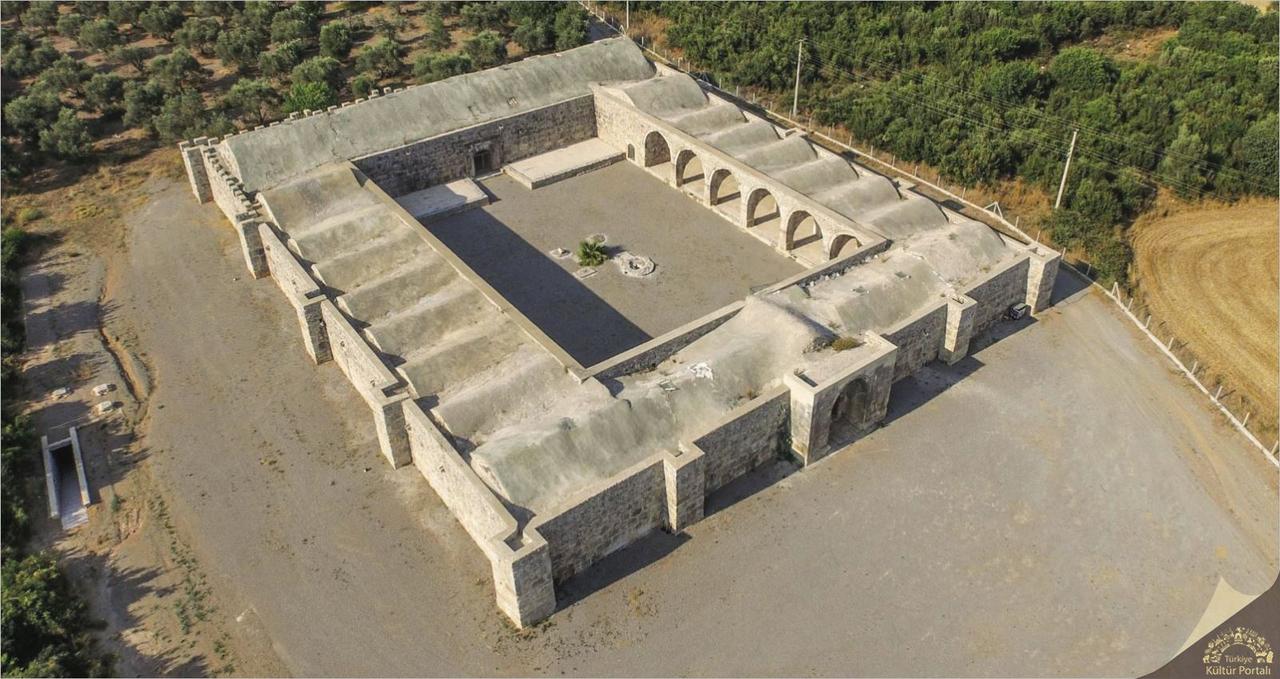
Kırkgöz Han is a caravanserai structure located in the Döşemealtı district of Antalya Province, dated to the Anatolian Seljuk period. Situated along the north-south trade route connecting Antalya and Konya, which was heavily used throughout history, the han served as a significant stopping point within the Seljuk state’s menzil system. According to the marble inscription on its portal, the construction date falls between 1237 and 1246, during the reign of Sultan II. Gıyaseddin Keyhüsrev. The plan, comprising an open courtyard and a covered section, along with the materials used in its load-bearing system and spatial organization, reveals that the structure was designed both functionally and in accordance with the architectural principles of its time. In these respects, Kırkgöz Han is regarded as a typical example of Seljuk provincial architecture and provides valuable insight into the spatial organization of menzil structures.
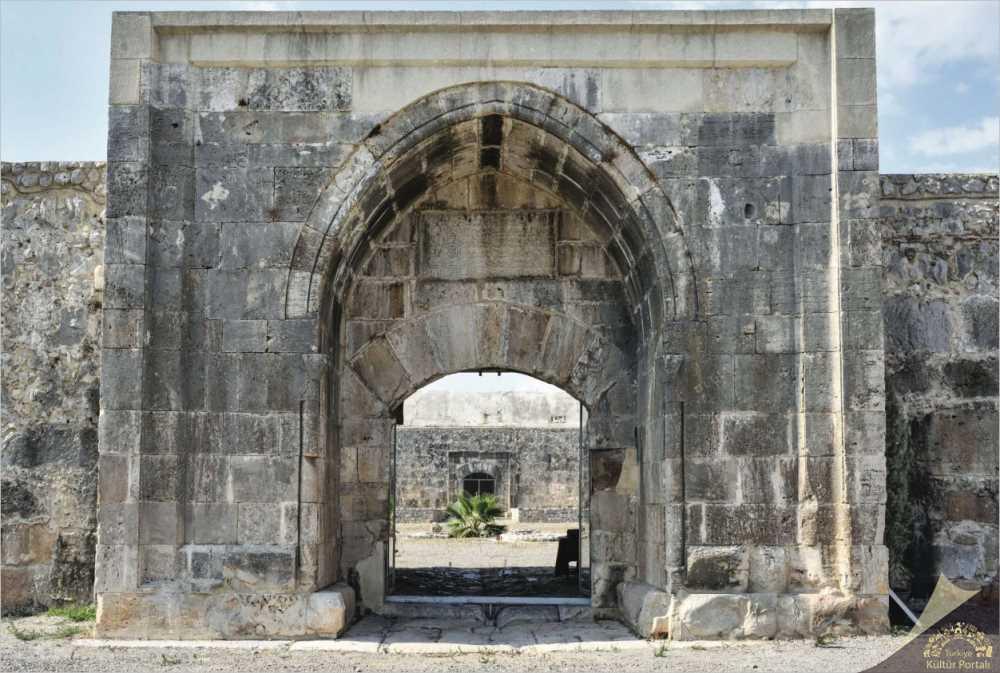
View of the Portal of Kırkgöz Han (Ministry of Culture and Tourism of the Republic of Türkiye)
Kırkgöz Han is situated approximately 30 kilometers northwest of the city center of Antalya, in the Kırkgöz locality within the Döşemealtı district. The han is positioned along a natural north-south transit route that has been in use since antiquity and was particularly significant during the Seljuk period as a key trade corridor linking Konya and Antalya. The nearby Kırkgöz springs influenced both the selection of the site and supplied the han’s water needs.
The original foundation inscription of Kırkgöz Han has not survived. However, the structure exhibits clear characteristics of the Anatolian Seljuk period in terms of its architectural plan and construction technique. While direct information regarding its exact construction date and patron is lacking, some researchers propose that it was built during the reign of II. Gıyâseddin Keyhüsrev (1237–1246). This assessment is based on the similarity of its architectural style to other caravanserais from the same period. In particular, the courtyard-plan type, the arcade arrangement, and the use of cut stone point to the mid-thirteenth century. It is understood that the Seljuk administration constructed such structures along routes connecting important port cities like Antalya to inland regions to ensure the security of trade.
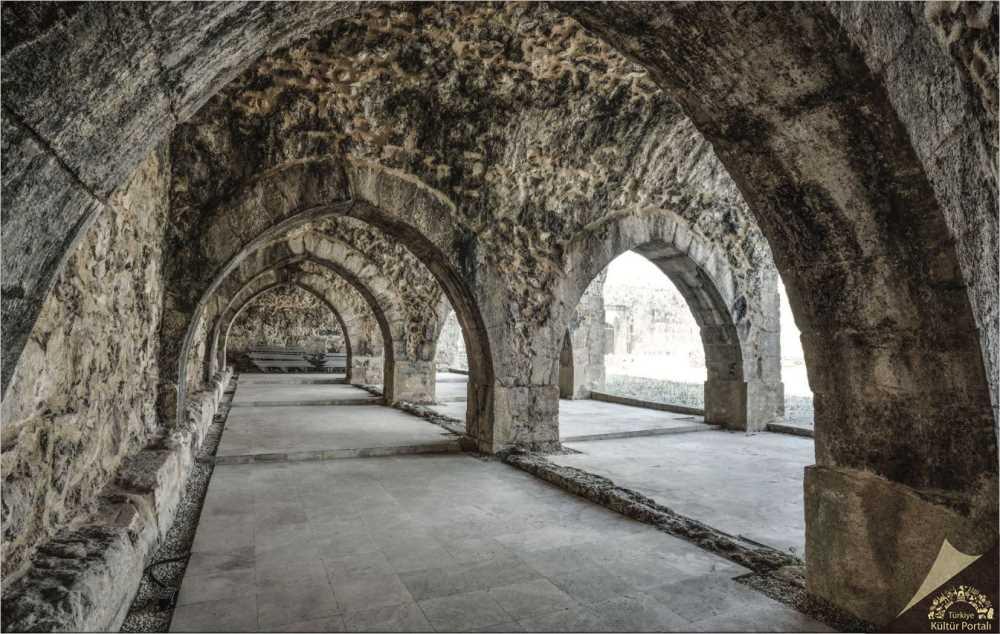
View of the Arcaded Section in the Courtyard of Kırkgöz Han (Ministry of Culture and Tourism of the Republic of Türkiye)
Kırkgöz Han follows the classic Seljuk caravanserai plan, consisting of an open courtyard and a covered section. The structure extends in an east-west direction, with its entrance facade facing east. After entering, one passes first into the open courtyard and then into the covered section to the west.
The courtyard is rectangular in plan and forms a large open area designed to accommodate lodging, animal shelter, and unloading of goods during the summer months. Much of the surrounding structure has been destroyed, but traces indicate that arcades likely lined both long sides.
The covered section was constructed to serve as lodging during the winter months. It begins with a monumental opening directly from the courtyard and consists of six bays covered by barrel vaults. The supporting piers are connected by pointed arches. The width of the space and its symmetrical layout demonstrate technical mastery in the planning.
In the southwest corner of the courtyard, a structure with six enclosed rooms rises; a small mosque occupies its upper floor. Access to the mosque is via an external staircase. This arrangement, characteristic of larger Seljuk hans such as the Sultan hans, is also implemented at Kırkgöz Han.
Dressed cut stone is the predominant material used in the construction. The outer surfaces of the walls feature finely worked stone, while the inner infill consists of rubble stone and mortar. The supporting piers are made of large stone blocks. Although stonework is prominent in the vaulted roof system, decorative elements are minimal. This reflects the structure’s functional character, prioritizing durability over ornamentation.
Kırkgöz Han served as a key menzil station along the trade route descending from Konya to Antalya during the Seljuk period. Caravanserais were typically built at daily travel intervals; in this context, Kırkgöz Han forms part of an important chain together with Evdir Han to the north and Alara Han to the south. The structure was designed to meet diverse needs, including lodging for travelers and caravans, care for animals, and protection of goods.
Over time, the han has suffered various damages, particularly to the courtyard section, which has been largely destroyed. In the 2000s, restoration and cleaning works were carried out under projects supported by the Antalya Provincial Directorate. Today, parts of the structure have been partially raised but it has not been fully restored. Nevertheless, significant information about Seljuk caravanserai architecture can still be gleaned from the preserved covered section and the mosque structure.
Video Explaining Kırkgöz Han (ANTALYABBTV)
Kırkgöz Han is a structure that embodies the typical features of Seljuk caravanserai architecture, not monumental in scale but carefully planned for functionality. Its restrained decorative approach, reliance on stonework, and internal spatial organization reflect adaptation to the economic and political framework of its time. The relationship between the structure and its geographical setting, as well as its proximity to water sources, highlights the importance of site selection in menzil architecture.
Antalya Büyükşehir Municipality TV. "Tarihi Kırkgöz Hanı." YouTube video. Accessed June 24, 2025. https://youtu.be/4MKmzNBOiV8?si=iz2kNOUrvfP2Nj5E.
Bakkal, Aydın. “Antalya Selçuklu Kervansarayları.” *Turkish Academic Research Review* 4, no. 4 (2019): 521–570. Accessed June 24, 2025. https://dergipark.org.tr/tr/pub/tarr/issue/51565/644055.
Palaz Yıldırım, Semra. “Kırkgöz Han Üzerine Bir Değerlendirme.” *Akademik Hassasiyetler* 6, December (2019): 223–257. https://dergipark.org.tr/tr/pub/akademik-hassasiyetler/issue/50533/627845.
Türkiye Kültür Portalı. "Kırkgöz Han." Accessed June 24, 2025. https://www.kulturportali.gov.tr/turkiye/antalya/gezilecekyer/kirk-goz-koprusu-1.
Türkiye Kültür Portalı. "Tarihin Tanıkları Hanlar." Accessed June 24, 2025. https://www.kulturportali.gov.tr/portal/tarihintaniklarihanlar.

Architectural Style(s) | Anatolian Seljuk architecture | ||||||||
|---|---|---|---|---|---|---|---|---|---|
Construction Material | Kesme taş | ||||||||
Building Type | Menzil hanı | ||||||||
Construction Period | The reign of II. Gıyaseddin Keyhüsrev (1237–1246) | ||||||||
Site | Döşemealtı District, Antalya Province, Türkiye | ||||||||
Location and Access
Dating and Patronage
Architectural Plan and Structural Features
General Planning
Open Courtyard Section
Covered Section (Winter Section)
Mosque and Other Units
Construction Technique and Materials
Function and Historical Significance
Conservation and Current Condition