


This article was automatically translated from the original Turkish version.
+1 More
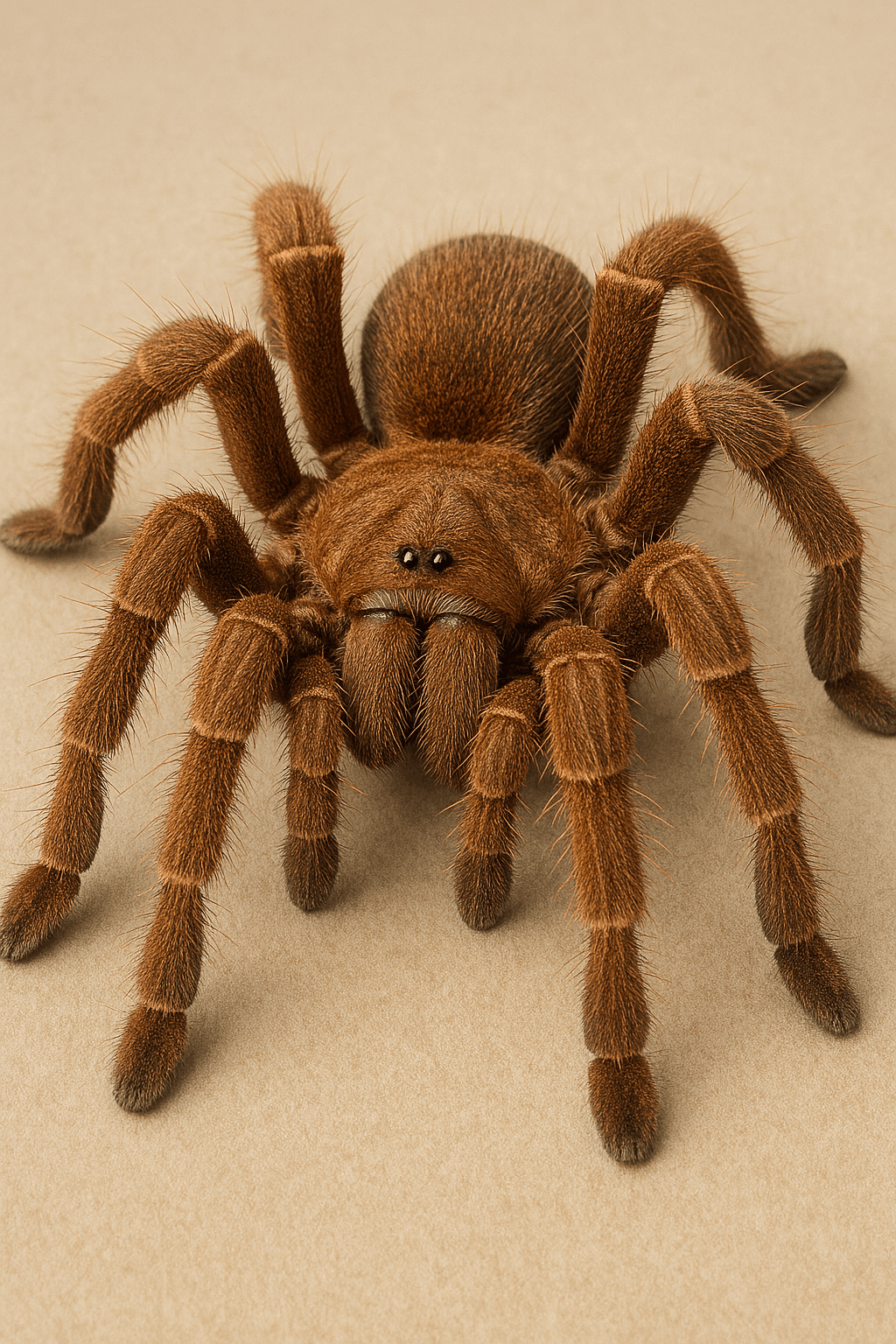
An AI-generated Pelinobius Muticus
Team | Araneae | ||||||||
|---|---|---|---|---|---|---|---|---|---|
Family | Theraphosidae | ||||||||
Spiders are key species that maintain biological balance through their predatory roles within ecosystems. Individuals belonging to the family Theraphosidae are particularly valuable organisms for research, both in terms of biological diversity and behavioral adaptations. Pelinobius muticus is a spider species within the Theraphosidae family that attracts attention due to its morphological and ethological characteristics.
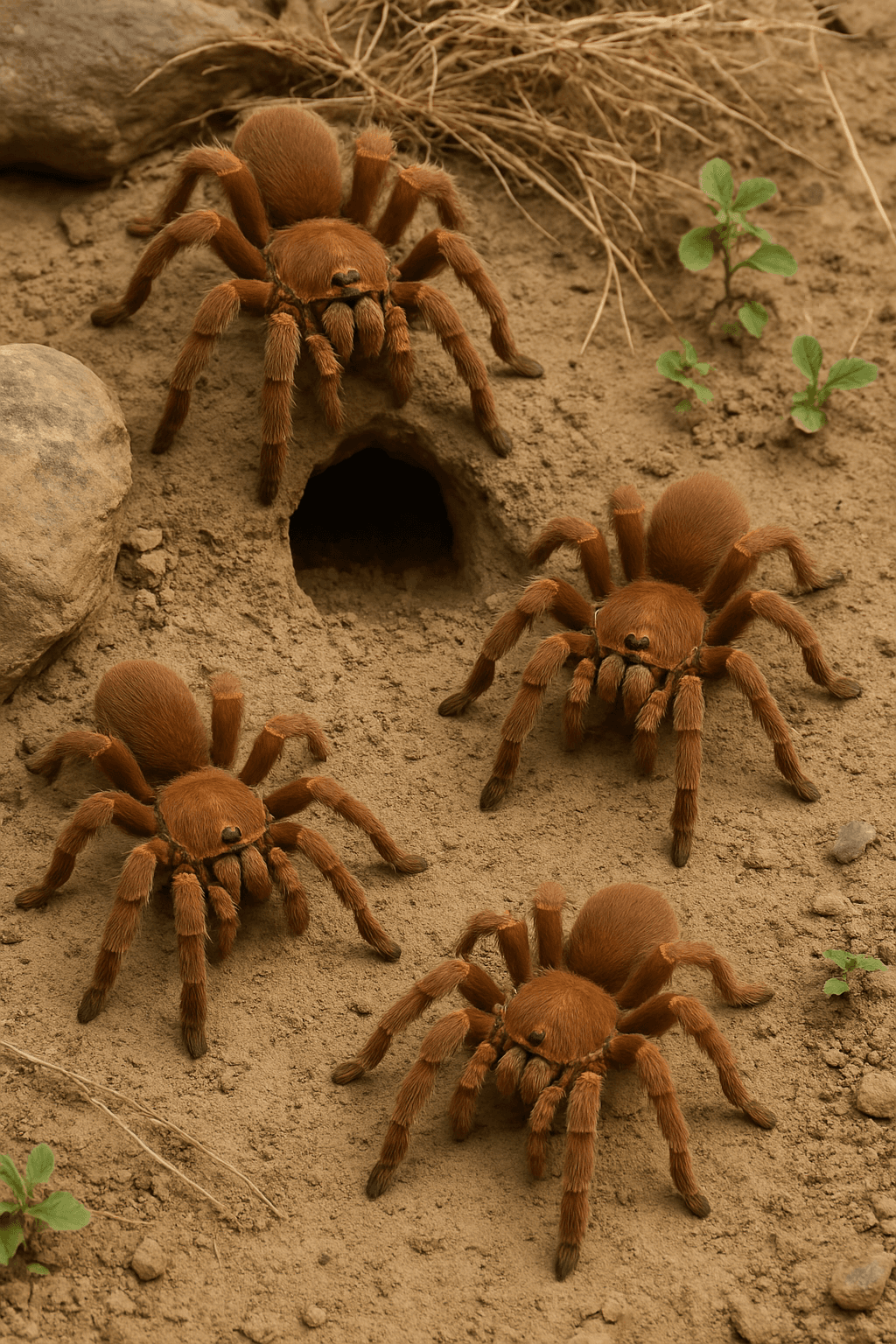
A group of King Baboon Spiders generated by AI
Pelinobius muticus belongs to the order Araneae and the family Theraphosidae, and is the only known member of the genus Pelinobius. This monotypic structure indicates that the species has followed an isolated evolutionary path. Taxonomically, it is classified as follows:
Kingdom: Animalia
Phylum: Arthropoda
Class: Arachnida
Order: Araneae
Family: Theraphosidae
Genus: Pelinobius
Species: P. muticus
Evolutionarily, this species is distinctly differentiated from Theraphosid species native to Asia and the Americas, both in behavior and morphology. This divergence can be explained by specialized adaptations shaped in isolated ecological niches.
P. muticus is characterized by a large body, thick leg structure, and a densely hairy exoskeleton. Its average leg span ranges between 18–20 cm. Color tone is typically copper to brown, providing advantages for both camouflage and heat absorption.
Females are generally larger than males and can live up to 15–20 years. Males have a shorter lifespan and typically die shortly after mating. The large and robust structure of the pedipalps and chelicerae plays a decisive role in physically neutralizing prey.
Morphological adaptations have evolved in integration with digging behavior and defensive mechanisms. These structures are not only critical for species identification but also essential for explaining behavioral patterns.
P. muticus is distributed in semi-arid regions of Eastern Africa. Its habitats consist of savanna and semi-desert ecosystems with loose and permeable soil structures. Temperature, humidity, and soil conditions in these areas are highly variable. The species adapts to this variability through complex tunnel systems constructed underground. These burrows serve not only as physical protection but also play a vital role in thermoregulation and moisture control. Habitat preference directly influences the species’ life cycle and behavioral repertoire. Moreover, P. muticus’s impact on local biodiversity enables it to function as an ecological “micro-predator.”
This species exhibits high levels of aggression and territorial behavior. Sound production known as stridulation is activated particularly under threat perception. This sound, generated by rubbing the pedipalps together, serves as a deterrent in both interspecific and intraspecific communication. Ethologically, although P. muticus is often described as a passive sit-and-wait predator, it displays active defense or aggression when threatened. This is one of the key ethological traits distinguishing it from other tarantula species. The species is nocturnal and hides in its burrow during the day, exhibiting photophobic behavior. This behavioral structure provides evolutionary advantages in both hunting strategies and predator avoidance mechanisms.
P. muticus is a typical “sit-and-wait” predator. During hunting, it uses its powerful chelicerae to immobilize prey through direct physical contact. Its diet includes insects, arthropods, and occasionally small vertebrates. This metabolically slow species can survive long periods without feeding. This feature enables it to cope with environmental uncertainties in terms of energy efficiency. Digestion occurs externally (ectodigestion); the spider enzymatically breaks down the prey’s internal tissues and absorbs the nutrients.
Reproduction is seasonal and intensifies immediately after rainy periods. The male individual locates the female’s burrow by following pheromone trails she leaves behind. After mating, the male is often killed and may be consumed by the female. The female stores fertilized eggs in a protected egg sac within her burrow. The hatchlings remain under the mother’s protection for several weeks. During ontogenetic development, they molt several times before reaching maturity. Females typically mature after several years, while males reach maturity at an earlier stage.
Unlike New World tarantulas, P. muticus lacks urticating hairs. Instead, it relies on its powerful chelicerae and stridulation for defense. This mechanical defense can be effective against natural predators such as birds, snakes and small mammals. Stridulation is not only used during threats but may also serve as a signal to females prior to mating. In this sense, a unified behavioral structure combining defense and communication strategies can be described.
Although P. muticus is frequently sought after by exotic animal enthusiasts for terrarium keeping, its aggressive nature generally makes it unsuitable for captivity. When removed from its natural habitat and traded commercially, the species suffers both individually and at the population level from stress and adaptation issues. Although not listed by CITES, habitat destruction and illegal exotic pet trade threaten the species’ long-term sustainability. Therefore, conservation strategies must be planned not only at the individual level but also based on the integrity of its habitat.
Pelinobius muticus, despite its intimidating appearance, is an organism of extreme scientific value. Its morphological, ethological, and ecological characteristics provide important insights into understanding biological diversity and reevaluating human-species relationships. This study provides a theoretical foundation for why this species must be protected. Every living organism’s unique role within its habitat is indispensable for the continuity of all ecosystems.
"Pelinobius muticus." National Center for Biotechnology Information (NCBI). Accessed April 11, 2025.https://www.ncbi.nlm.nih.gov/Taxonomy/Browser/wwwtax.cgi?id=753628.
"Pelinobius muticus." PubMed Central (PMC). Accessed April 11, 2025.https://pmc.ncbi.nlm.nih.gov/articles/PMC6832493/.
Klátil, Lubomír. Sklípkani: krasavci s chlupatima nohama. Zlín: Nakl. Kabourek, 1998. ISBN 978-80-901466-5-5.

An AI-generated Pelinobius Muticus
Team | Araneae | ||||||||
|---|---|---|---|---|---|---|---|---|---|
Family | Theraphosidae | ||||||||
No Discussion Added Yet
Start discussion for "King Baboon Spider (Pelobius muticus)" article
Taxonomic Positioning and Evolutionary Perspective
Morphological Characteristics: Representation of Structural Specialization
Habitat Features and Microecological Niche
Ethological Characteristics: Aggressive and Territorial Lifestyle
Feeding Biology: Prey Tactics and Energy Efficiency
Reproductive Biology and Ontogenetic Development
Defensive Mechanisms: Mechanical, Not Chemical, Protection
Human-Species Interaction and Conservation Necessity