


This article was automatically translated from the original Turkish version.
+1 More
Chrysanthemum morifolium ramat., a perennial herbaceous ornamental plant belonging to the Asteraceae (Compositae) family, is commonly known as chrysanthemum. Its natural distribution area is Asia, where it has played a particularly important role in Japan and China. Due to its aesthetic value and commercial potential, it is widely used in cut flower and landscape applications. Plant is known for flowering under short day conditions, and for this reason it is also called the "November flower".
Chrysanthemum plants can reach a height of 40 to 120 cm with upright shoots arising from the stem. The leaves are deeply lobed, coarsely toothed and fleshy. When classified by flower form, they are divided into two main groups: standard (single-flowered) and spray (multi-flowered). The spray group includes pompon, spider, decorative and anemone forms. This classification is among the key criteria for variety selection in the cut flower industry.

Chrysanthemum (This image was generated by artificial intelligence)
The most common method of chrysanthemum production is propagation by cuttings. Cuttings taken manually from mother plants are approximately 7 to 8 cm in length and root within 15 to 20 days in a suitable rooting medium.
This medium typically consists of pure sand, perlite or peat moss mixtures and is maintained at a temperature of 20 to 22°C. High humidity is provided through a misting system, and rooting occurs within 15 to 20 days. During rooting, hormone application is commonly used to accelerate root formation.
Because chrysanthemums are prone to bud formation, artificial lighting (at night) is used during the vegetative stage to suppress flowering. Night temperatures should be maintained at 15 to 16°C and daytime temperatures at 16 to 20°C. No more than five cuttings should be taken from a single mother plant, and it should not be kept for more than six months.
Chrysanthemum is a cool-season plant. Optimal daytime temperature is 18 to 21°C and nighttime temperature is 15 to 16°C. During the bud formation stage, temperature should be lowered to 12 to 13°C. Light requirement is high; however, as a short-day plant, flowering begins under photoperiods shorter than 13.5 hours. Therefore, in commercial cultivation, day length is controlled artificially. The plant prefers rich, well-drained soils with a pH of 5.5 to 6.5. 【1】

Chrysanthemum (This image was generated by artificial intelligence)
During transplanting, seedlings are spaced at 15 x 15 cm intervals in greenhouses, resulting in an average of 60 to 62 plants per square meter. Planting depth should not be excessive; otherwise, various root rots and fungal diseases may occur. Watering should be done generously immediately after planting, and leaf misting should be applied to maintain moisture.
Watering and fertilization are critical factors in chrysanthemum care. The plant requires regular and sufficient water; therefore, drip irrigation is one of the most suitable methods. Fertilization should be carried out at regular intervals, especially during flowering, to meet the plant’s nutritional needs. Organic and mineral fertilizers applied to the soil support plant growth and development.
Pinching is performed approximately 10 to 15 days after planting to encourage branching. Similarly, during the growth phase, wire or net supports are used to stabilize the stems. Carbon dioxide fertilization can be applied in greenhouses between 10:00 and 16:00 in the morning; this practice directly improves flower quality by increasing the rate of photosynthesis.
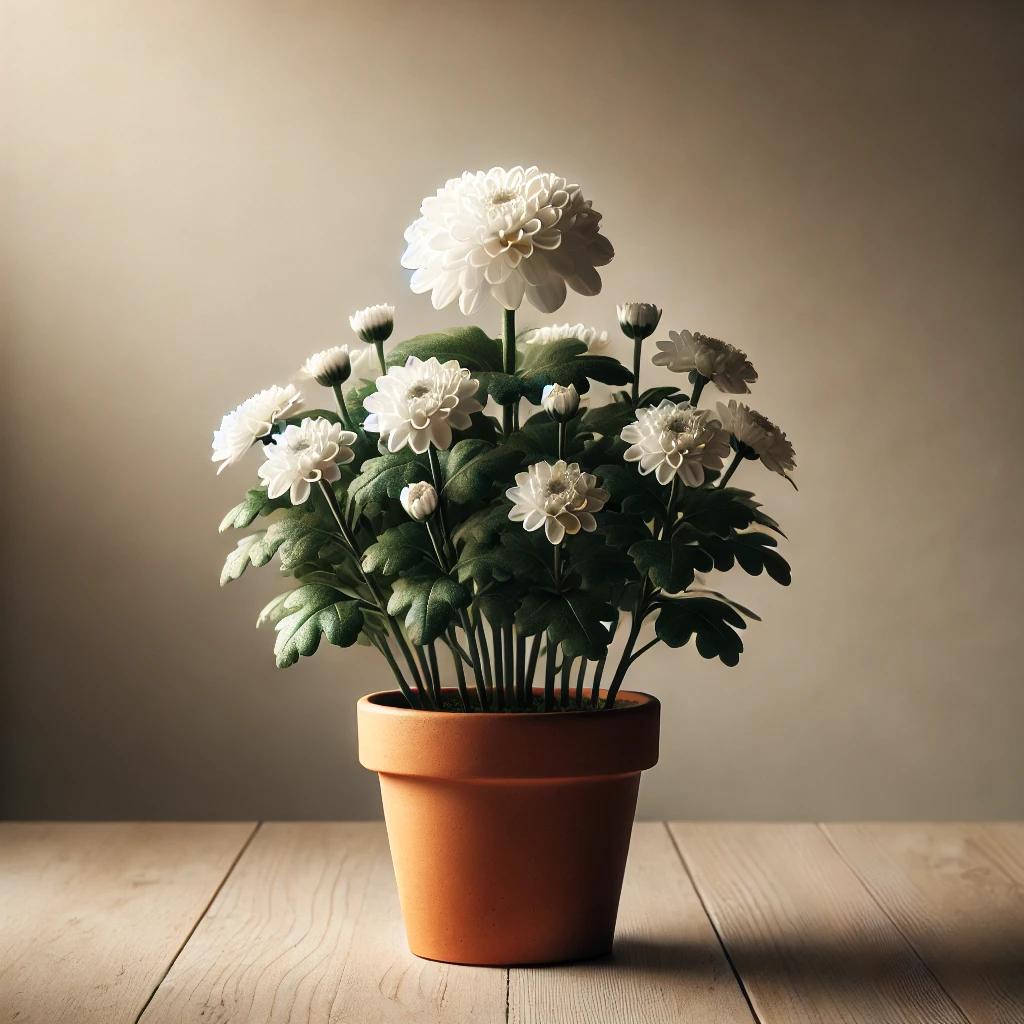
Chrysanthemum (This image was generated by artificial intelligence)
Flowers are harvested before they fully open. Cut stems are sorted according to length and flower form. Subsequently, a "water uptake" treatment is applied: stems are placed in containers filled with water to preserve freshness. Before market distribution, they must be stored at appropriate temperatures (1 to 4°C) and high humidity (approximately 90% RH). These procedures directly affect the flower’s vase life.
Due to its morphological diversity, ease of production and long vase life, chrysanthemum is one of the most prominent ornamental plants. Modern production techniques have made it possible to supply this plant to the market year-round. However, for sustainable production, ecological conditions must be carefully monitored, mother material quality must be preserved, and post-harvest procedures must be applied with precision.
Aşı ve Çelikle Üretilen Kesme Çiçekler. Ankara: T.C. Millî Eğitim Bakanlığı, 2016.
Kazaz, Doç. Dr. Soner. Kasımpatı (Krizantem) Yetiştirme Tekniği. Ankara: Ankara Üniversitesi Ziraat Fakültesi Bahçe Bitkileri Bölümü.
“Bahçecilik Kasımpatı Yetiştiriciliği.” T.C. Millî Eğitim Bakanlığı. Ankara, 2007.
“Çelik, Aşı ve Doku Kültürü Yöntemiyle Çoğaltılan Kesme Çiçek Süs Bitkileri Yetiştiriciliği.” T.C. Millî Eğitim Bakanlığı. Ankara, 2012.
[1]
T.C. Milli Eğitim Bakanlığı, Bahçecilik Kasımpatı Yetiştiriciliği, Ankara, 2007, 3-5.

Botanical Characteristics
Ecological Requirements
Cultivation Techniques
Maintenance Practices
Harvest and Post-Harvest Operations