This article was automatically translated from the original Turkish version.
Type of Geographical İndication | Origin Name | ||||||||
|---|---|---|---|---|---|---|---|---|---|
Application Date | 21 May 2018 | ||||||||
Registration Number | 527 | ||||||||
Registration Date | 28 August 2020 | ||||||||
Product / Product Group(s) | Processed and unprocessed fruits vegetables and mushrooms | ||||||||
Applicant/Registrant(s) | Karamanlı Municipality | ||||||||
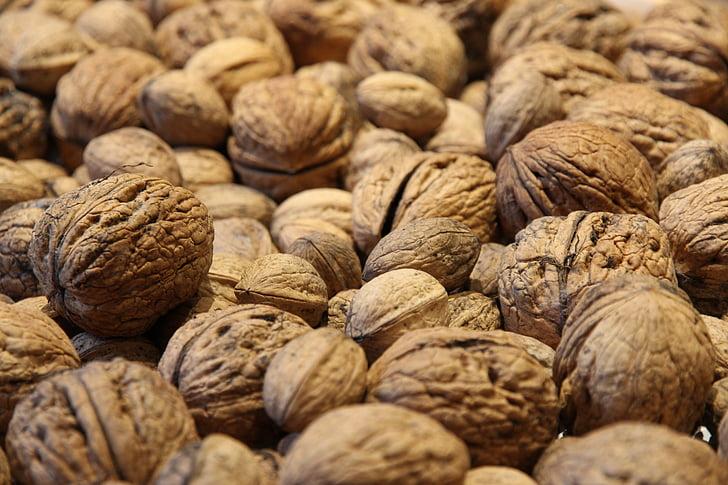
Karamanlı Walnut is a geographical indication-registered walnut variety distinguished by its high oil content, dense kernel fill, and resistance to frost. It is produced from the Şebin, Kaman 1, and Yalova 1 varieties of Juglans regia L., cultivated in the potassium- and lime-rich soils of Karamanlı district.
The geographical boundary of Karamanlı Walnut is limited to Karamanlı district of Burdur Province. The term “Karamanlı Walnut” and its origin emblem must appear on the product itself or its packaging. When this is not feasible on the product or packaging, the term “Karamanlı Walnut” and the origin emblem must be displayed in a clearly visible location within the production facility.
The Şebin, Kaman 1, and Yalova 1 walnut varieties are used in the production of Karamanlı Walnut. The soil structure of Karamanlı district significantly influences walnut quality. The soil has a pH of 7.6 and an organic matter content of 3.09%, both exceeding the standard limits established for conventional walnut cultivation. The 20% lime content in the soil enhances plant and fruit development, particularly in terms of oil accumulation, by improving the availability of phosphorus and micronutrients such as iron, zinc, copper, and manganese. The potassium content of the soil is approximately 174 ppm, which is higher than the regional average and increases the tree’s resistance to frost. As a result, walnut trees in the region can withstand temperatures as low as −5°C during flowering and fruit set stages without damage to the crop. High potassium levels increase kernel fill, while calcium strengthens cell walls, enhancing resistance to bacterial diseases. Nitrogen content contributes to fruit development and color formation.
The oil content of Karamanlı Walnut is 68.23% (±3), protein is 17.43% (±1), and carbohydrates are 7.55% (±1). The average dimensions of the walnut are 42.47 mm (±1.68) in length, 34.00 mm (±2.02) in width, and 33.41 mm (±1.82) in thickness. Walnut trees enter dormancy from early November to mid-March and begin flowering and fruit set from late April to the end of May. The soil structure of the region, along with planting and maintenance methods, and the drying and processing techniques applied during harvest, contribute to the unique qualities of the product.
Before planting, the land intended for walnut cultivation is plowed using a disk harrow and cultivator to prepare it for planting. Markings are made on the planting area to indicate where each tree will be placed. Holes measuring approximately 70 cm in width and 50 cm in depth are dug at intervals of 8x8 m, 9x9 m, or 10x10 m, depending on soil characteristics, and saplings are planted. Each sapling is tied to a stake to support its growth and prevent damage. Pollinator varieties are planted at intervals of 60–70 meters from the main variety.
The soil in the planting area is cultivated at least twice annually: deep plowing in autumn and shallow plowing in spring. Irrigation for Karamanlı Walnut begins in May using drip irrigation. Trees require the most water during July and August, depending on local climatic conditions and soil structure, and irrigation frequency is increased during these months. Irrigation is carried out either early in the morning or just before sunset to ensure efficiency and effectiveness. Trees are irrigated four to six times before harvest.
Pruning is performed during the sapling growth phase by selecting five branches positioned 30–60 cm above the trunk and removing all other branches. Once the tree begins fruiting, pruning is carried out every two years, with careful attention paid to maintaining sparse shoot density. This method enhances both tree productivity and fruit quality. Trees managed through these pruning and cultivation practices develop a canopy width of up to 15 meters and produce 70–80 kg of shelled walnuts per tree.
The final irrigation should be conducted 20–25 days before harvest. Before deciding to harvest, the outer green husk of the walnut is inspected for cracking, which indicates the onset of the harvest season. Additionally, harvest begins only after confirming that the inner hard shell has fully hardened and contains no internal voids.
Harvesting of Karamanlı Walnut is carried out using mechanical shaking and hand collection. This method prevents damage to both the fruit and the trees, preserving storage life and product quality. Walnuts that fall to the ground after shaking, along with those collected by hand, are promptly separated from their green husks. This separation can be performed manually or using appropriate tools, machinery, and equipment. After husk removal, the walnuts are dried thoroughly in a cool, dry environment and then stored in mesh bags in a dry, well-ventilated, and sun-free location.
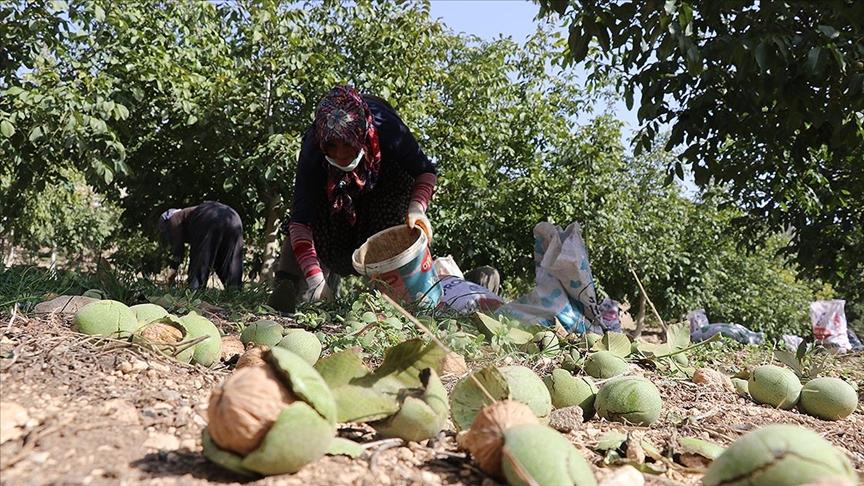
Karamanlı Walnut Harvest (Anadolu Agency)
Monitoring activities are conducted by a three-member oversight body coordinated by the Karamanlı Municipality, comprising one representative each from the Karamanlı Municipality, the Karamanlı District Directorate of Agriculture and Forestry, and the Karamanlı Chamber of Agriculture. Inspections may be carried out once upon registration of any new facility or producer with the Chamber of Agriculture, once during each flowering and fruiting period (April–May), and once during each harvest period (September–October), or at any time upon request or complaint.
Inspections are primarily conducted during production and harvest stages by authorized inspectors, ensuring compliance with production methods and product specifications. Inspectors verify the geographical origin of the product, planting and cultivation methods, timing and technique of harvest, drying and classification procedures, physical dimensions and dryness levels of the product, and suitability of storage conditions. The oversight body may engage experts from public or private institutions or hire services from qualified individuals or legal entities to carry out inspections. The registering authority is responsible for pursuing legal procedures to protect the rights associated with the geographical indication.
Anadolu Ajansı. “Lezzetini Toprağından Alan Coğrafi İşaretli ‘Karamanlı Cevizi’nde Hasat Telaşı.” Anadolu Ajansı. Accessed July 14, 2025. https://www.aa.com.tr/tr/ekonomi/lezzetini-topragindan-alan-cografi-isaretli-karamanli-cevizinde-hasat-telasi/2718652
Hippopx. “Ceviz JPG.” Hippopx. Accessed July 14, 2025. https://www.hippopx.com/tr/walnuts-walnut-nuts-close-106409
Turk Patent and Trademark Office. "Karamanlı Cevizi." *Coğrafi İşaretler Portalı*. Accessed July 14, 2025. https://ci.turkpatent.gov.tr/cografi-isaretler/detay/38572
Turkish Patent and Trademark Office. "Karamanlı Cevizi Coğrafi İşaret Belgesi." *Coğrafi İşaretler Portalı.* Accessed July 14, 2025. https://ci.turkpatent.gov.tr/Files/GeographicalSigns/23cd21c7-3d00-4b67-bd15-8cf0c569a9f0.pdf

Type of Geographical İndication | Origin Name | ||||||||
|---|---|---|---|---|---|---|---|---|---|
Application Date | 21 May 2018 | ||||||||
Registration Number | 527 | ||||||||
Registration Date | 28 August 2020 | ||||||||
Product / Product Group(s) | Processed and unprocessed fruits vegetables and mushrooms | ||||||||
Applicant/Registrant(s) | Karamanlı Municipality | ||||||||
Geographical Boundary and Usage Format
Distinctive Characteristics
Production Method
Harvest and Storage
Monitoring