

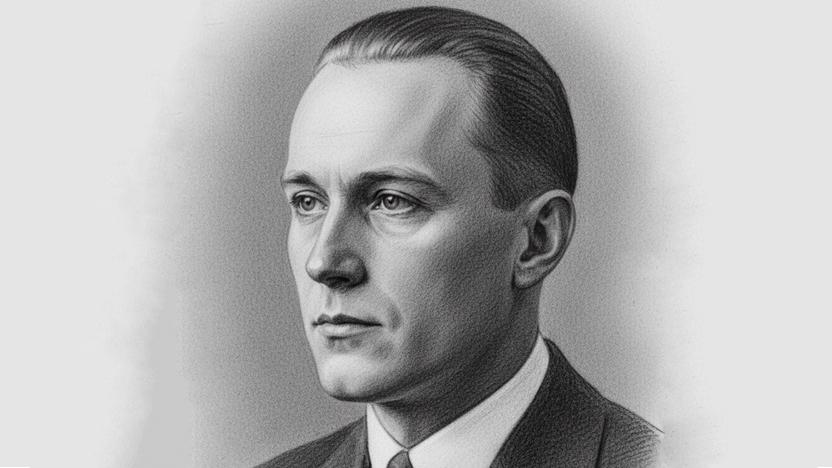

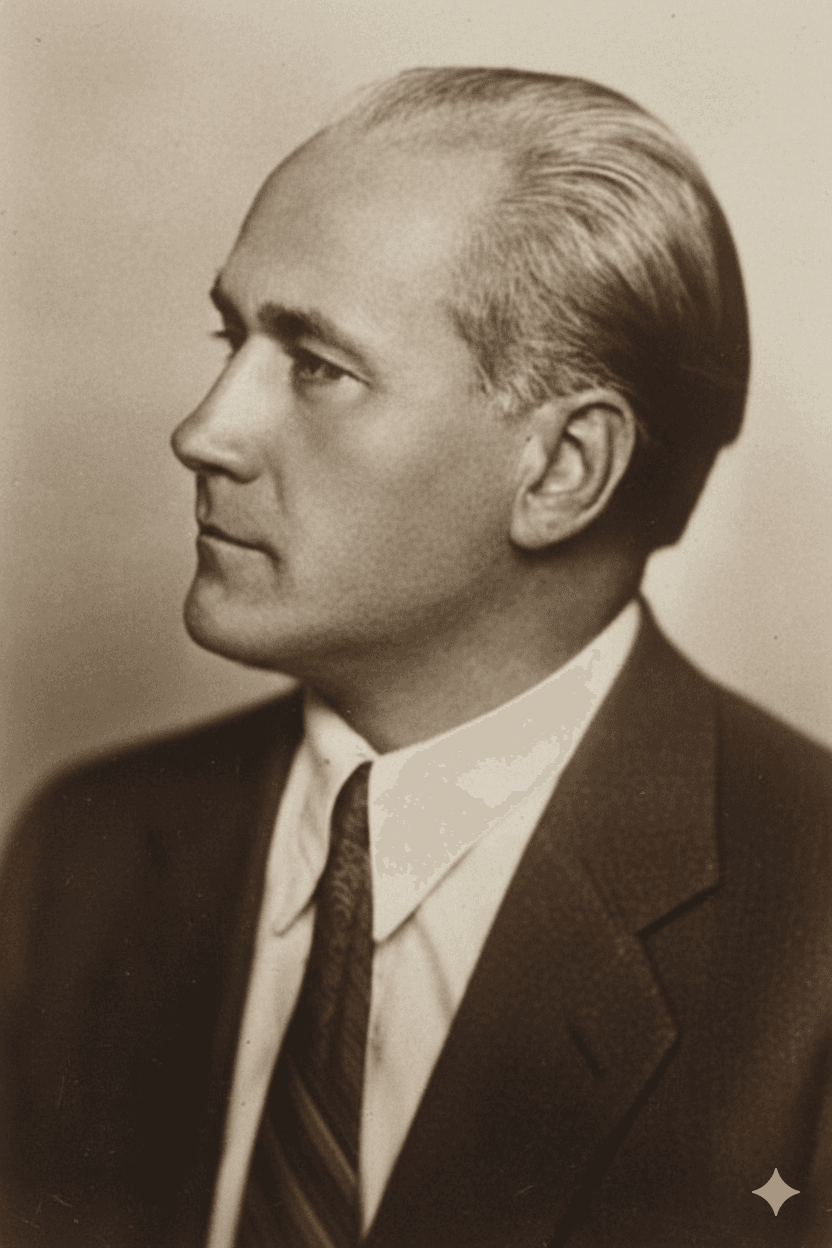
Kalman Tihanyi (Generated by Artificial Intelligence.)
Birth | 28 April 1897 | ||||||||
|---|---|---|---|---|---|---|---|---|---|
Death | 16 February 1947 | ||||||||
Title | Hungarian physicist and engineer | ||||||||
Education | Electrical engineering and physics education in Pressburg and Budapest | ||||||||
Areas of Expertise | Electronic Television, Radio Engineering | ||||||||
Kalman Tihanyi, a Hungarian physicist and engineer born in 1897, played a key role in the development of modern television, one of the technological achievements of the 20th century. He is best known for designing the technology known as the "storage principle," which made the technical realization and industrial mass production of television possible.
Kalman Tihanyi was born on 28 April 1897 in Újbuda, then part of the Nyitra Region of Austria-Hungary (today in Slovakia). He received his education in electrical engineering and physics in Pozsony and Budapest.
At the age of 16, Tihanyi filed his first patent application. A year later, this patent, which enabled the wireless switching of street lamps, was purchased by a company in Vienna. Additionally, Tihanyi's inventions between 1912 and 1916 are recorded in a hundreds-of-pages-long notebook preserved in the Manuscript Collection of the Hungarian Academy of Sciences.
In 1916, he joined the army of the Austro-Hungarian Monarchy, where he gained experience in radio engineering that he would use throughout his later career. Although his interest in television began in 1917, he first publicly announced his research in 1925 with a publication titled "On Electronic Transmission Over Distance."
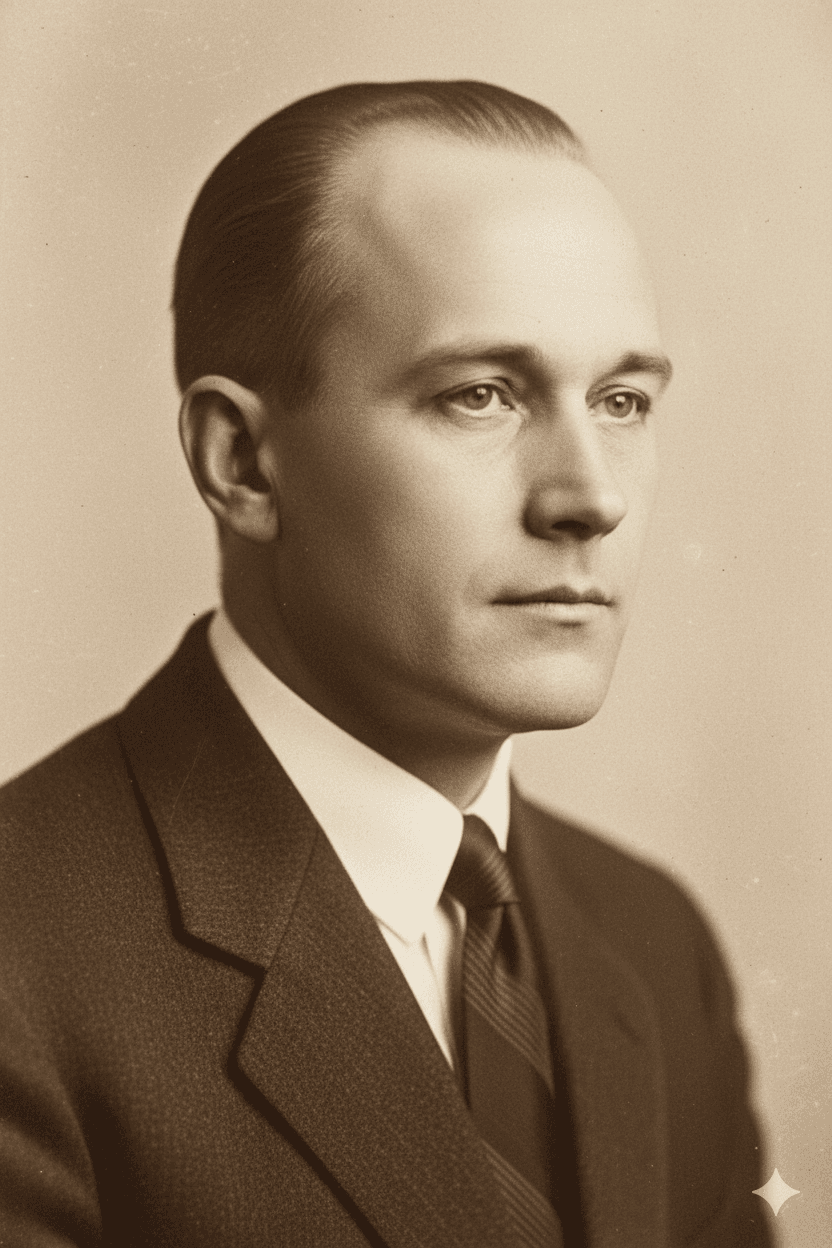
Kalman Tihanyi (Generated by Artificial Intelligence.)
The contributions of Hungarian physicist and engineer Kalman Tihanyi to television technology represent a pivotal shift in the history of early electronic television. Tihanyi addressed a fundamental problem: the low sensitivity of camera tubes to light and the resulting weak electrical output. To solve this issue, he introduced the charge storage technology in early 1924.
His final design from this work was patented in Hungary in 1926 under the name "Radioskop" (T-3768). Tihanyi's system described a cathode ray tube-based charge storage television system in three distinct concepts: wired, wireless, and color. This patent application consisted of a detailed 42 pages explaining the system's design and mass production.
At the heart of the system was the technology later known as the "storage principle." Although Tihanyi's invention shared some superficial similarities with earlier proposals that used cathode ray tubes for both transmitter and receiver, it represented a completely novel concept in design and operation.
In 1928, Tihanyi obtained the patent for the final and improved version of this system.
Tihanyi's invention was initially well received by European manufacturers such as Telefunken and Siemens. However, these companies ultimately chose to continue developing mechanical television systems based on Nipkow disks and rejected Tihanyi's electronic system. In response, Tihanyi traveled to Berlin in 1928, established his own laboratory, and with the help of his younger brother, also an electrical engineer, produced the first experimental image tube. Subsequently, the Radio Corporation of America (RCA) contacted Tihanyi, signed an agreement to purchase his patent, and began laboratory development of the camera tube.
Based on Tihanyi's ideas, the first functional American camera tubes were completed several months later at RCA by Vladimir Zworykin. RCA named this new television system the iconoscope.
In addition to television, Tihanyi worked in other fields:
Kalman Tihanyi's 1926 patent application for the "Radioskop" has been part of the UNESCO Memory of the World Programme since 2001 and is the first Hungarian document to be included in the program. This document, preserved in the National Archives of Hungary, represents the first definition of a television system by the inventor and the only complete existing collection of Hungarian patent applications. The Archive stores the original patent document separately in a special protective foil to preserve its original condition.
In the final years of his career, Tihanyi sought to transform his expertise in television technology into a commercial enterprise by founding his own television company in Hungary. However, despite his inventions, these efforts did not succeed. His final endeavors proved fruitless, and the inventor died on 16 February 1947.
Early Television. "Kalman Tihanyi." Accessed October 19, 2025.https://www.earlytelevision.org/kalman_tihanyi.html
Hungarian Intellectual Property Office. “Kálmán Tihányi.” *Hungarian Inventors and Inventions.* Accessed October 19, 2025.https://hipo.gov.hu/en/hungarian-inventors-and-inventions/kalman-tihanyi
UNESCO ICDH. “MoW International Registers.” Memory of the World International Registers. Accessed October 19, 2025.https://www.unescoicdh.org/eng/sub.php?menukey=289&mod=view&no=23731&page=20&scode=00000005&listCnt=10&code1=00000004
UNESCO. “Kalman Tihanyi’s 1926 Patent Application ‘Radioskop’.” Memory of the World. Accessed October 19, 2025.https://www.unesco.org/en/memory-world/kalman-tihanyis-1926-patent-application-radioskop

Kalman Tihanyi (Generated by Artificial Intelligence.)
Birth | 28 April 1897 | ||||||||
|---|---|---|---|---|---|---|---|---|---|
Death | 16 February 1947 | ||||||||
Title | Hungarian physicist and engineer | ||||||||
Education | Electrical engineering and physics education in Pressburg and Budapest | ||||||||
Areas of Expertise | Electronic Television, Radio Engineering | ||||||||
Early Life and Education
"Radioskop" and the Storage Principle
International Reactions and Relationship with RCA
Other Works
UNESCO Memory of the World Programme
Death