


This article was automatically translated from the original Turkish version.
Kalandar Night is the name of a centuries-old New Year’s celebration tradition in Türkiye, primarily observed in the Eastern Black Sea region, including areas such as Trabzon, Rize, and Artvin. It encompasses a festive practice that brings together various beliefs, forms of entertainment, costumes, and symbols. This concept is regarded by local communities as a valued tradition and remained largely unknown across the country for a long time. In Türkiye, the general public first became aware of the term “Kalandar” through the 2016 film Kalandar Soğuğu, directed by Mustafa Kara, after which interest and curiosity about the tradition increased significantly.
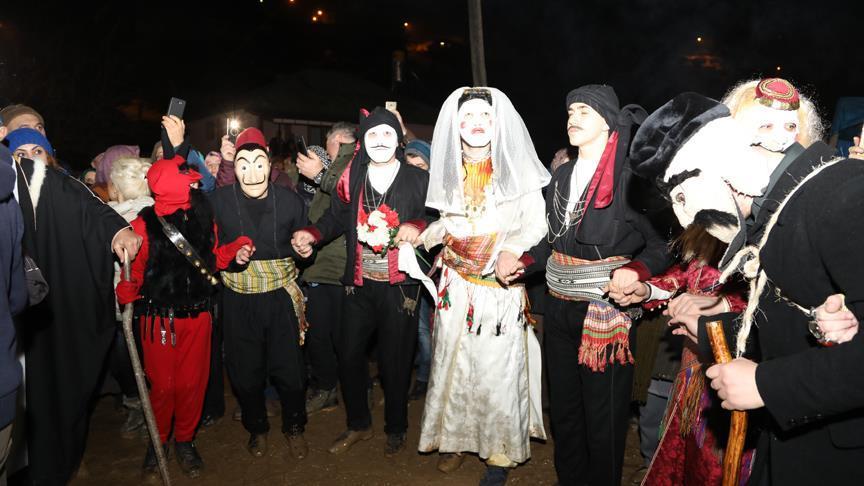
Kalandar Night in Trabzon (AA)
Kalandar is the name of a centuries-old New Year’s celebration tradition primarily observed in the Eastern Black Sea region of Türkiye, including Trabzon, Rize, and Artvin. Kalandar Night refers to the rituals taking place between the night of January 13 and the day of January 14. It is believed that the first person to enter a home on the night of January 13 brings prosperity and good fortune; therefore, it is desired that this person be wealthy and auspicious.
Although Kalandar is widespread throughout the Black Sea region, especially in the Eastern Black Sea, it holds a special place in Trabzon and Gümüşhane. One of the places where the tradition is still actively celebrated today is the village of Livera (Yazlık), located in the Maçka district of Trabzon. Activities begin in the evening after daytime preparations and continue throughout the night and into the following day. During the celebrations, games, melodies, rituals, and beliefs intertwine. Practices associated with the night include lighting bonfires in the village square, performing the horon dance accompanied by the kemençe, and visiting houses door to door.
As part of Kalandar Night traditions, children and young people go door to door in the streets, leaving a torba or bag at each door, ringing the bell, and then singing maniler while waiting for gifts from the householders. One example of such a maniler is:
Kalandar Night, the state chimney,
The heaven’s teacher who fills my bag,
The hell’s teacher who does not fill it,
Male above, female below.
In the example of Livera (Yazlık) village, during the Kalandar festivities, young people and children perform a theatrical play known as “Karakoncolos” or “Momoyer,” accompanied by rhymes, maniler, and folk songs while going door to door. The house-to-house visits traditionally begin at the home of the village’s oldest resident, and doors are knocked on in sequence. As soon as the door opens, the hidden children and youths throw a bag tied to a rope through the opening, or climb onto the roof and lower the bag down the chimney. The homeowner is expected to place some food items from their home—such as grain, nuts, apples, pears, or bread—into the bag. This practice is known as “torba atmak” or “Kalandar house-to-house visits.”
The homeowner tries to guess who the visitors are. If they fail to identify them, they place food items such as koliva corn, hazelnuts, apples, pears, or bread into the bag. If they correctly guess the identity of the visitors, they humorously place objects such as a kitten, a piece of firewood, thread, or ragged cloth into the bag instead. The collected food items are stored and later shared collectively after the festivities end, as it is believed that doing so enhances abundance and prosperity.
During Kalandar Night, a theatrical performance involving improvised exchanges is held, known as “Karakoncolos” or “Momoyer,” terms derived from the Greek for “mountain man” or “bear.” The narrative centers around a grotesque, dark-colored monster. It is believed to be the size of a cat, monkey, or child, covered in fur and hair. It is said to roam at night, behaving playfully and harmlessly, yet its appearance causes fear and panic among people. For this reason, during Kalandar Night, children and young people dress in animal pelts, tie cowbells around their waists, blacken their faces with soot, and dishevel their hair to assume the guise of Karakoncolos.
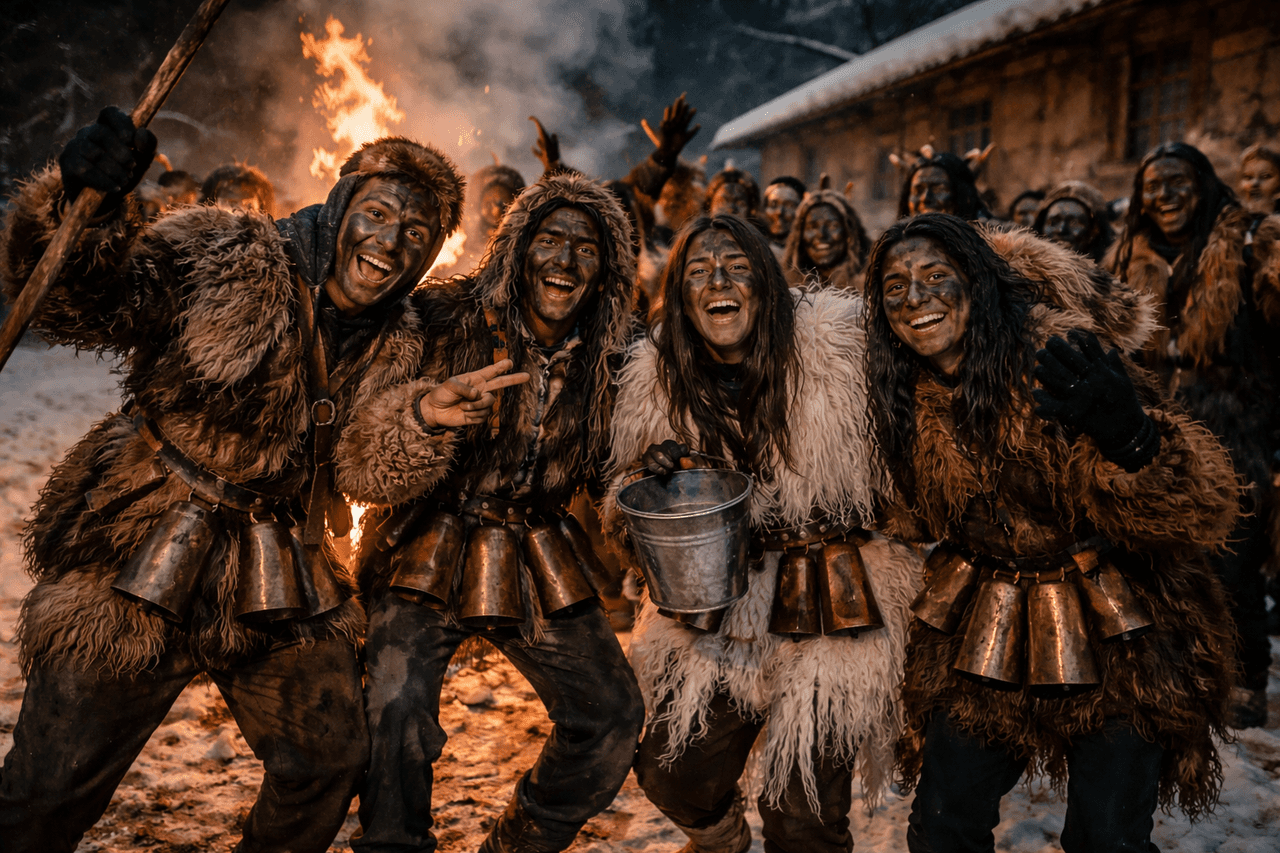
Karakoncolos Kılığına Girmiş İnsanlar (Yapay Zeka İle Oluşturulmuştur)
Within the Kalandar celebrations, a supernatural entity known locally as “Karakoncolos” and associated beliefs are central. In folk tradition, particularly widespread in the Eastern Black Sea region, Karakoncolos is regarded as a winter spirit, also referred to as Koncolos, Yaban Adam, or Publik. It is believed that this entity arrives in coastal villages during winter, either carried by storms from the mountains or emerging from the sea. İbrahim Tuncer, who has conducted fieldwork and research on the region, especially in Çaykara district of Trabzon, provides the following information about Karakoncolos: Karakoncolos or Karakoncilo is likened to a jinn, fairy, bear, or monkey; its body is covered in hair and it is imagined as a creature possessing limbs of various animals; it is most commonly envisioned in the form of a bear or monkey. It is believed to enter homes during the shortest day and longest night of the year. Households leave food offerings at their doorsteps to appease it, believing that it will consume the food and depart without causing harm.
Alay, Okan. “Anadolu ve Kafkasya Kavşağında Geleneksel Bir Yılbaşı Kutlaması: Kalandar.” *Motif Akademi Halkbilimi Dergisi* 11, no. 23 (2018): 96–110. Accessed January 13, 2026.https://dergipark.org.tr/tr/pub/mahder/article/427735
Haber Merkezi. “Anadolu’nun Soğuk Cini: Karakoncolos’un Efsanevi Hikayesi.” *Ensonhaber*, January 14, 2022. Accessed January 13, 2026.https://www.ensonhaber.com/yasam/anadolunun-soguk-cini-karakoncolosun-efsanevi-hikayesi#google_vignette
Karakurum, Meltem Yılmaz. “Karadeniz’in Yeni Yıl Geleneği ‘Kalandar’ Festival Tadında Yaşatılacak.” Anadolu Ajansı, December 31, 2025. Accessed January 13, 2026.https://www.aa.com.tr/tr/kultur/karadenizin-yeni-yil-gelenegi-kalandar-festival-tadinda-yasatilacak/3786029
Karakurum, Tolga. “Trabzon’da ‘Kalandar’ Kutlandı.” Anadolu Ajansı, January 13, 2019. Accessed January 13, 2026.https://www.aa.com.tr/tr/turkiye/trabzonda-kalandar-kutlandi/1363741
Çaykara Gazetesi. “Çaykara’da Kalandar Gecesi.” Çaykara Gazetesi, January 14, 2021. Accessed January 13, 2026.https://www.caykaragazetesi.com/sanat/caykarada-kalandar-gecesi-56182/
Çaykara Gündem. "Trabzon’da Uzungöl Gençlerinden Kalandar Gecesi Etkinlikleri." Çaykara Gündem, January 15, 2024. Accessed January 13, 2026.https://caykaragundem.com/haber/trabzonda_uzungol_genclerinden_kalandar_gecesi_etkinlikleri-11532.html
The “Torba Atmak” Practice
The Karakoncolos and Momoyer Theatrical Play
The Karakoncolos Belief and Its Names