


This article was automatically translated from the original Turkish version.
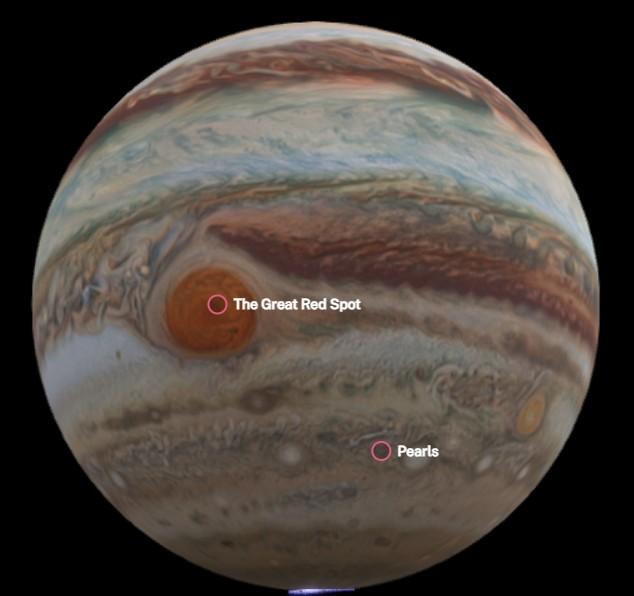
Jupiter, the Giant of the Solar System
Type | Gas Giant | ||||||||
|---|---|---|---|---|---|---|---|---|---|
Distance from the Sun | ~778 million km (5.2 AU) | ||||||||
Diameter | 142984 km (11 times Earth's diameter) | ||||||||
Mass | 1.898 × 10²⁷ kg (318 times Earth's mass) | ||||||||
Orbital Period | 11.86 Earth years | ||||||||
Rotation Period | 9 hours 56 minutes | ||||||||
Surface Temperature (Average) | -145 °C | ||||||||
Moons | 95+ (Io, Europa, Ganymede, Callisto are prominent) | ||||||||
Rings | Has thin and faint rings | ||||||||
Primary Component | Hydrogen (%90) and Helium (%10) | ||||||||
Jupiter is the fifth planet in the Sun System and is located at an average distance of 778 million kilometers from the Sun. Acting as a transitional point between the inner and outer planets, Jupiter is also the largest planet, with a mass greater than the combined mass of all other planets.
Because Jupiter is easily visible to the naked eye, it has been known since antiquity. Therefore, it has no special “discovery date”; it was observed by Babylonian, Chinese and Greek astronomers. However, in 1609–1610, Galileo Galilei discovered its four largest moons — Io, Europa, Ganymede and Callisto — during telescopic observations and provided one of the most important pieces of evidence supporting the idea that planets orbit the Sun.
Jupiter (Source: Youtube-BBC)
Jupiter, the largest planet in the Sun System, has an equatorial diameter of approximately 142,984 kilometers, making it about 11 times larger than Earth. With a mass of 1.898 × 10²⁷ kilograms, this giant planet is more massive than all other planets combined and plays a decisive role in the mass balance of the Sun System. Its average density is only just 1.33 g/cm³, indicating that it is composed largely of gases.
Jupiter’s atmosphere consists primarily of hydrogen (90%) and helium (10%). In addition to these gases, it contains ammonia (NH₃), methane (CH₄), water vapor (H₂O), and other trace gases. Distinct zonal bands are visible in the atmosphere; these appear as alternating dark and colored stripes, each with its own set of fast winds blowing in different directions. Winds at Jupiter’s poles reach speeds of up to 600 km/h, accompanied by complex cyclonic structures. Its most striking atmospheric feature is the Great Red Spot, a massive storm system observed since the 17th century. This anticyclonic structure is larger than Earth and has persisted for centuries.
Jupiter has no solid surface; the region designated as its “surface” is a virtual reference point where atmospheric pressure equals 1 bar. Beneath the atmosphere, hydrogen first becomes liquid, and at greater depths, under extreme pressure, it transforms into metallic hydrogen. This phase behaves like a liquid metal, with free-moving electrons enabling electrical conductivity. This property is critical to the formation of Jupiter’s powerful magnetic field. According to scientific models, beneath these layers lies a core roughly the size of Earth, composed of rock and likely molten metals. While the existence of this core is not certain, gravity data from the Juno mission supports its presence.
Jupiter possesses the strongest planetary magnetic field in the Sun System, approximately 10 to 20 times stronger than Earth’s, generating a magnetosphere of immense proportions. This magnetosphere interacts with the solar wind to produce a dense radiation belt around Jupiter. Jupiter also has a thin and transparent ring system; these rings were first discovered in 1979 by the Voyager 1 spacecraft.
Jupiter rotates on its axis faster than any other planet in the Solar System, completing one rotation in only approximately 9 hours and 56 minutes, causing it to adopt an oblate shape — flattened at the poles and bulging at the equator. It completes one orbit around the Sun in 11.86 Earth years.
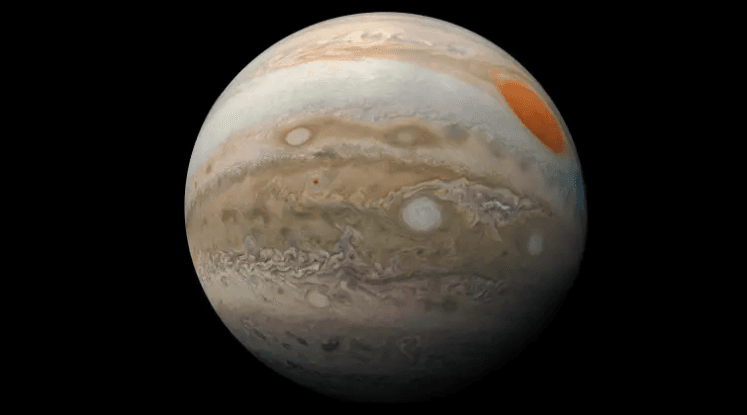
NASA’s Juno spacecraft captured an image of Jupiter’s Great Red Spot on February 12, 2019. (Source:
Jupiter’s magnetic field is the strongest and most extensive planetary magnetic field in the Sun System. This magnetic field is approximately 10 to 20 times stronger than Earth’s and can reach up to 14 Gauss at the poles. The field’s influence creates a massive magnetosphere that acts like a protective shield, deflecting charged particles from the Sun. Jupiter’s magnetosphere can extend millions of kilometers downstream when interacting with the Sun’s magnetic field, making its magnetic environment larger in some aspects than the Sun itself.
The source of this powerful magnetic field is the layer of metallic hydrogen within Jupiter’s interior. Under immense pressure, hydrogen in Jupiter’s interior transforms into a metallic phase in which electrons move freely and conduct electricity. Rapid rotation and convection currents within this liquid metallic hydrogen layer generate a dynamo effect that produces Jupiter’s enormous magnetic field. On Earth, a similar process occurs through the flow of liquid iron in the outer core, but on Jupiter, this role is fulfilled by metallic hydrogen.
Jupiter’s magnetic field not only forms a protective shield against the solar wind but also generates intense radiation belts around the planet. These belts trap particles — particularly electrons and ions — creating regions of extremely high energy. This condition poses a major challenge for Jupiter’s moons and spacecraft operating in this region. Special protective systems were developed for NASA’s Galileo and Juno missions to withstand this intense radiation environment.
The magnetic field is also responsible for the spectacular auroral phenomena observed at Jupiter’s poles. These auroras form similarly to Earth’s northern lights but are far larger and more energetic. Data collected by the Juno spacecraft since 2016 indicate that these auroras are not solely driven by the solar wind but may also originate from interactions between Jupiter’s magnetic field and its moons. In particular, ions released by volcanic activity on Io significantly enhance the intensity of these auroral events.
As one of the five planets visible to the naked eye in the Sun System, Jupiter has been observed by humanity since ancient times. Babylonian, Chinese and Maya astronomers regularly tracked Jupiter in the sky and recorded its movements in their calendars. The Greeks identified it as Zeus, while the Romans named it Jupiter. However, a turning point in scientific observation occurred in 1609–1610 when Galileo Galilei made telescopic observations. By discovering Jupiter’s four large moons — Io, Europa, Ganymede and Callisto — Galileo laid the foundation for telescopic astronomy and provided strong support for the heliocentric universe model.
Until the 20th century, knowledge about Jupiter was limited to telescopic observations. However, beginning in the 1970s, space missions provided far more detailed data. The first spacecraft to reach Jupiter was Pioneer 10. In 1973, this craft flew by the planet and made the first direct measurements of Jupiter’s magnetic field and radiation environment. The subsequent Pioneer 11, in 1974, provided information on both the atmosphere and the rings.
Following these initial missions, Voyager 1 and Voyager 2 arrived at the Jupiter system in 1979. These missions yielded the most striking images and data on Jupiter’s moons to date. Discoveries such as Io’s volcanic activity and Europa’s icy surface revolutionized astrobiology. The Voyagers also discovered Jupiter’s faint and delicate rings.
The Galileo mission, launched in 1995, was the first spacecraft to enter orbit around Jupiter and collect data over an extended period. Galileo deployed a probe into Jupiter’s atmosphere, directly measuring temperature, pressure and composition. It also provided key findings on the detailed structure of the magnetic field and surface features of the moons. The mission ended in 2003 when the spacecraft was deliberately directed into Jupiter’s atmosphere.
The most important current mission to study Jupiter is NASA’s Juno spacecraft, which arrived at the planet in 2016. Juno was specifically designed to investigate Jupiter’s poles, gravity field, magnetic structure, and deep atmospheric circulation. Data from Juno have enabled more accurate models of the planet’s interior and the metallic hydrogen region. Juno has also led pioneering studies on auroras and ionospheric analysis.
European Space Agency (ESA)’s JUICE (JUpiter ICy moons Explorer) mission, launched in 2023, will reach the Jupiter system in 2031 and conduct detailed investigations of icy moons such as Europa, Ganymede and Callisto. This mission has generated great anticipation because it is expected to provide crucial data on the possible oceans beneath Europa’s ice and the potential for life.
In addition to being the largest planet in the Sun System, Jupiter is also one of the planets with the most moons. As of 2024, the number of confirmed moons has exceeded 95 and continues to grow with new observations. However, within this vast satellite system, the four large moons known as the Galilean moons — Io, Europa, Ganymede and Callisto — are the most scientifically significant. Discovered in 1610 by Galileo Galilei, these moons are considered one of the foundational pillars of modern astronomy. Jupiter’s large moons attract significant scientific interest not only due to their size but also because of their unique geological and physical properties.
In addition to these, Jupiter has dozens of smaller, irregularly shaped moons. These small moons mostly have irregular orbits and are likely asteroids captured from the outer Sun System. Dynamical groupings such as the Himalia group and the Ananke group classify these small moons. Although less intriguing than Europa, they provide important clues about Jupiter’s formation and how its gravitational influence gathered surrounding material.
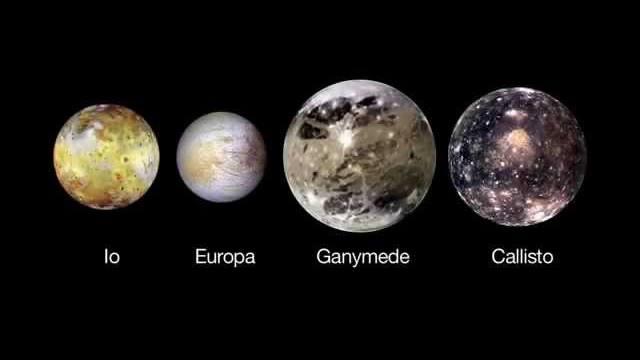
Jupiter’s Moons – The Galilean Moons (Source: UYDU)
Although Jupiter is impressive in size and atmospheric structure, its potential to directly support life is extremely low. The main reasons are its lack of a solid surface, its atmosphere’s extreme pressure and temperature, and its surrounding intense radiation belts. While some layers in Jupiter’s upper atmosphere — at about 50 kilometers altitude — have temperature and pressure conditions somewhat similar to those on Earth, the stability and persistence of these conditions are very low. Moreover, the high wind speeds and chemical composition (such as ammonia, methane and hydrogen sulfide) in these regions are inhospitable to life.
However, some scientists have proposed that microbial life might exist in transient, short-lived forms within Jupiter’s thick atmospheric layers. This idea is based on the “atmospheric plankton” hypothesis proposed by scientists such as Carl Sagan and Edwin Salpeter in the 1970s. According to this model, microscopic organisms might survive temporarily in atmospheric layers with sufficient energy and chemical diversity. However, this remains purely theoretical; no observational or experimental evidence has yet confirmed this hypothesis.
Nevertheless, some of Jupiter’s moons — particularly Europa, Ganymede and Callisto — are considered far more promising targets for life because they are believed to harbor subsurface liquid water oceans. The presence of water, combined with potential chemical energy sources and tidal heating, suggests the possibility of environments analogous to Earth’s hydrothermal vents.
Thus, scientific focus has shifted from the planet itself to its moons.
Since ancient times, Jupiter has been one of the brightest objects in the night sky and has held an important place in the mythology of many civilizations. The ancient Romans named this giant planet after their king of the gods, Jupiter (Iuppiter), who corresponds to Zeus in Greek mythology. Jupiter was regarded as the god of the sky and thunder and became a symbol of divine power and political authority. Roman emperors frequently identified themselves with Jupiter to legitimize their divine authority. Temples, victory ceremonies and inscriptions reinforced this connection as part of imperial ideology.
In ancient Babylon, Jupiter was associated with the god Marduk. Marduk was revered as the god of creation and order, and Jupiter’s grand and powerful motion in the sky made it a symbol of cosmic order. In China, Jupiter was called the “Year Star” and formed the basis of the 12-year zodiac system. Each year was named according to Jupiter’s position in the sky, playing a major role in astrological time calculations.
In modern astrology, Jupiter is associated with luck, abundance, expansion and wisdom. In birth charts, Jupiter’s position is believed to indicate a person’s belief systems, learning style and potential for growth in life. It is described as the “great benefic”; in contrast to Saturn’s restrictive nature, Jupiter is seen as a force that brings opportunities, development and expansion.
This multi-layered symbolic past demonstrates that Jupiter has left a deep mark on human history not only through its physical size but also through its cultural and intellectual influence. Its brightness and regular motion in the sky have made it an object interpreted both scientifically and spiritually as a celestial body.
Agreicius, and Agreicius. “Jupiter.” NASA Science, March 12, 2025.https://science.nasa.gov/jupiter/.
BBC Earth Science. "Jupiter: The Largest Planet in Our Solar System | BBC Earth Science." YouTube, May 12, 2024.https://www.youtube.com/watch?v=-AakWzvAgRM.
Beard, M., North, J., & Price, S. (1998). Religions of Rome: Volume 1. Cambridge University Press.
Bolton, S. J. et al. (2017). Jupiter's interior and deep atmosphere: The Juno mission. Space Science Reviews, 213(1–4), 5–37.
Bolton, S. J., et al. (2017). Juno Observes Jupiter’s Magnetosphere and Aurora. Science, 356(6340), 821–825.
Ceres, and Ceres. “Jüpiter’in Uyduları ve Keşifleri.” *Uzay ve Astronomi Bilgi Kaynağı*, March 2, 2021.https://www.uzay.co/jupiterin-uydulari-ve-kesifleri/.
Connerney, J. E. P., et al. (2018). A New Model of Jupiter’s Magnetic Field from Juno’s First Nine Orbits. Geophysical Research Letters, 45(6), 2590–2596.
Connerney, J. E. P., et al. (2018). A New Model of Jupiter’s Magnetic Field from Juno’s First Nine Orbits. Geophysical Research Letters, 45(6), 2590–2596.
Dyal, P., et al. (1981). Magnetic Field Measurements by Pioneer 10 and 11. Journal of Geophysical Research.
Guillot, T. (1999). Interior of Giant Planets Inside and Outside the Solar System. Science, 286(5437), 72–77.
Hand, K. P., & Chyba, C. F. (2007). Empirical constraints on the salinity of the europan ocean and implications for a thin ice shell. Icarus, 189(2), 424–438.
Helled, R., Anderson, J. D., Podolak, M., & Schubert, G. (2011). Interior models of Jupiter: A comparative study. The Astrophysical Journal, 726(1), 15.
Johnson, T. V., & Soderblom, L. A. (2003). Galileo Mission to Jupiter. Nature, 424, 769–770.
Kivelson, M. G., et al. (2002). The Permanent and Inductive Magnetic Moments of Ganymede. Icarus, 157(2), 507–522.
Lodders, K. & Fegley, B. (1998). The Planetary Scientist's Companion. Oxford University Press.
Lopes, R. M. C., et al. (2004). Io After Galileo: A New View of Jupiter’s Volcanic Moon. Springer.
NASA Solar System Exploration – Jupiter Moons:https://solarsystem.nasa.gov/moons/jupiter-moons/overview/
NASA – Jupiter Overview:https://solarsystem.nasa.gov/planets/jupiter/overview/
NASA. (2024). *Jupiter - Solar System Exploration*.https://solarsystem.nasa.gov/planets/jupiter/overview/
Nichols, J. D. et al. (2017). Jupiter’s Aurora: Recent Discoveries. Nature Astronomy, 1, 596–602.
North, J. (2008). Cosmos: An Illustrated History of Astronomy and Cosmology. University of Chicago Press.
Pankenier, D. W. (2013). Astrology and Cosmology in Early China: Conforming Earth to Heaven. Cambridge University Press.
Rogers, J. H. (1998). Origins of the ancient constellations: I. The Mesopotamian traditions. Journal of the British Astronomical Association, 108(1), 9–28.
Roth, L., et al. (2014). Transient Water Vapor at Europa’s South Pole. Science, 343(6167), 171–174.
Sagan, C., & Salpeter, E. E. (1976). Particles, Environments, and Possible Ecologies in the Jovian Atmosphere. The Astrophysical Journal Supplement Series, 32, 737–755.
Sasportas, H. (1985). The Twelve Houses. Wessex Astrologer Ltd.
Seager, S. (2010). Exoplanet Atmospheres: Physical Processes. Princeton University Press.
Sheppard, S. S., et al. (2003). An Abundant Population of Small Irregular Satellites Around Jupiter. Nature, 423, 261–263.
Showman, A. P. & Ingersoll, A. P. (1998). Interpretation of Galileo probe data and implications for Jupiter’s atmospheric dynamics. Icarus, 132(2), 205–220.
Showman, A. P., & Malhotra, R. (1999). Tidal Evolution into the Laplace Resonance and the Resurfacing of Ganymede. Science, 286(5437), 77–84.
Smith, B. A., et al. (1979). The Jupiter System Through the Eyes of Voyager 1. Science, 204(4396), 951–972.
Turcan, R. (1996). The Cults of the Roman Empire. Blackwell Publishing.
Van Helden, A. (1995). Galileo and the Telescope. University of Chicago.
Van Helden, A. (1995). Galileo and the Telescope. University of Chicago.
Yeomans, D. K. (1995). Great Red Spot on Jupiter. NASA/JPL.

Jupiter, the Giant of the Solar System
Type | Gas Giant | ||||||||
|---|---|---|---|---|---|---|---|---|---|
Distance from the Sun | ~778 million km (5.2 AU) | ||||||||
Diameter | 142984 km (11 times Earth's diameter) | ||||||||
Mass | 1.898 × 10²⁷ kg (318 times Earth's mass) | ||||||||
Orbital Period | 11.86 Earth years | ||||||||
Rotation Period | 9 hours 56 minutes | ||||||||
Surface Temperature (Average) | -145 °C | ||||||||
Moons | 95+ (Io, Europa, Ganymede, Callisto are prominent) | ||||||||
Rings | Has thin and faint rings | ||||||||
Primary Component | Hydrogen (%90) and Helium (%10) | ||||||||
Physical and Structural Properties
Magnetic Field
Observation and Space Missions
Moons
Could There Be Life on Jupiter?
Cultural and Mythological Significance