


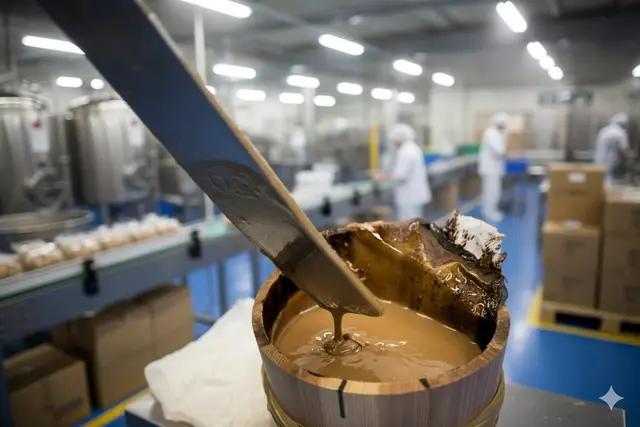
Joboji Urushi (Generated by Artificial Intelligence)
Name(s) | Joboji Urushi | ||||||||
|---|---|---|---|---|---|---|---|---|---|
Class | Others | ||||||||
Applicant | Iwate Prefectural Joboji Urushi Production Association | ||||||||
Main Production Area | Iwate Prefecture, Aomori Prefecture, Certain areas of Akita Prefecture | ||||||||
Joboji Urushi, a traditional and cultural material from Japan, is a special type of lacquer that boasts superior hardness and durability after curing. Obtained from the sap of the lacquer tree, this product has been widely used in the repair and restoration of historical architecture, national treasures, and cultural assets that have represented Japan for centuries.
The production area for Joboji Urushi covers Iwate Prefecture, Aomori Prefecture, and parts of Akita Prefecture. These areas include all of Iwate Prefecture; Sannohe District, Hachinohe City, and Towada City in Aomori Prefecture; and Kosaka Town, Kazuno City, and Odate City in Kazuno District in Akita Prefecture. Joboji Urushi was registered as a Geographical Indication (GI) on December 27, 2018, with registration number 73. The applicant and address are Iwate Prefectural Joboji Urushi Production Association, 37-4 Shimomaeda, Joboji-machi, Ninohe City, Iwate Prefecture.
About Joboji Urushi (地理的表示産品情報発信サイト)
The regions where Joboji Urushi is produced have a long history of striving to create suitable conditions for the cultivation of lacquer trees, beginning with the Morioka Principality's promotion of lacquer tree cultivation during the Edo period (1603-1867). During the Meiji period (1868-1912), producers adopted the technique of regenerating lacquer forests by managing the shoots from felled trees. With these techniques, producers have continued to protect the lacquer forests that produce Joboji Urushi, preserving the country's largest lacquer resource to this day.
Joboji Urushi is harvested by artisans known as urushi kaki shokunin, or lacquer collectors , who make their living primarily by collecting lacquer sap . Shipping standards require that the lacquer "not be intentionally adulterated with foreign substances for purposes such as embossing" and "not be mixed with lacquers other than Joboji Urushi." Lacquer that meets these standards is shipped as arami-urushi (extracted lacquer sap) and ki-urushi (raw lacquer). Artisans in the production area produce a wide variety of lacquer types, reflecting their individual characteristics and techniques.
Information Website on Japan Geographical Indication Products. “Joboji Urushi.” Information Website on Japan Geographical Indication Products. Accessed October 24, 2025. https://pd.jgic.jp/en/register/entry/73.html.
Ministry of Agriculture, Forestry and Fisheries (MAFF). “Joboji Urushi (Registration No. 73).” Ministry of Agriculture, Forestry and Fisheries (MAFF). Accessed October 24, 2025. https://www.maff.go.jp/e/policies/intel/gi_act/register/s73.html.
地理的表示産品情報発信サイト. "73 Joboji Urushi." YouTube video. February 25, 2020. 02:19. Accessed October 24, 2025. https://www.youtube.com/watch?v=wwLsaKF8XJ8.

Joboji Urushi (Generated by Artificial Intelligence)
Name(s) | Joboji Urushi | ||||||||
|---|---|---|---|---|---|---|---|---|---|
Class | Others | ||||||||
Applicant | Iwate Prefectural Joboji Urushi Production Association | ||||||||
Main Production Area | Iwate Prefecture, Aomori Prefecture, Certain areas of Akita Prefecture | ||||||||
Production Area and Geographical Indication
History and Traditional Production
Production Process and Standards
This article was created with the support of artificial intelligence.