


This article was automatically translated from the original Turkish version.
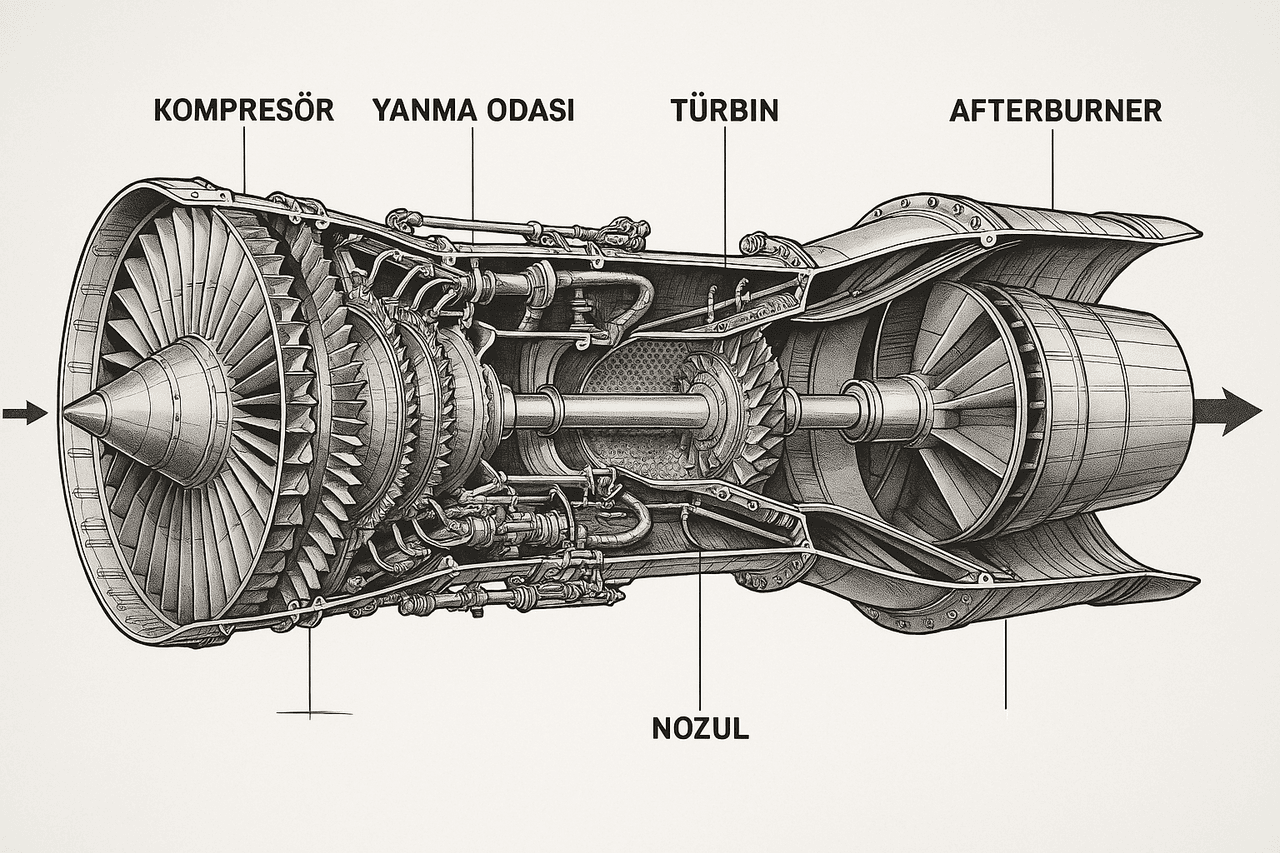
Jet Engine
Definition | A type of engine that generates thrust by burning a compressed air-fuel mixture according to the action-reaction principle | ||||||||
|---|---|---|---|---|---|---|---|---|---|
Date of Discovery | 1939 (Hans von Ohain – first flight) 1930 (Frank Whittle) | ||||||||
Precursor | Reaction rockets (China – 1232 AD) Aeolipile (Heron – 250 AD) | ||||||||
Application Area | Military and civilian aircraft Missiles UAVs Helicopters Some ground vehicles | ||||||||
Principle(s) of Operation | Newton's third law of motion (action-reaction) | ||||||||
Main Component | Compressor Exhaust/nozzle Turbine Combustion chamber Air intake | ||||||||
Fuel Types | JP-4 JP-8 (military) Jet-B (civilian) Jet-A | ||||||||
Engine Types | Turboshaft Turbofan Turbojet Ramjet Scramjet Pulsejet Turboprop | ||||||||
Developer | Frank Whittle (United Kingdom) Hans von Ohain (Germany) | ||||||||
A jet engine is a type of internal combustion engine based on Newton’s third law of motion, namely the action-reaction principle. These engines take in air, use the oxygen from it to burn fuel, and expel the resulting high-temperature and high-pressure gases rapidly from the rear, thereby generating thrust that propels the attached vehicle forward.
Jet engines are also known as reaction engines or gas turbines. In their simplest definition, they operate on the principle of “obtaining forward thrust by compressing atmospheric air, mixing it with fuel, igniting the mixture, and ejecting the resulting gases at high velocity in the opposite direction.” This thrust enables the jet engine to accelerate the aircraft forward.
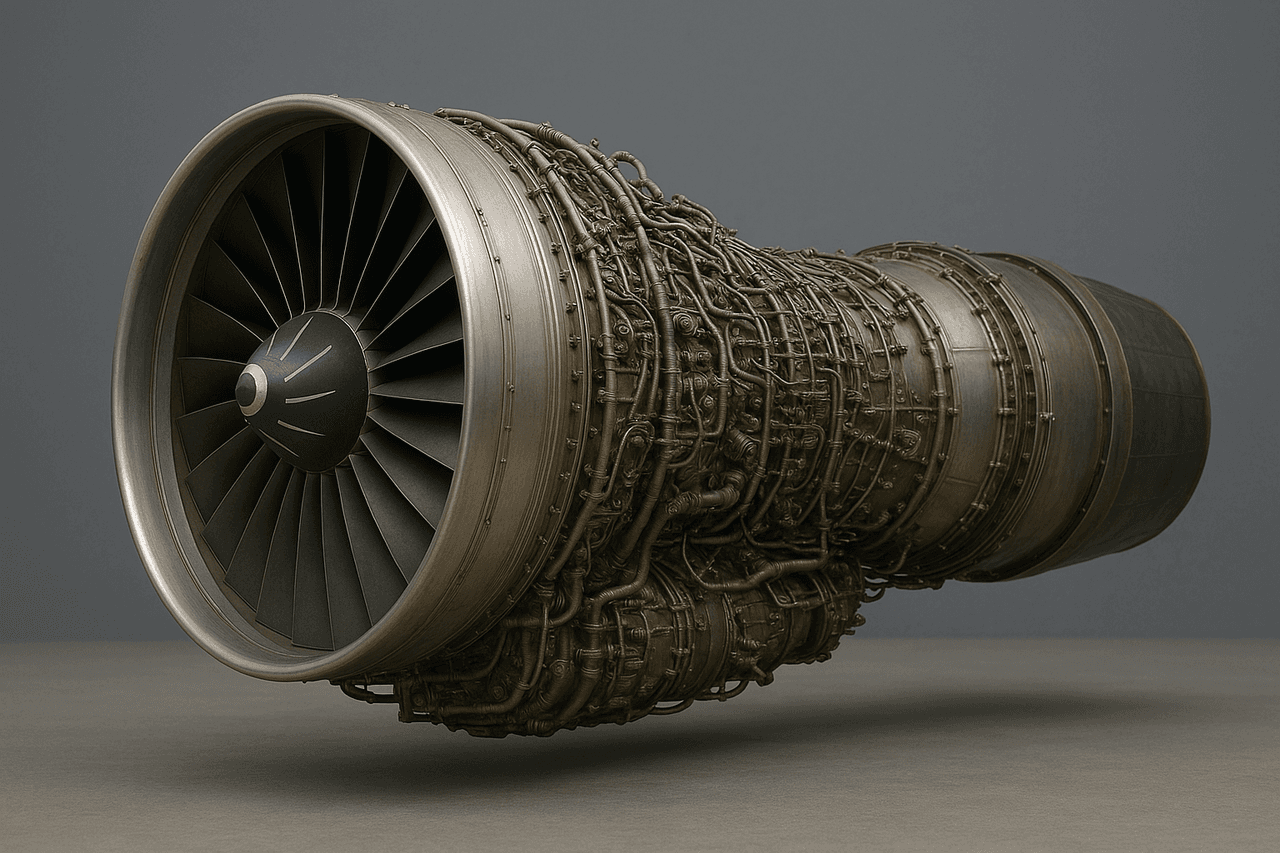
Generated with the help of artificial intelligence.
Jet engines are regarded as one of the most important inventions in aviation history. Developed since the 1930s, these engines have established their place in history as technologies symbolizing power and speed. They enabled the modernization of military aircraft; jet aircraft, missiles, unmanned aerial vehicles (UAVs), model rockets, rocket engines, and even some high-speed land vehicles have employed them. Additionally, they have found application in industrial gas turbines and the maritime sector.
Jet engines are systems used in both military and civil aviation, enabling powerful, fast, and high-altitude flight. They are known for being highly complex from an engineering standpoint yet based on a simple and effective working principle.
The history of the jet engine is a technological development process that extends far beyond the 20th century. The origins of systems operating on gas reaction date back to the Chinese use of fireworks around 3000 BCE. The “aeolipile,” a spherical device developed by Hero of Alexandria in 250 CE that rotated due to steam escaping through curved pipes, is considered the first mechanical system powered by gas reaction. In 1232 CE, the Chinese used gas-reactive rockets as weapons during the Battle of Kaifengfu.
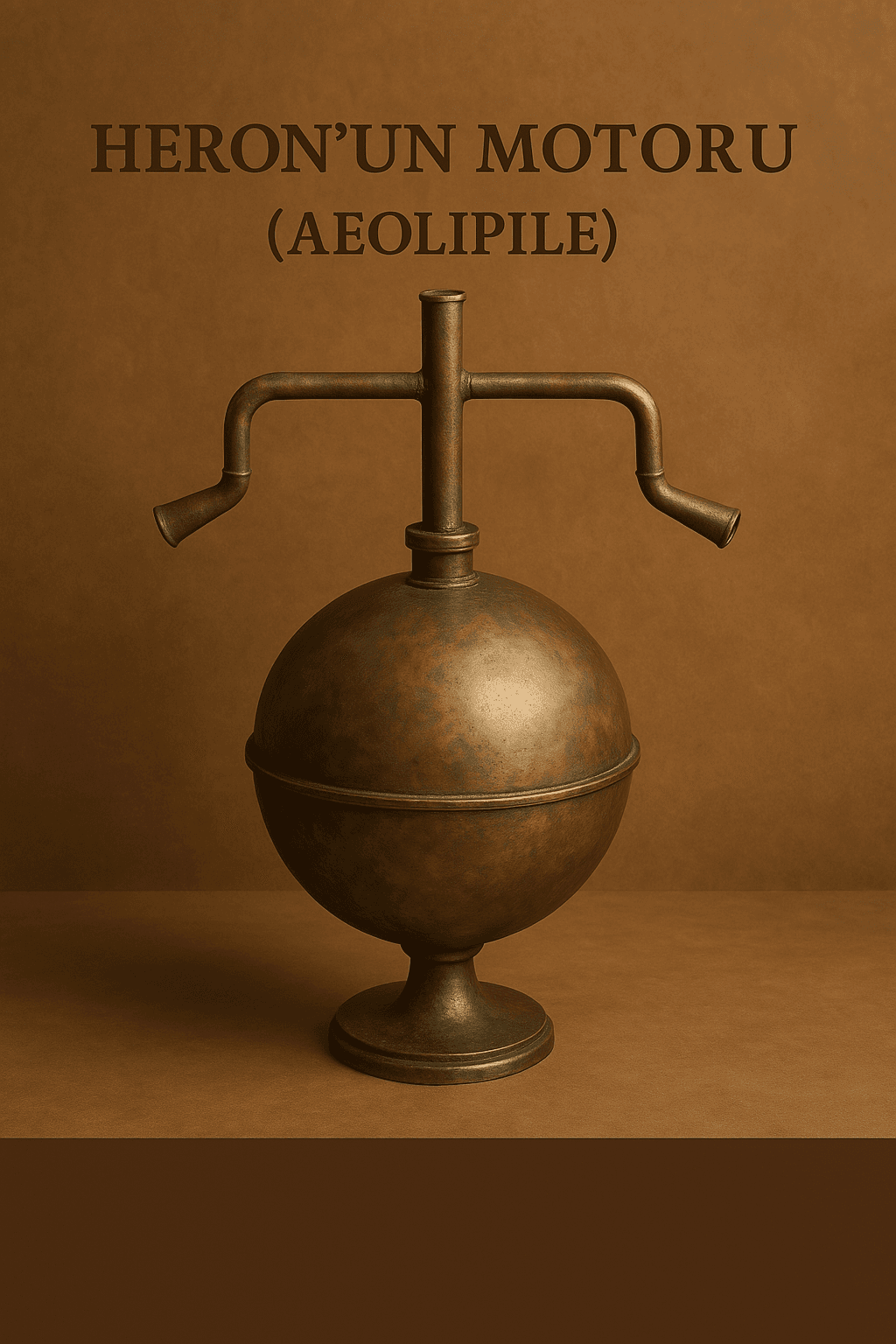
Generated with the help of artificial intelligence.
Frank Whittle patented his gas turbine-based engine design in 1930. In 1936, he founded the company “Power Jets Ltd.” to begin its development. The first engine test was conducted in 1937. Initial technical problems were encountered; however, these were resolved by 1938. The first jet aircraft, the Gloster E-28/39, developed with support from the British government, was successfully flown on 15 May 1941 using the Power Jets W.1 engine. Whittle was granted the title of “Sir” in 1948 for this invention.
Hans von Ohain began his work on turbojets while earning his doctorate at the University of Göttingen in Germany. In 1937, he tested the first prototype powered by hydrogen fuel and achieved successful results. These developments attracted the attention of Ernst Heinkel, who supported the development of the “He S-3” engine for the Heinkel He 178 aircraft. On 27 August 1939, this jet-powered aircraft completed the world’s first jet engine flight, piloted by Erich Warsitz.
A brief summary of jet engine history is as follows:
Jet engines operate according to Newton’s third law of motion, known as the action-reaction principle. This law states that “for every action, there is an equal and opposite reaction.” In jet engines, this principle is realized when high-pressure hot gases expelled from the rear of the engine push the engine—and thus the aircraft—forward.
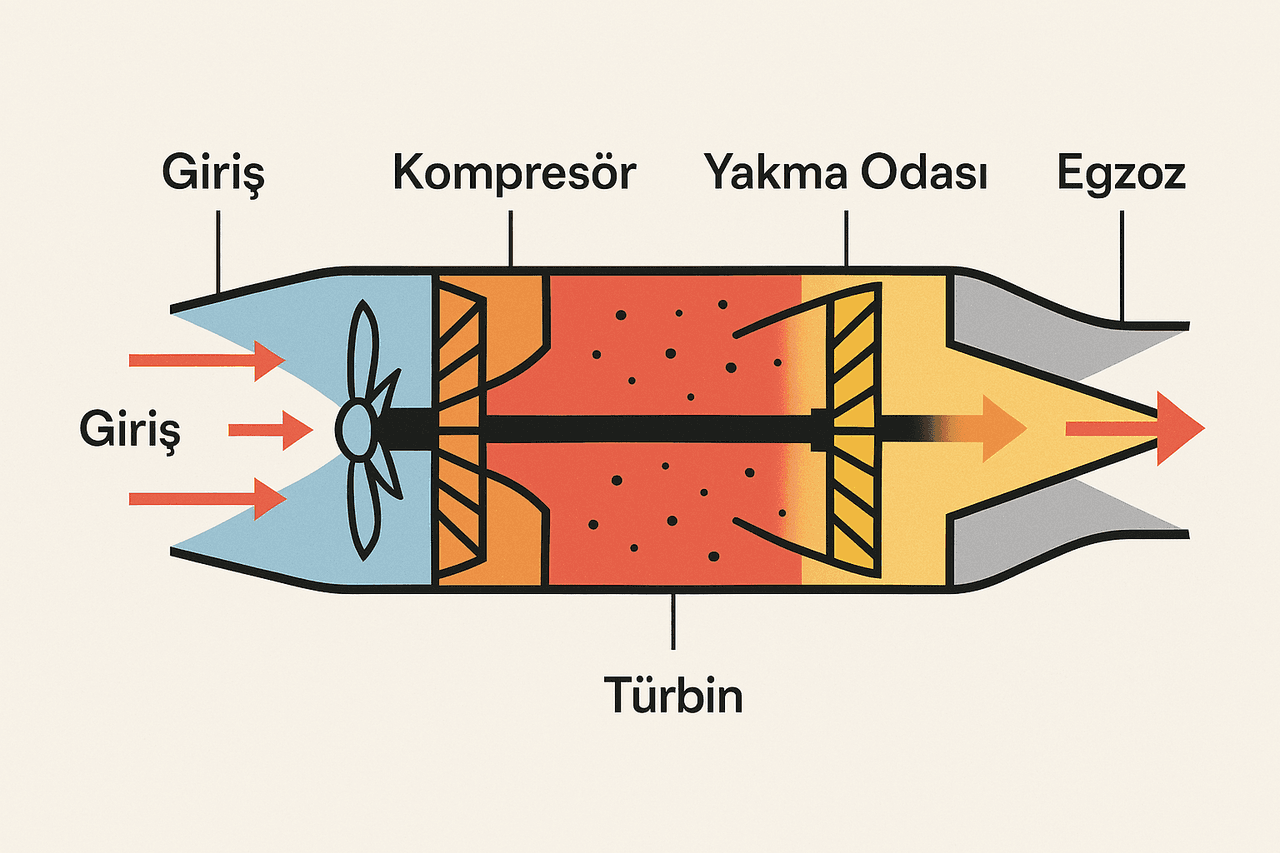
Generated with the help of artificial intelligence.
The basic operating cycle of a jet engine proceeds through the following steps:
1. Air Intake (Air Inlet): Atmospheric air entering the engine through the intake at the front of the aircraft is directed through specially shaped inlet ducts designed for subsonic or supersonic flight conditions.
2. Compressor (Compressor): Air is compressed by rotating disks and blades made of high-strength materials such as titanium mounted on the engine shaft. This compression reduces the air’s volume while increasing its pressure and temperature. In modern jet engines, the compression ratio can reach up to 40:1.
3. Combustion Chamber (Combustion Chamber): High-pressure, heated air enters the combustion chamber, where a spark is generated via igniters, igniting the fuel-air mixture. As a result, the temperature and energy of the gases increase dramatically.
4. Turbine (Turbine): High-pressure, high-temperature gases are directed toward the turbine. The turbine rotates using the energy of these gases and drives the shaft, which in turn powers the compressor and the inlet fan.
5. Exhaust and Nozzle (Exhaust & Nozzle): Gases exiting the turbine pass through the exhaust pipe and are ejected at high velocity through the nozzle, generating forward thrust. In some engines, an afterburner (afterburner section) is used to increase thrust by injecting additional fuel into the exhaust stream to produce extra propulsion.
This cycle repeats continuously while the engine is operating, ensuring uninterrupted thrust production by the jet engine.
Fuels used in jet engines are generally based on kerosene and are formulated to have a high flash point and low volatility. The main fuel types are:
Each jet engine type and mission profile is designed to operate at maximum efficiency with a specific fuel type. Fuel measurements are typically made in pounds (lb).
Jet engines are complex yet effective systems requiring the coordinated operation of numerous subsystems, from fan geometry to combustion chamber design, turbine blade orientation, and exhaust shape.
Jet engines are classified into different types based on their structure and operating principles. Fundamentally, they are divided into “turbo” and “jet” types depending on whether they contain rotating components.
Turbojet engines are the simplest and earliest developed type of jet engine. In these engines, air is drawn in from the front, compressed by a compressor, mixed with fuel and ignited in the combustion chamber, and then expelled at high energy through the turbine and nozzle. The turbine drives the compressor to sustain continuous operation. Turbojets are effective at high speeds but suffer from disadvantages such as high fuel consumption, excessive noise, and inefficiency at low speeds. Today, they are primarily used in military aircraft and missiles.
Turbofan engines are developed by adding a large fan to the turbojet system. This fan at the inlet divides the airflow into two streams: one passes through the engine core, while the other bypasses the core. This bypass air is also expelled at high velocity, providing additional thrust. Turbofan engines operate more quietly, consume less fuel, and are suitable for long-range, subsonic flights. They are the most common type of jet engine used in civil aviation today.
Turboprop engines have a core similar to a turbojet but direct most of the energy from the turbine to a propeller. This propeller operates efficiently at low speeds. Fuel efficiency is high at speeds below 800 km/h. They are commonly used in regional passenger aircraft, training aircraft, and military cargo aircraft. The first turboprop engine was developed by Gyorgy Jendrassik in 1938.
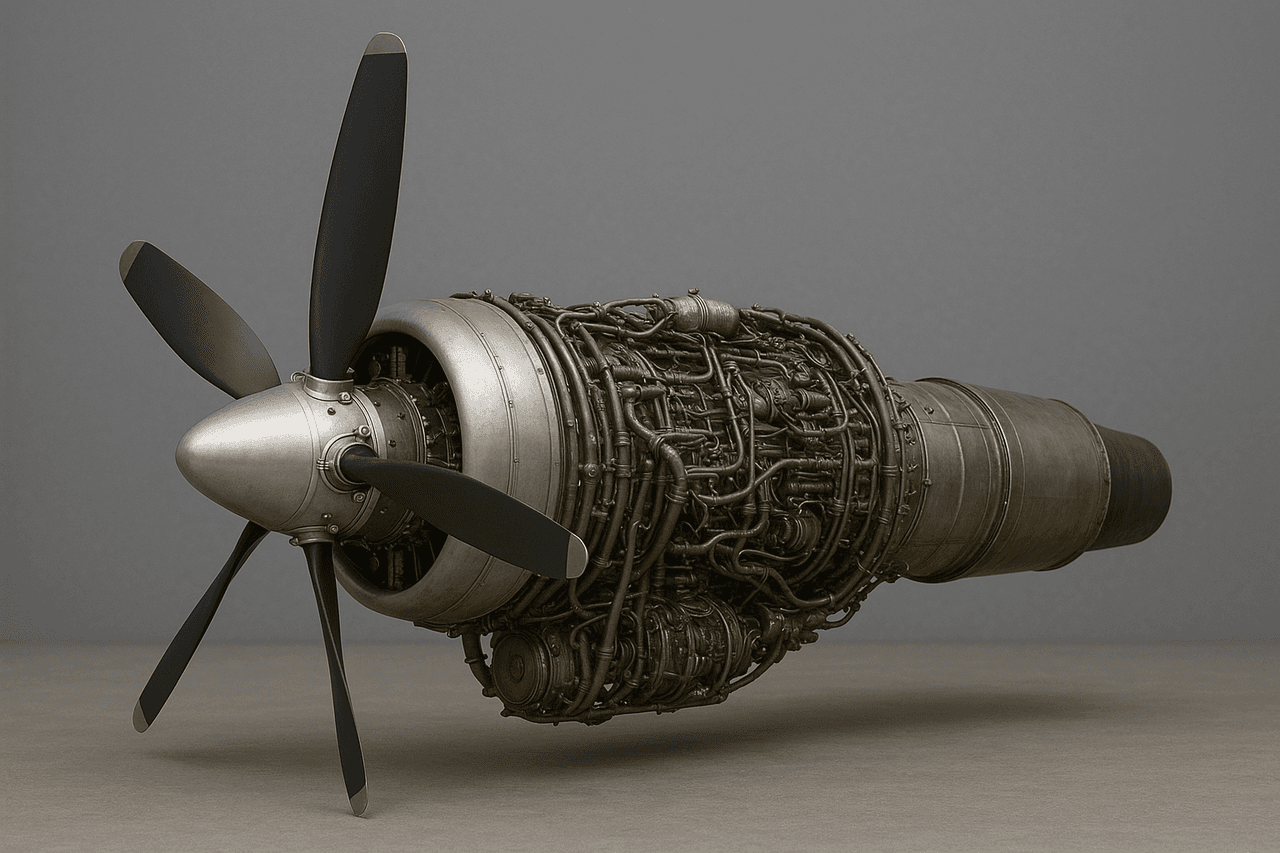
Generated with the help of artificial intelligence.
Turboshaft engines are similar in principle to turboprop engines; however, their purpose is not thrust but mechanical power generation. The generated power is typically transferred to a helicopter rotor or a generator. The power shaft rotates the output via a gearbox. Rotor speed can be regulated independently of the gas generator. This is the most common engine type used in helicopters.
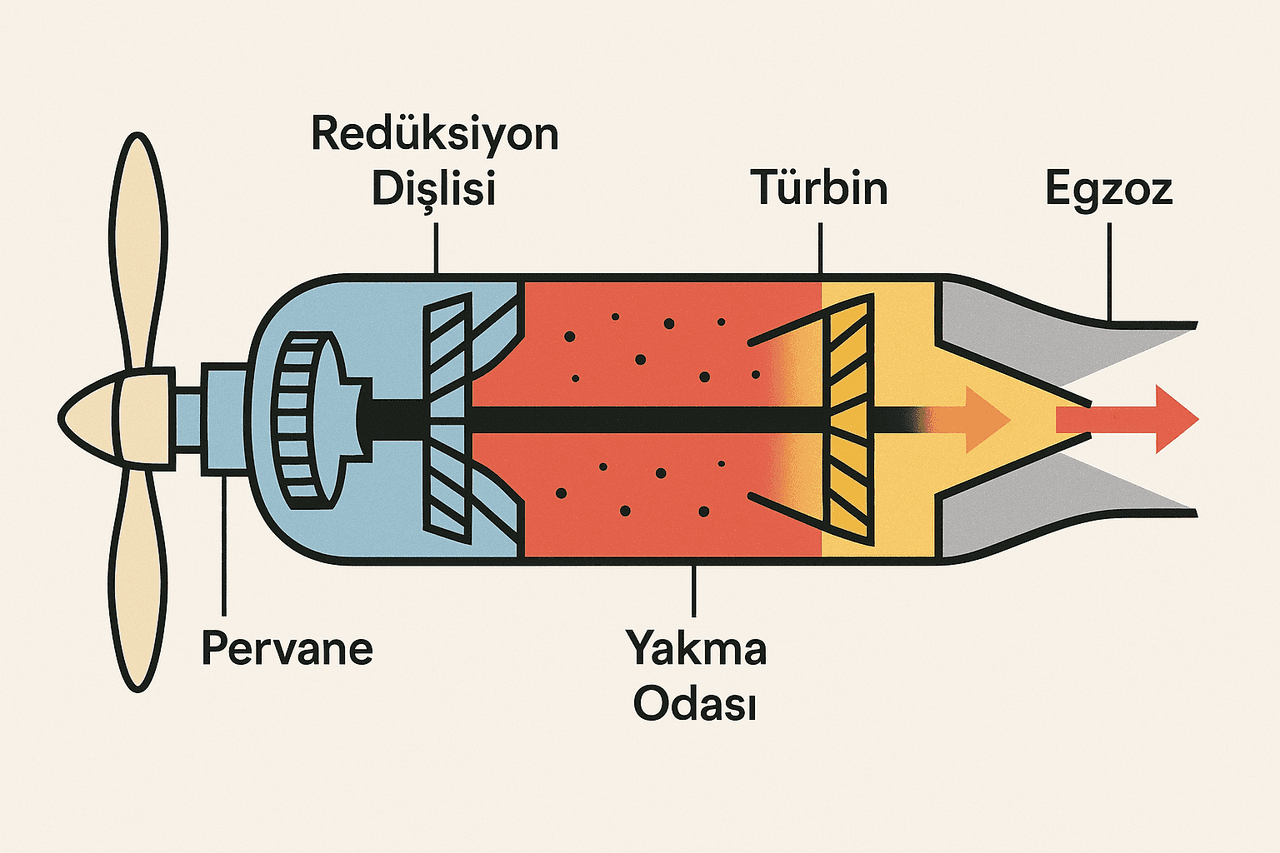
Generated with the help of artificial intelligence.
Ramjet engines are the simplest type of jet engine and contain no moving parts. They can only operate while moving forward at sufficient speed to compress incoming air. Therefore, they require an external booster for takeoff. Ramjet engines are preferred in pre-accelerated systems such as guided missiles and hypersonic platforms. While effective at high speeds, they cannot operate at low speeds or when stationary.
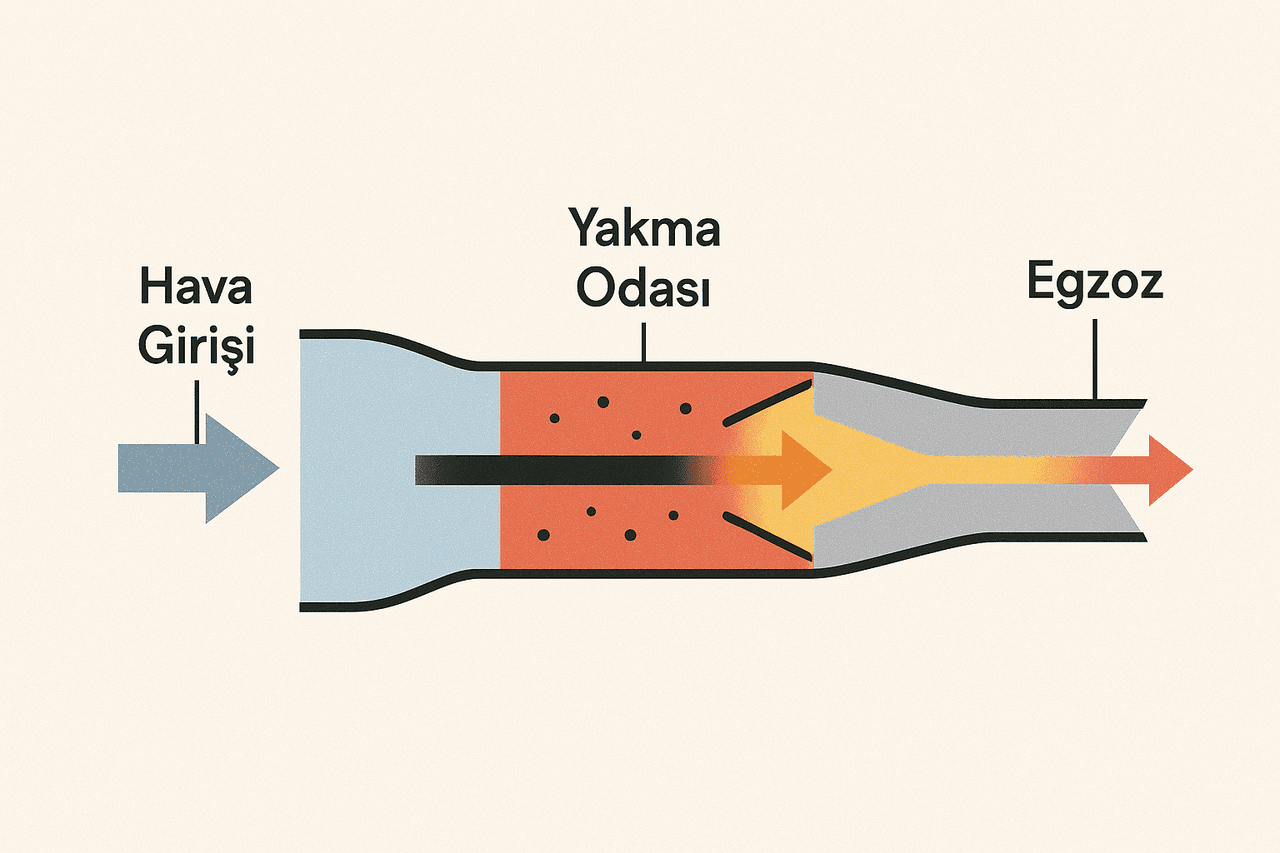
Generated with the help of artificial intelligence.
Scramjet engines are an advanced version of the ramjet system. The key difference is that combustion occurs at supersonic speeds. Like ramjets, they require the aircraft’s speed to compress air and can operate at very high speeds (Mach 5 and above). They have been used in hypersonic flight projects such as NASA’s X-43A. They contain very few moving parts.
Pulsejet engines are simple jet engines that operate through periodic explosive pulses. They come in valved and valveless variants. Their first applications were in German V-1 missiles during World War II. Their construction is very simple, and some models can operate statically. Due to their ease of operation with combustible gases and low cost, they are sometimes preferred in experimental projects or simple UAVs.
Each of these jet engine types has been developed to meet specific requirements of altitude, speed, efficiency, and operational purpose. Today, most passenger aircraft use turbofan engines, military aircraft use turbojet and turbofan engines, helicopters use turboshaft engines, and missiles use ramjet and scramjet engines.
Cumpsty, N., and A. Heyes. Jet Propulsion: A Simple Guide to the Aerodynamic and Thermodynamic Design and Performance of Jet Engines. 2nd ed. Cambridge, U.K.: Cambridge University Press, 2015.
Gunston, Bill. Jet Propulsion: A Century of Jet Power. Marlborough, U.K.: The Crowood Press, 2006.
Hünecke, Klaus. Jet Engines: Fundamentals of Theory, Design and Operation. 2nd ed. St. Paul, MN: Motorbooks International, 1997.
Jenkins, Dennis R. Lockheed SR-71 Blackbird: The Illustrated History of America's Legendary Mach 3 Spy Plane. St. Paul, MN: Motorbooks International, 2001.
Rolls-Royce. The Jet Engine. 5th ed. Derby, U.K.: Rolls-Royce plc, 2005.
Saravanamuttoo, H. I. H., G. F. C. Rogers, and H. Cohen. Gas Turbine Theory. 6th ed. London: Pearson Education, 2009.
Tenenbaum, M. J. "Rocket and Jet Propulsion Origins." In History of Rocketry and Space Travel, 3rd ed., edited by Wernher von Braun and Frederick I. Ordway, III. New York: Harper & Row, 1985.
Whittle, Frank. Gas Turbine Aero-Thermodynamics: With Special Reference to Aircraft Propulsion. Oxford, U.K.: Pergamon Press, 1981.
Wooldridge, E. T. Into the Jet Age: Conflict and Change in Naval Aviation, 1945–1975. Annapolis, MD: Naval Institute Press, 1995.

Jet Engine
Definition | A type of engine that generates thrust by burning a compressed air-fuel mixture according to the action-reaction principle | ||||||||
|---|---|---|---|---|---|---|---|---|---|
Date of Discovery | 1939 (Hans von Ohain – first flight) 1930 (Frank Whittle) | ||||||||
Precursor | Reaction rockets (China – 1232 AD) Aeolipile (Heron – 250 AD) | ||||||||
Application Area | Military and civilian aircraft Missiles UAVs Helicopters Some ground vehicles | ||||||||
Principle(s) of Operation | Newton's third law of motion (action-reaction) | ||||||||
Main Component | Compressor Exhaust/nozzle Turbine Combustion chamber Air intake | ||||||||
Fuel Types | JP-4 JP-8 (military) Jet-B (civilian) Jet-A | ||||||||
Engine Types | Turboshaft Turbofan Turbojet Ramjet Scramjet Pulsejet Turboprop | ||||||||
Developer | Frank Whittle (United Kingdom) Hans von Ohain (Germany) | ||||||||
History of the Jet Engine
Principle of Operation of the Jet Engine
Main Components of a Jet Engine
Fuels Used in Jet Engines
Types of Jet Engines
Turbojet
Turbofan
Turboprop
Turboshaft
Ramjet
Scramjet (Supersonic Combustion Ramjet)
Pulsejet