This article was automatically translated from the original Turkish version.
+1 More
Catalog Name | Sharpless 248 (Sh2-248) IC 443 | ||||||||
|---|---|---|---|---|---|---|---|---|---|
Constellation | Gemini (İkizler) | ||||||||
Distance(s) | 5 500 parsecs) 000 light-years (1 | ||||||||
Diameter | Approximately 70 light-years | ||||||||
Nebula Type | Supernova remnant (Supernova Remnant, SNR) | ||||||||
Discovery(ies) | Isaac Roberts 1895 | ||||||||
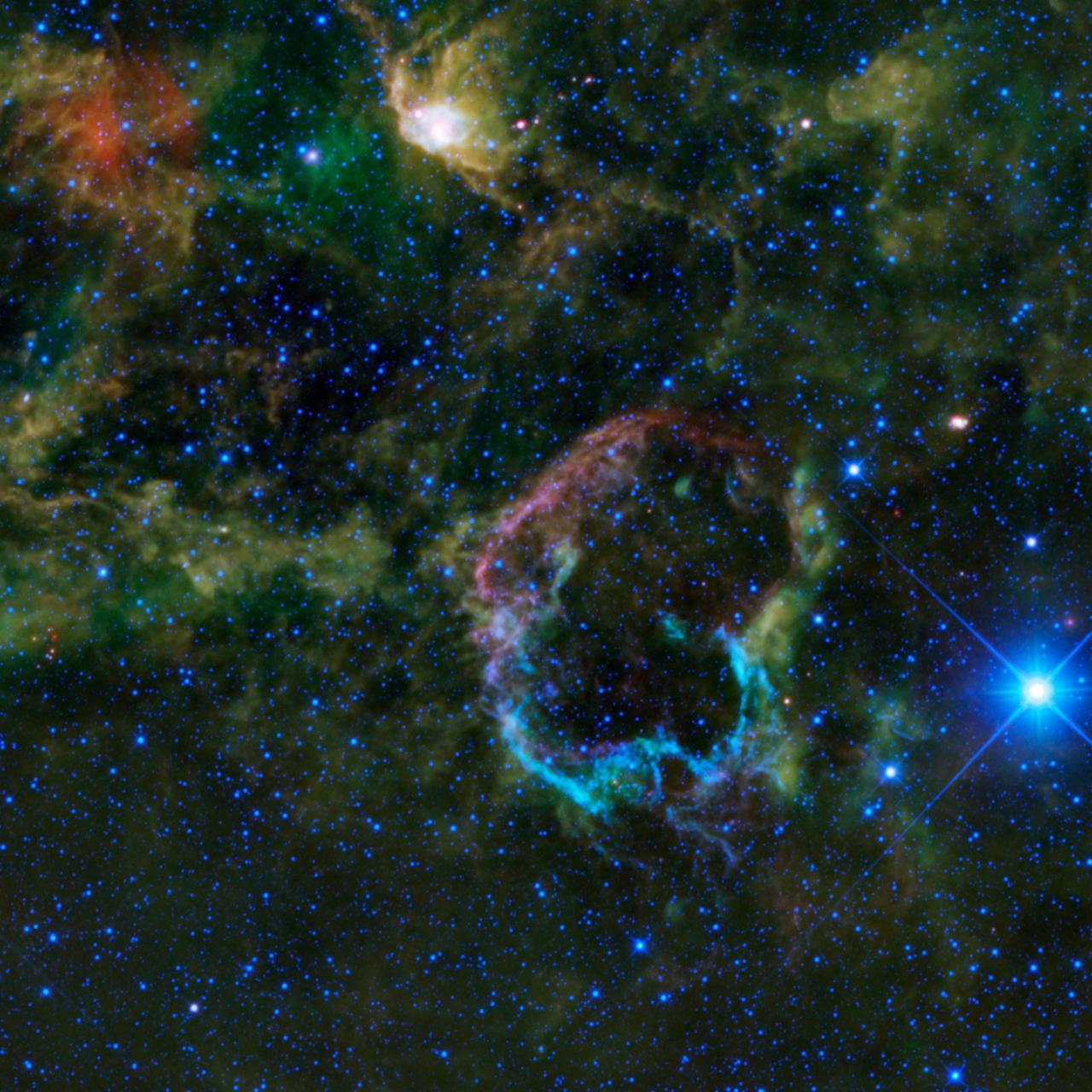
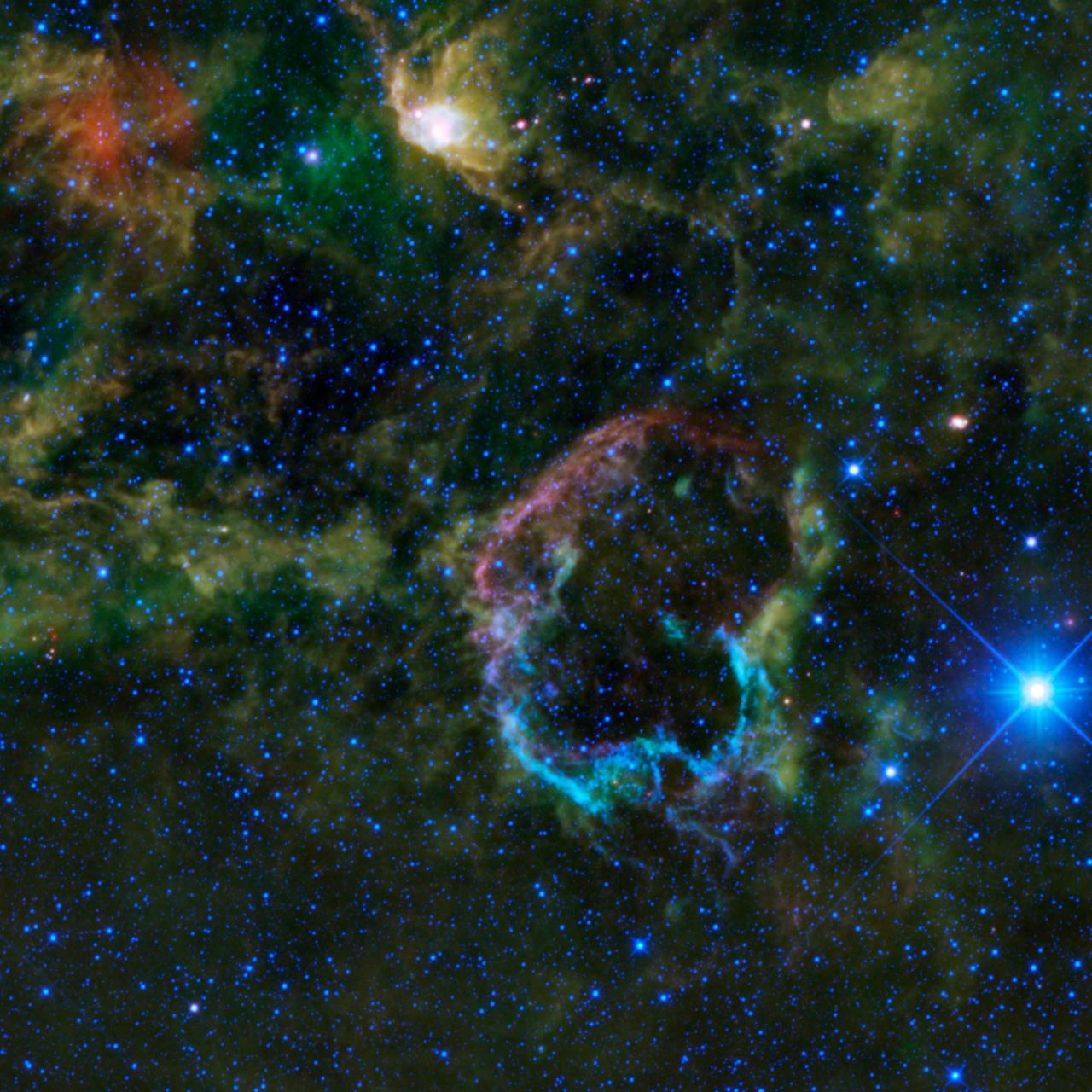
Jellyfish Nebula (IC 443), is a supernova remnant located approximately 5,000 light-years from Earth in the direction of the Gemini constellation. It has acquired this name due to its complex filamentary structures that resemble neural networks. The nebula has been studied in detail through observations across radio, visible, infrared, and X-ray wavelengths.
Brain Nebula (NASA)
IC 443 is the remnant of a supernova explosion that occurred between 3,000 and 30,000 years ago. The progenitor star is believed to have been a massive star, likely exceeding eight solar masses. The energy and plasma released by the explosion interacted with the surrounding interstellar medium to form the nebula’s current structure.
The shock waves produced by the explosion collided with nearby molecular gas and dust clouds, causing ionization and strong X-ray emission. These interactions have resulted in the observed multi-layered structure.
A neutron star candidate, designated CXOU J061705.3+222127, has been detected near the center of IC 443. It is thought to have formed as a result of the supernova. However, given its position and motion, different hypotheses have been proposed regarding its direct association with the supernova remnant.
The nebula exhibits an asymmetric morphology, suggesting that the supernova explosion occurred in a non-uniform interstellar environment. IC 443 consists roughly of two regions:
The filamentary structures are the result of Rayleigh-Taylor and Kelvin-Helmholtz instabilities triggered by the supernova shock wave’s interaction with the surrounding medium.
The nebula contains various ionized atoms and molecules. Spectroscopic analyses have detected the following components:
These emission lines provide information about plasma temperature and density. IC 443 serves as an important laboratory for understanding how supernova remnants interact with their surrounding environment. Much of the research on the following topics has been conducted using IC 443:
IC 443 has been studied in multiple observational campaigns by Hubble, Spitzer, Chandra, and other observatories. Observations across different spectral bands have led to the public release of various composite images.
NASA. “An Explosion of Infrared Color.” *NASA Jet Propulsion Laboratory.* Accessed July 16, 2025. https://www.jpl.nasa.gov/images/pia13449-an-explosion-of-infrared-color/.
NASA. “IC 443 – Jellyfish Nebula.” *NASA Science - 3D Resources.* Accessed July 16, 2025. https://science.nasa.gov/3d-resources/ic-443-jellyfish-nebula/.
NASA. “IC 443: The Jellyfish Nebula.” *Astronomy Picture of the Day*, December 26, 2023. Accessed July 16, 2025. https://apod.nasa.gov/apod/ap231226.html.

Catalog Name | Sharpless 248 (Sh2-248) IC 443 | ||||||||
|---|---|---|---|---|---|---|---|---|---|
Constellation | Gemini (İkizler) | ||||||||
Distance(s) | 5 500 parsecs) 000 light-years (1 | ||||||||
Diameter | Approximately 70 light-years | ||||||||
Nebula Type | Supernova remnant (Supernova Remnant, SNR) | ||||||||
Discovery(ies) | Isaac Roberts 1895 | ||||||||
No Discussion Added Yet
Start discussion for "Jellyfish Nebula (IC 443)" article
General Characteristics
Formation and Astrophysical Origin
Technical and Observational Properties
Pulsar Connection and Morphology
Astrochemical Content and Scientific Significance