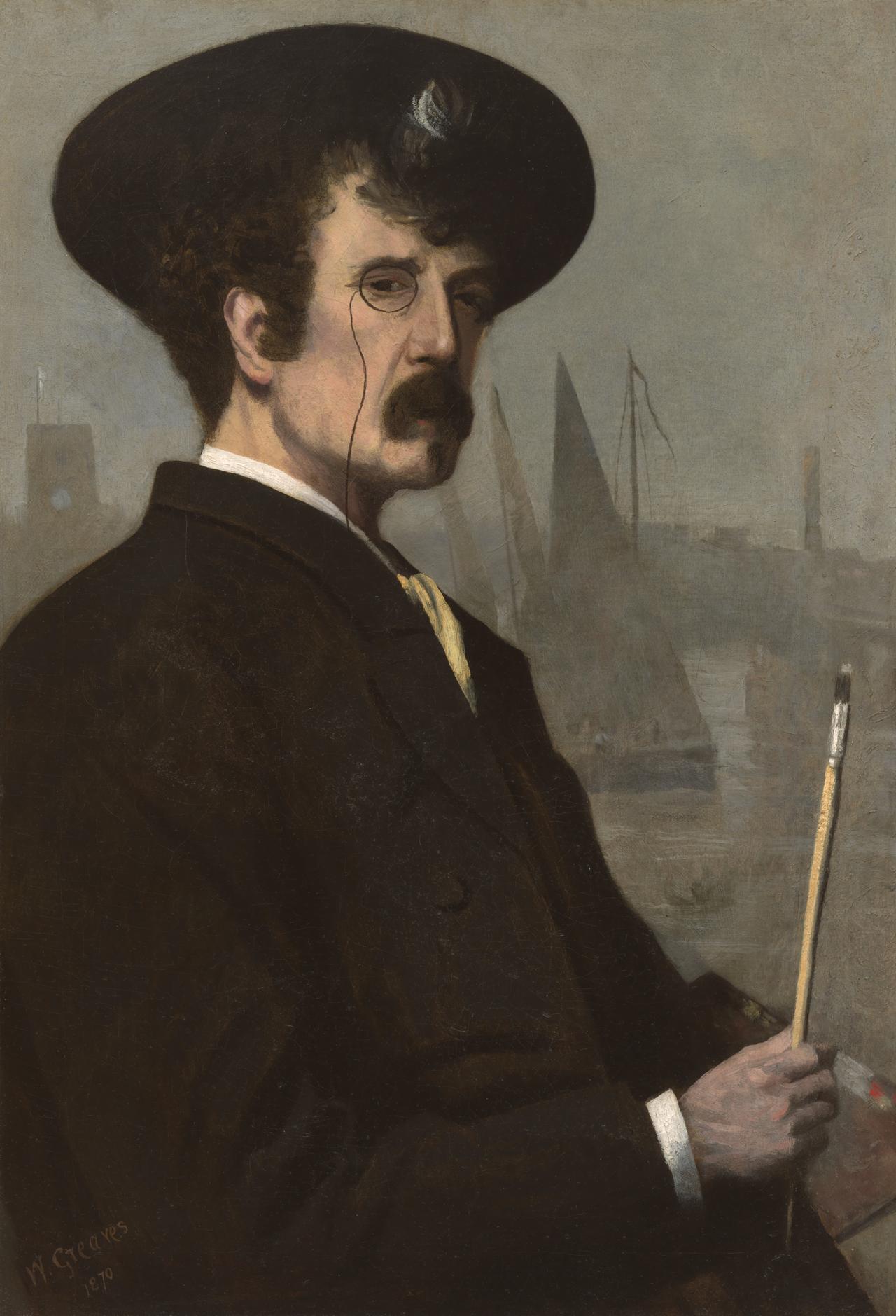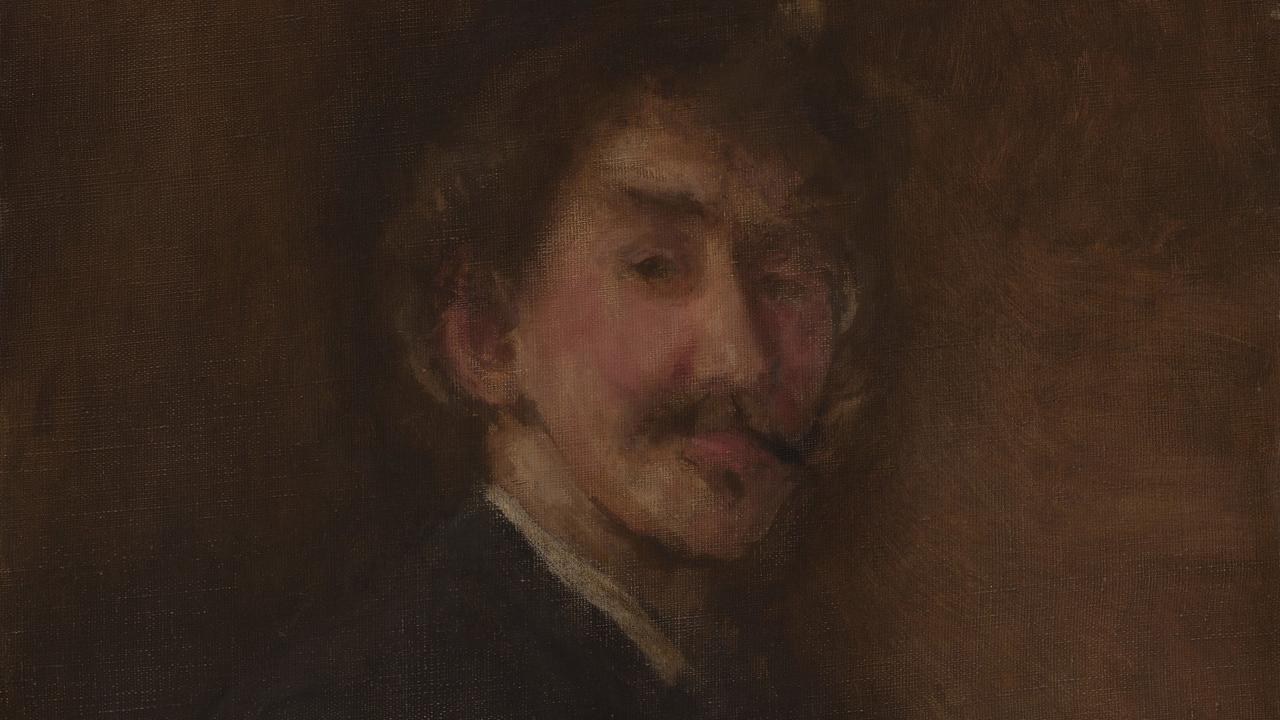
+1 More

Full Name | James Abbott McNeill Whistler | ||||||||
|---|---|---|---|---|---|---|---|---|---|
Date of Birth | 1834-07-10 | ||||||||
Place of Birth | Lowell - Massachusetts / USA | ||||||||
Date of Death | 1903-07-17 | ||||||||
Place of Death | London - United Kingdom | ||||||||
Nationality | American | ||||||||
Education | Charles Gleyre Atölyesi United States Military Academy - West Point École Impériale et Spéciale de Dessin | ||||||||
Field | Design (Interior) Lithography Engraving and Printmaking Painting | ||||||||
Movements / Influences | Art for Art’s Sake Realism Tonalism Japonism Aesthetic Movement | ||||||||
James McNeill Whistler (1834–1903) was an American painter, printmaker, and art theorist who exerted significant influence on the artistic milieu of Europe and America in the second half of the 19th century. Opposing the narrative-driven structure of Realism, he played a pivotal role in the development of modern art through approaches that emphasized formal and aesthetic qualities. His works offered an alternative to the traditional painting conventions of his time through titles derived from musical terminology and compositions inspired by Japanese art. Active in artistic circles in Paris and London, he became one of the leading figures of the Aesthetic Movement in England. His polemics and legal battles in defense of his artistic philosophy brought into question the social position and expressive freedom of the artist.
James McNeill Whistler was born in 1834 in Lowell, Massachusetts, United States. His father, George Washington Whistler, was a renowned railroad engineer; his mother was Anna Matilda McNeill Whistler. Whistler was the only surviving child among four brothers. He spent part of his childhood in Russia, where his father had been appointed as a consultant for the construction of the Saint Petersburg–Moscow railway by Tsar Nicholas I. From 1843 to 1848, he lived with his family in Saint Petersburg and took painting lessons at the Imperial Academy of Fine Arts.
After his father’s death in 1849, the family returned to the United States. Whistler was subsequently admitted to the United States Military Academy at West Point. There he studied drawing under Robert W. Weir but struggled in other subjects. He was dismissed from the academy in 1854 due to poor performance in chemistry. During this period he developed his drawing skills and briefly worked in the drawing department of the United States Coast and Geodetic Survey. It was during this assignment that he first encountered etching and engraving techniques.
In 1855 Whistler traveled to Paris to pursue formal art training. His proficiency in French, acquired during his childhood education in Saint Petersburg, was sufficient for his needs. In Paris he enrolled at the École Impériale et Spéciale de Dessin (Petite École) and in the atelier of Charles Gleyre, receiving an academic Beaux-Arts education. However, the influence of this training on his artistic development was limited. During his years in Paris he became acquainted with artists such as Gustave Courbet, Henri Fantin-Latour, Alphonse Legros, and Édouard Manet, establishing close ties with the avant-garde circles of the time. He was deeply influenced by the works of Dutch and Spanish Baroque masters—Rembrandt, Vermeer, De Hooch, and Velázquez—focusing on form, light, and surface organization. These influences would play a decisive role in Whistler’s art in subsequent years.
James McNeill Whistler moved to London in 1859, leaving Paris both to escape its intense competition and to establish himself more distinctly as an artist in England. London offered a less developed artistic environment than Paris, but this presented an advantage for Whistler. In England, a newly emerging middle-class collector base with limited cultural capital provided a receptive ground for an artist offering a different artistic vision.
After settling in London, Whistler initially continued working in a realist style influenced by Courbet. His painting Wapping, depicting everyday scenes along the River Thames, was exhibited by the Royal Academy and received favorable critical attention. However, the rejection of his 1862 painting Symphony in White, No. 1: The White Girl, portraying his lover Joanna Hiffernan, by the Royal Academy had a profound impact on the artist. This rejection marked the beginning of his departure from narrative realism toward formalist explorations.
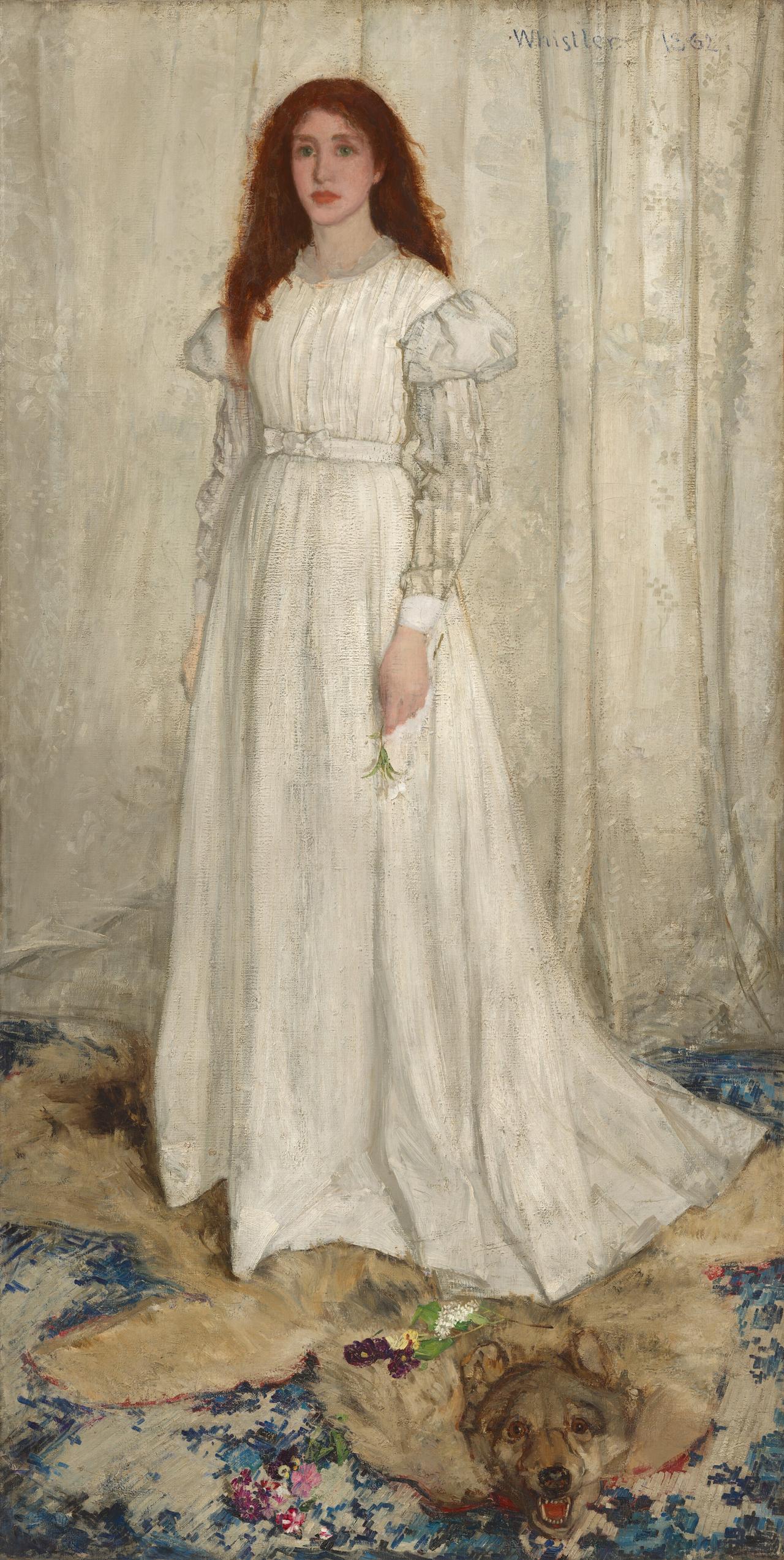
Symphony in White, No. 1: The White Girl (National Gallery of Art)
In his artistic transformation, Whistler moved away from direct representation of reality and focused instead on concepts such as visual harmony, tonal transitions, and aesthetic unity. During a period when Japanese art was beginning to gain recognition in Europe, Whistler became one of the first Western artists to show a strong interest in Japanese aesthetics. The compositional arrangements, formal simplicity, and economy of color found in Japanese woodblock prints profoundly shaped his artistic approach. He began to present figures and spaces through a symbolic and poetic language. During this time he began titling his paintings with musical terms such as “nocturne,” “symphony,” and “harmony,” arguing that paintings should be evaluated independently of their subject matter, based solely on their internal structure.
From the late 1860s onward, Whistler embraced a new artistic philosophy centered on aesthetic principles, becoming one of the pioneers of modern painting. This transformation established him not only as a technical innovator but also as a conceptual figure offering a compelling alternative to the prevailing artistic norms of his time.
James McNeill Whistler’s Nocturne series occupies a pioneering position in late 19th-century Western painting for its fusion of visual expression with formal simplicity and atmospheric mood. Produced primarily in the 1870s, this series depicts scenes around the River Thames in London. In these works Whistler abandoned detailed observational rendering in favor of emphasizing the visual impressions created by night light, fog, shadow, and reflection.
Nocturne was chosen as a title to underscore the analogy between painting and music. Whistler aimed for his paintings to be evaluated not by their content but by their tone, sensation, and composition.
The best-known example of the series, Nocturne in Black and Gold: The Falling Rocket (1875), depicts a fireworks display over Cremorne Gardens in London. The composition draws attention through its almost abstract use of splattered paint. After its exhibition at the Grosvenor Gallery in 1877, the work became the subject of harsh criticism by John Ruskin and led to the Whistler–Ruskin lawsuit.
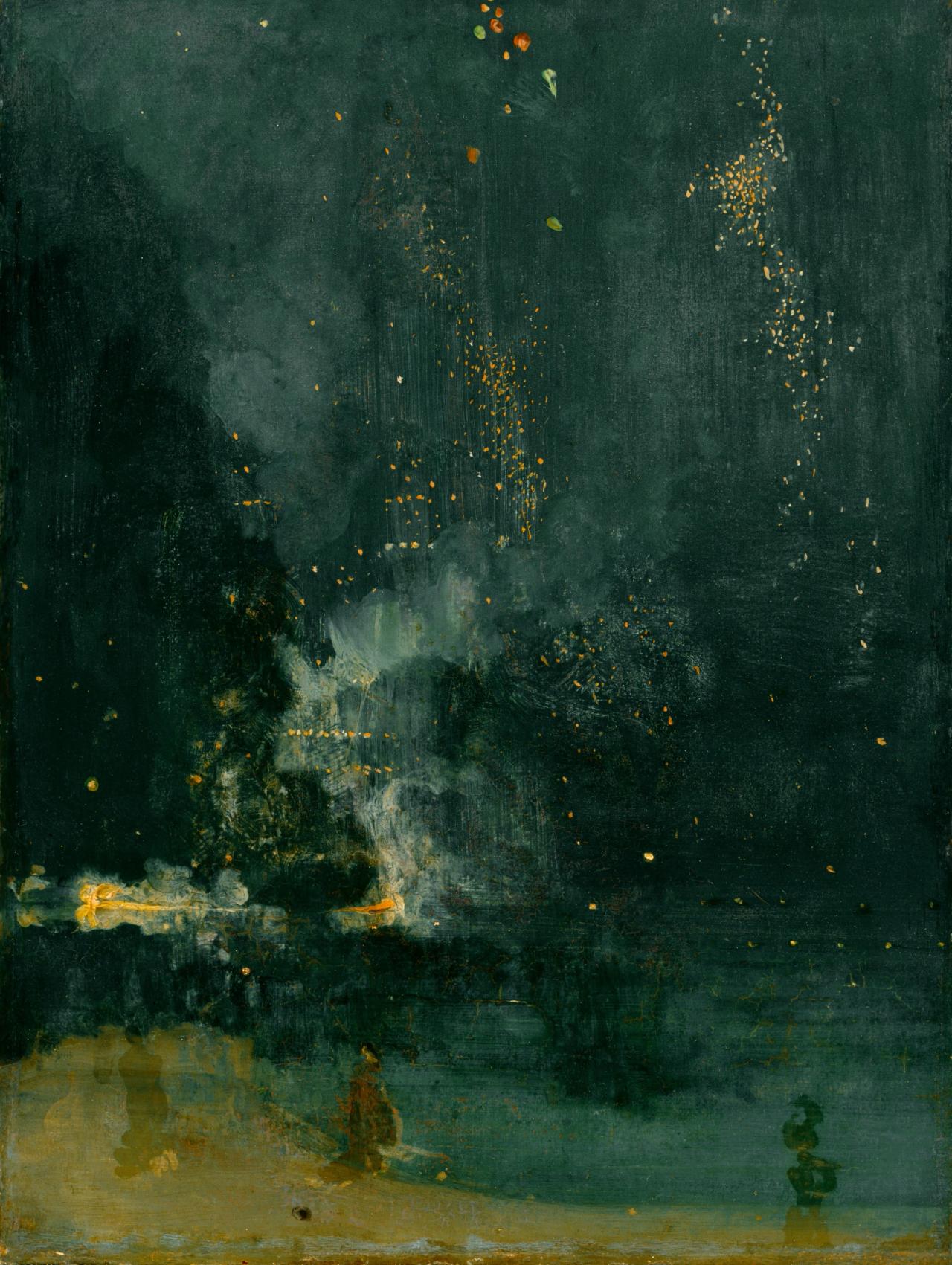
Nocturne in Black and Gold: The Falling Rocket (DETROIT INSTITUTE OF ARTS)
Nocturne: Blue and Silver—Battersea Reach and Nocturne: The Thames at Battersea, among other examples, depict industrial structures, bridges, and harbor areas rendered in hazy and muted tones. Boundaries between figures, structures, and water surfaces are deliberately blurred. Although the compositions are based on real locations, details are pushed into the background and the overall atmospheric effect is brought to the fore.
Nocturne series paintings demand not only visual perception but also emotional engagement from the viewer. Whistler’s series has been regarded as more abstract, introspective, and formalist in comparison to Impressionism’s direct perception of nature.
James McNeill Whistler was an artist whose significance extended beyond painting to his contributions in printmaking and design during the 19th century. In the early stages of his career he worked as a map draftsman for the United States Coast and Geodetic Survey. This experience was decisive in developing his skills in drawing technique and surface organization. His early important works in printmaking include the French Set and Thames Set etchings produced in the late 1850s.
Whistler employed various printmaking techniques, primarily etching (acid-based engraving) and drypoint (dry needle). His 1879–1880 trip to Venice significantly enriched his work in this medium. In etchings such as The Little Venice from this period, he combined architectural details, reflections, and light-shadow relationships within a minimalist compositional approach. Extensive empty spaces, limited detail, and pronounced tonal transitions brought together visual simplicity and poetic atmosphere.
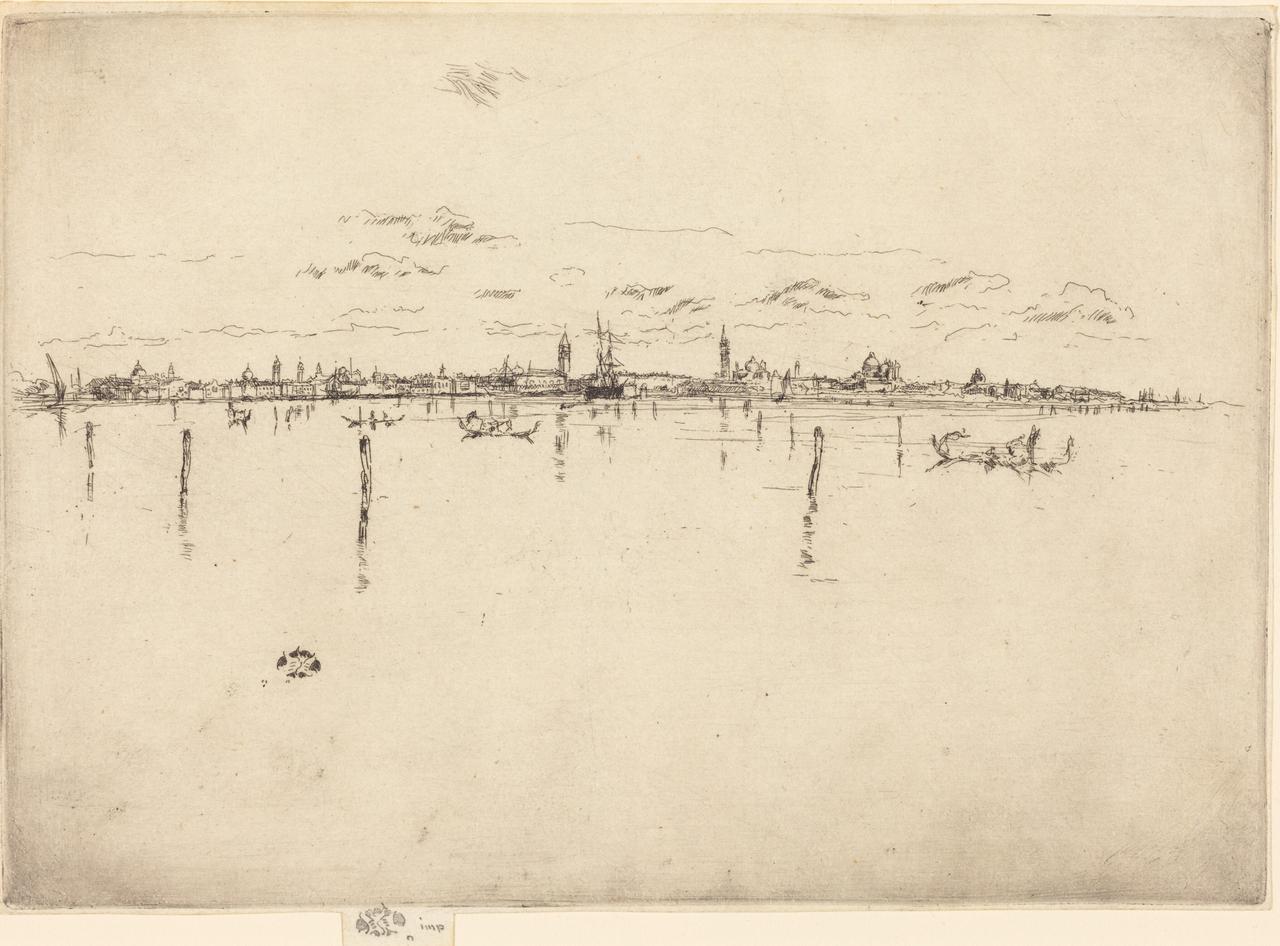
The Little Venice (National Gallery of Art)
Whistler also worked in lithography, producing a lithotint print titled Nocturne: The Thames at Battersea (1878) that presented a misty, still, and nearly abstract urban view.
His engagement with printmaking, technique, and design distinguished him from the classical artistic norms of his time. His pursuit of aesthetic unity and formal sensitivity contributed to the formation of modern art’s structural foundations. In this context, Whistler was regarded not merely as a practitioner but as the founder of a visual system grounded in aesthetic principles.
James McNeill Whistler became one of the most influential advocates of the principle “art for art’s sake” in the late 19th-century art world. Opposing the dominant view that art must carry moral, didactic, or social messages, he argued that an artwork should be evaluated solely on its own aesthetic merits. This philosophy directly informed both his theoretical writings and his painting practice.
For Whistler, nature served as a source of inspiration, but the artist’s task was not to copy nature as it appeared but to select and arrange its elements of form, color, and order to create a new and unified composition. In his famous 1885 lecture, Ten O’Clock Lecture, he clearly articulated these views, stating, “Nature is rarely right… The artist is bound to transform this natural chaos into harmony by the knowledge of selection and arrangement,”【1】 emphasizing the aesthetic transformation of nature over its imitation.
Whistler maintained that art should be constructed through emotional and formal elements akin to music. Hence he titled his works with musical terms such as “nocturne,” “symphony,” “harmony,” and “arrangement.” This approach encouraged viewers to engage with his paintings not through narrative or content but through formal and atmospheric qualities. To him, a painting should be perceived aesthetically, much like a melody is heard.
This philosophical stance manifested not only in his paintings but also in framing, exhibition methods, and interior design. Whistler meticulously designed every detail—from picture frames to the wall colors of exhibition halls—to preserve the visual unity of the artwork. This holistic approach established him as a major representative of the Aesthetic Movement.
Through his debates on artistic autonomy and the creator’s freedom, Whistler played a decisive role in shaping the theoretical foundations of modern art. His legal battle against criticism of his painting Nocturne in Black and Gold, The Falling Rocket set a precedent regarding the artist’s right to expression and the criteria for evaluating art.
The legal dispute between James McNeill Whistler and the influential art critic John Ruskin is remembered as one of the most significant debates of the 19th-century art world concerning aesthetic values. The controversy began with the 1877 exhibition of Whistler’s Nocturne in Black and Gold: The Falling Rocket (1875) at the Grosvenor Gallery in London. One of eight Nocturne paintings displayed, the work became the target of Ruskin’s harsh critique. In his publication Fors Clavigera, Ruskin described the painting as “flinging a pot of paint in the public’s face” and dismissed Whistler’s demand of two hundred guineas as “Cockney impudence.”【2】
Whistler viewed these remarks as a personal and professional attack. At the same time burdened by serious debts, he initiated the lawsuit both to publicly articulate his artistic philosophy and to secure financial compensation. The trial began on 25 November 1878 in the Exchequer Chamber of the London High Court and lasted only two days. Ruskin did not appear in court due to illness; artists such as Edward Burne-Jones testified in his defense. Burne-Jones described Whistler’s paintings as “unfinished” and “devoid of composition,” acknowledging his color sense but asserting he saw no further artistic value.
During the trial, Whistler seized the opportunity to defend his artistic philosophy before the public. In response to the question, “Do you complete a painting in two days?” he replied, “Yes, but those two days are the result of a lifetime of acquired knowledge.” This answer became a defining example of the argument that art depends not merely on physical labor but on accumulated insight and understanding.【3】
The court ruled in Whistler’s favor but awarded only symbolic damages. The failure to cover legal costs and his existing financial difficulties drove Whistler into bankruptcy. In 1879 he lost both his home and possessions, prompting him to travel to Venice to rebuild his career.
James McNeill Whistler died in London on 17 July 1903 at the age of 69. In his later years he suffered from health problems and was emotionally and physically weakened following the death of his wife, Beatrice Philip, in 1896. London, where he spent most of his life, served as both the center of his artistic production and the hub of his intellectual circle.
Whistler’s death was regarded as the loss of a major figure in the art world of his time. His lifelong commitment to an individualistic artistic vision inspired many artists during the transition to modernism. His emphasis on formal simplicity, tonal harmony, and aesthetic approaches detached from narrative became foundational precursors to the abstract and formalist tendencies that emerged in early 20th-century art.
Following his death, his works entered museum collections in both the United States and Europe. Retrospective exhibitions were organized and numerous scholarly studies were published on his life and art.
Detroit Institute of Arts. “Nocturne in Black and Gold, the Falling Rocket.” dia.org. Accessed October 13, 2025.https://dia.org/collection/nocturne-black-and-gold-falling-rocket-64931
Losee, William F. “James McNeill Whistler, the Painter.” *Brush and Pencil* 12, no. 5 (1903): 319–33. Accessed October 13, 2025.https://doi.org/10.2307/25505916
National Gallery of Art. “Gold and Brown: Self-Portrait.” nga.gov. Accessed October 13, 2025.https://www.nga.gov/artworks/45879-gold-and-brown-self-portrait
National Gallery of Art. “Little Venice.” nga.gov. Accessed October 13, 2025.https://www.nga.gov/artworks/35138-little-venice
National Gallery of Art. “Symphony in White, No. 1: The White Girl.” nga.gov. Accessed October 13, 2025.https://www.nga.gov/artworks/12198-symphony-white-no-1-white-girl
Pennell, Joseph. “James McNeill Whistler.” *The North American Review* 177, no. 562 (1903): 378–84. Accessed October 13, 2025.http://www.jstor.org/stable/25119445
SAAM. "James McNeill Whistler." americanart.si.edu. Accessed October 13, 2025.https://americanart.si.edu/artist/james-mcneill-whistler-5349
Smithsonian. "J. A. M. Whistler." si.edu. Accessed October 13, 2025.https://www.si.edu/object/j-m-whistler:npg_NPG.91.125
THE CLARK. “WHISTLER'S MOTHER - ABOUT THE ARTIST.” clarkart.edu. Accessed October 13, 2025.https://www.clarkart.edu/microsites/whistlers-mother/exhibition-(2)
Weinberg, Barbara H. “James McNeill Whistler (1834–1903).” Met museum. Accessed October 13, 2025.https://www.metmuseum.org/essays/james-mcneill-whistler-1834-1903
Zajac, Mary. “How James McNeill Whistler Became a Brand and Fought for It in Court.” National Endowment for the Humanities. Accessed October 13, 2025.https://www.neh.gov/humanities/2014/septemberoctober/feature/how-did-james-mcneill-whistler-create-his-distinctive-brand
[1]
H. Barbara Weinberg, “James McNeill Whistler (1834–1903),” Met museum, son erişim: 13 Ekim 2025, https://www.metmuseum.org/essays/james-mcneill-whistler-1834-1903
[2]
Mary Zajac, “How James McNeill Whistler Became a Brand and Fought for It in Court,” National Endowment for the Humanities, son erişim: 13 Ekim 2025, https://www.neh.gov/humanities/2014/septemberoctober/feature/how-did-james-mcneill-whistler-create-his-distinctive-brand
[3]
Mary Zajac, “How James McNeill Whistler Became a Brand and Fought for It in Court,” National Endowment for the Humanities, son erişim: 13 Ekim 2025, https://www.neh.gov/humanities/2014/septemberoctober/feature/how-did-james-mcneill-whistler-create-his-distinctive-brand

Full Name | James Abbott McNeill Whistler | ||||||||
|---|---|---|---|---|---|---|---|---|---|
Date of Birth | 1834-07-10 | ||||||||
Place of Birth | Lowell - Massachusetts / USA | ||||||||
Date of Death | 1903-07-17 | ||||||||
Place of Death | London - United Kingdom | ||||||||
Nationality | American | ||||||||
Education | Charles Gleyre Atölyesi United States Military Academy - West Point École Impériale et Spéciale de Dessin | ||||||||
Field | Design (Interior) Lithography Engraving and Printmaking Painting | ||||||||
Movements / Influences | Art for Art’s Sake Realism Tonalism Japonism Aesthetic Movement | ||||||||
No Discussion Added Yet
Start discussion for "James McNeill Whistler" article
Early Life and Artistic Education
Settlement in London and Artistic Transformation
Nocturne Series
Printmaking, Techniques, and Design Philosophy
Art Philosophy
The Whistler–Ruskin Lawsuit and Public Impact
Death and Legacy