


This article was automatically translated from the original Turkish version.
+1 More
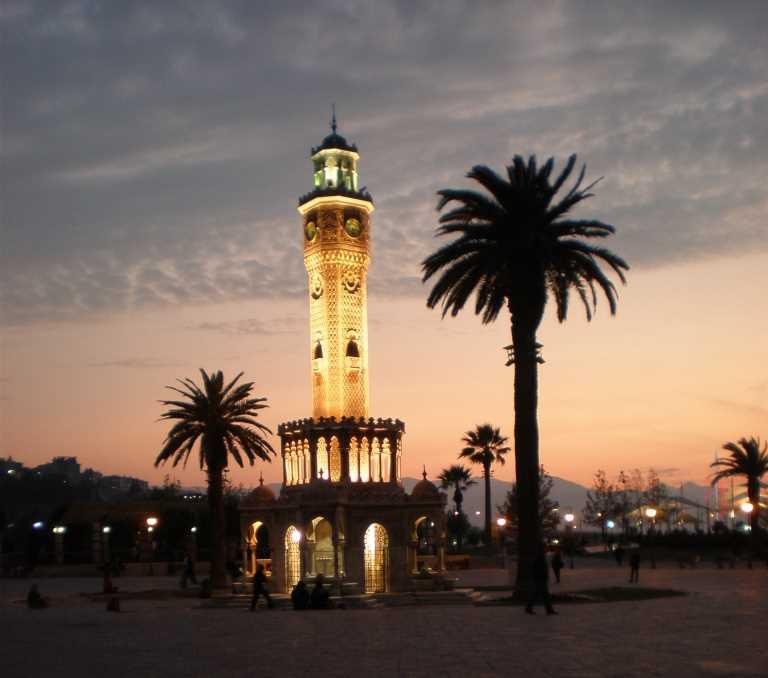
Izmir Clock Tower
Year of Construction | 1901 | ||||||||
|---|---|---|---|---|---|---|---|---|---|
Location | Konak Square / İzmir / Türkiye | ||||||||
Patron | II. Abdülhamid (on the 25th anniversary of his accession to the throne) | ||||||||
Architect | S. Raymond (or M. Raymond Père) | ||||||||
Height | 25 metres | ||||||||
Number of Floors | 4 floors | ||||||||
Architectural Style | Neo-Moorish (Maghrebi influences: horseshoe arch, Moorish cornice, decorations) | ||||||||
İzmir Clock Tower, built in 1901 to commemorate the 25th anniversary of the accession of Ottoman Sultan Abdulhamid II, is a clock tower located in İzmir’s Konak Square. It is one of İzmir’s iconic structures and was designed and constructed as part of the modernization and urbanization process during the Ottoman period.

İzmir Saat Kulesi ( İzmir İl Kültür Ve Turizm Müdürlüğü)
Under the influence of administrative and social transformations in the Ottoman Empire during the 19th century, new public buildings and squares began to be constructed in urban centers. İzmir emerged as one of the key cities undergoing this transformation. The history of Konak Square dates back to the second half of the 19th century with the construction of the Government House on the site. Previously, no square existed in this area, which was surrounded by structures such as Sarıkışla.
After the construction of the Government House, the square became known as Konak. Structures dating from the 18th century, such as the Yalı Mosque and its madrasa, were also located in this area. The clock tower was built on this site in 1901. The construction was supervised by Said Paşa, son of Kamil Paşa of Cyprus. A special model of the building was prepared and is preserved in Topkapı Palace. According to French inscriptions on the structure, the architect was S. Raymond; some sources refer to the name as M. Raymond Pere.
The tower stands 25 meters high and has four levels. It is built on a cruciform platform with an octagonal base. Regular cut stone was used in its construction, and some columns were imported from Marseille. At each corner of the structure are four marble water basins (şadırvan), which is why it is also known among the public as the “Havuzlu Anıt” (Monument with Pools). Each şadırvan is covered by a small domed structure in the baldachin style.
The tower’s architecture features pointed horseshoe arches, cylindrical columns, Moorish capitals, and vegetal and geometric ornamentation. On the tower’s facades are palmette motifs, five-pointed stars placed within baklava patterns, and crescent-and-star symbols. Originally, the Ottoman coat of arms and the tughra of Sultan Abdulhamid II were displayed on the tower; however, these symbols were removed in 1927 by a law enacted that year.
The second level is articulated by three-arched openings and features a surrounding gallery. The third level includes false openings with wide edges, small decorative balconies supported by consoles, and round medallions. The fourth level rises with a narrowing shaft and culminates in a domed octagonal baldachin. The domes are crowned with finials. The clocks on each face of the tower were gifted by German Emperor Wilhelm II.
Saat Kulesi Timelapse (İzmir Metropolitan Municipality)
Access to the clock mechanism is via a staircase that begins in a closed chamber on the ground floor and ascends upward. The clock mechanisms inside the tower remain operational.
İzmir Clock Tower is situated on the seaside facade of Konak Square. Together with the Government House, Yalı Mosque, and other historic structures, it contributes a symbolic identity to the square. As a vertical element in the city’s silhouette, the tower is an important monument reflecting İzmir’s urban identity and historical development during the transition from the Ottoman Empire to the Republic.
Anadolu Ajansı. “İzmir'in Simgesi Konak Saat Kulesi.” aa.com.tr. Accessed May 10, 2025.https://www.aa.com.tr/tr/yasam/izmirin-simgesi-konak-saat-kulesi/404373
DergiPark. “İzmir Saat Kulesi – İnci Kuytul Ersoy.” *Türk Dünyası İncelemeleri Dergisi*, no. IV, 2000, pp. 277–287.https://dergipark.org.tr/tr/download/article-file/406157(Accessed May 10, 2025).
Ministry of Culture and Tourism. "Saat Kulesi." Kültür Portalı. Accessed May 10, 2025.https://kulturportali.gov.tr/turkiye/izmir/gezilecekyer/saat-kulesi404803
İzmir Büyükşehir Municipality. "Saat Kulesi." izmir.bel.tr. Accessed May 10, 2025.https://www.izmir.bel.tr/tr/SaatKulesi/208
İzmir İl Directorate of Culture and Tourism. "Saat Kulesi." izmir.ktb.gov.tr. Accessed May 10, 2025.
İzmir İl Directorate of Culture and Tourism. “İstatistikler ve Veriler.” izmir.ktb.gov.tr. Accessed May 10, 2025.
“Tarihi İzmir Saat Kulesi.” Kültür Portalı. Accessed April 29, 2025.https://kulturportali.gov.tr/turkiye/izmir/gezilecekyer/saat-kulesi404803

Izmir Clock Tower
Year of Construction | 1901 | ||||||||
|---|---|---|---|---|---|---|---|---|---|
Location | Konak Square / İzmir / Türkiye | ||||||||
Patron | II. Abdülhamid (on the 25th anniversary of his accession to the throne) | ||||||||
Architect | S. Raymond (or M. Raymond Père) | ||||||||
Height | 25 metres | ||||||||
Number of Floors | 4 floors | ||||||||
Architectural Style | Neo-Moorish (Maghrebi influences: horseshoe arch, Moorish cornice, decorations) | ||||||||
History
Architectural Features
Materials and Techniques
Location and Significance