


IV. Ivan (WorldHistory)
Full Name | Ivan Vasilyevich | ||||||||
|---|---|---|---|---|---|---|---|---|---|
Spouse | Anna Koltovskaya (1572) Anna Vasilchikova (1575) Maria Nagaya (1581) Vasilisa Melentyeva Anastasia Romanovna (1547–1560) Maria Temryukovna (1561–1569) Marfa Sobakina (1571) | ||||||||
Nickname | Grozny (Грозный) Terrible | ||||||||
Date of birth | 1530-08-25 | ||||||||
Date of death | 1584-03-18 | ||||||||
Mother | Elena Glinskaya | ||||||||
Father | Vasili III (Grand Prince of Moscow) | ||||||||
Dynasty | Rurik Dynasty | ||||||||
Offices and Titles | Tsar of Russia (First Tsar): 1547–1584 Grand Prince of Moscow: 1533–1547 | ||||||||
Child | Dmitrii Ivanovich (1582–1591) Ivan Ivanovich (1554–1581) Fyodor Ivanovich (1557–1598) | ||||||||
Religion | Eastern Orthodox Christianity | ||||||||
Successor | Fyodor Ivanovich (1584–1598) | ||||||||
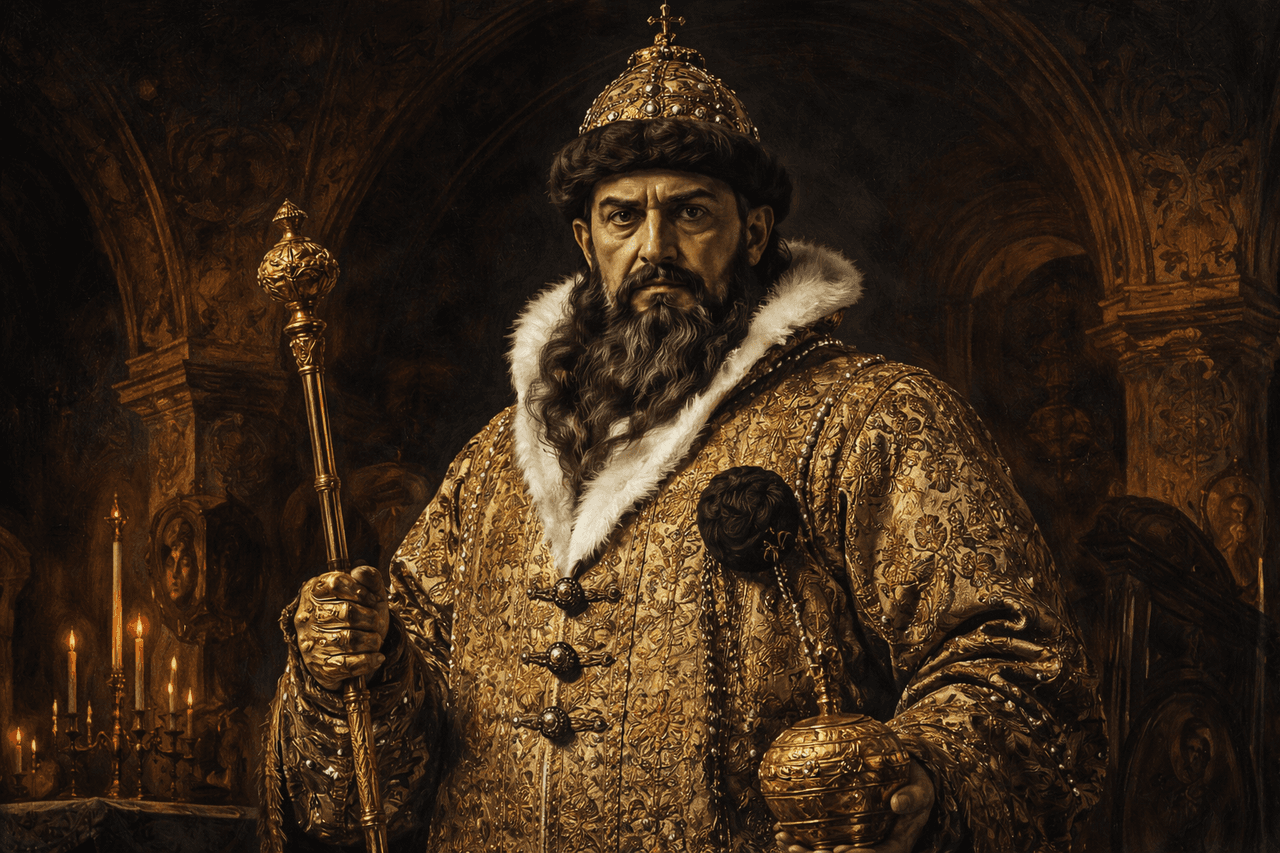
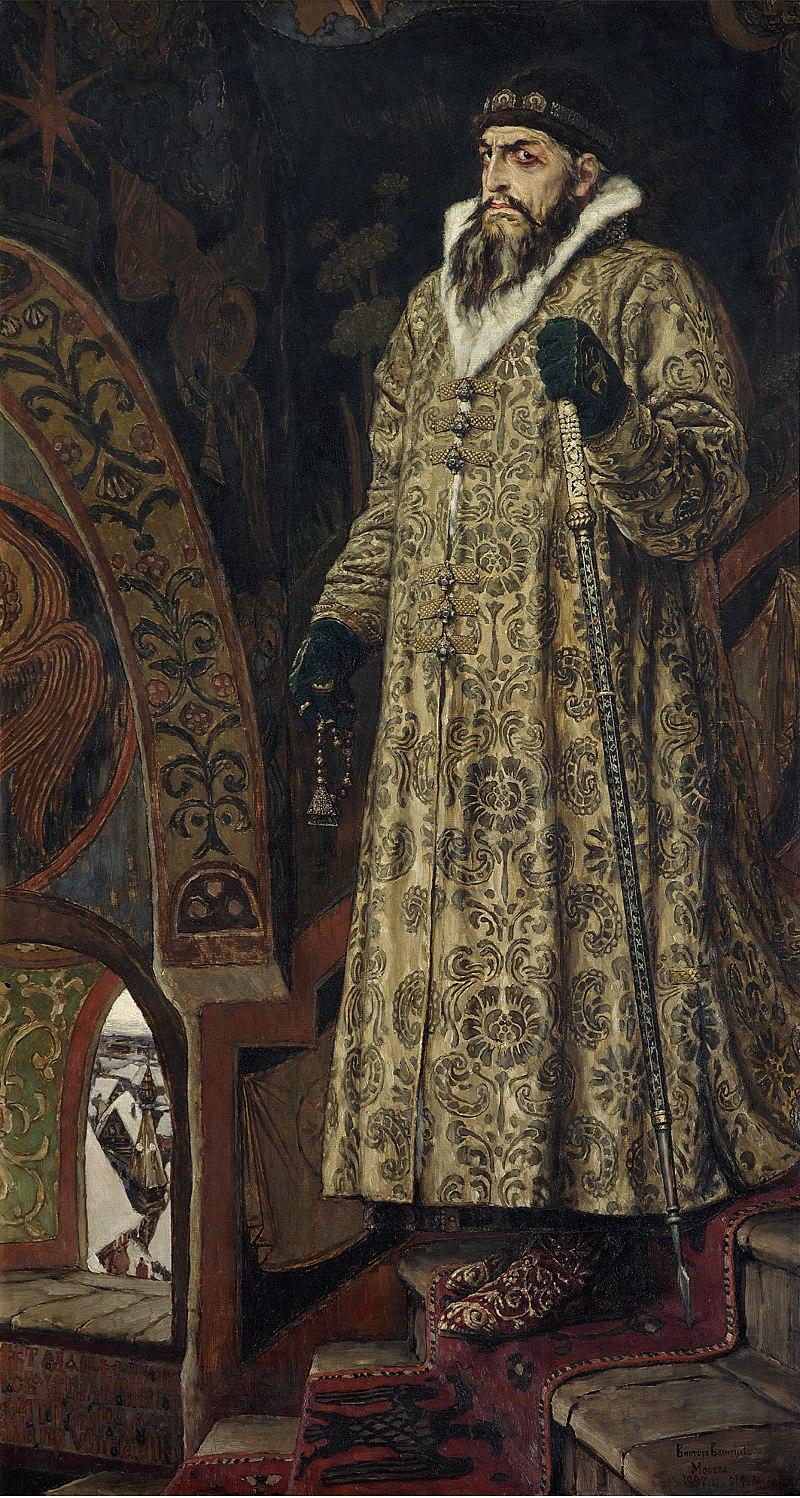
Ivan IV (Ivan the Terrible) was a ruler who lived between 1530 and 1584 and in 1547 adopted the title of “tsar” in Russia, governing the Moscow-centered Russian state. Ivan IV (Ivan Vasilyevich) was the son of Grand Prince Vasily III and Elena Glinskaya. He was born on 25 August 1530 in Kolomenskoye near Moscow. He ascended the throne as Grand Prince of Moscow at a young age following his father’s death; his mother Elena Glinskaya died when Ivan was eight years old. On 16 January 1547 he was crowned in the Uspenskiy (Assumption) Cathedral and assumed the title of tsar. On 3 February 1547 he married Anastasia Romanovna. He died in Moscow on 18 March 1584.
The epithet “Grozny” (Грозный) applied to Ivan IV has largely been rendered in Western languages as “Terrible”; the Turkish term “Ivan the Terrible” also derives largely from this translation tradition. However the meaning of “Grozny” cannot be reduced to a single negative equivalent; depending on context it carries broader connotations such as “majestic,” “awe-inspiring,” or “formidable.” The epithet also remains controversial in terms of its contemporary usage and adoption: it is uncertain whether Ivan was systematically addressed by this title during his lifetime, but it is noted that the epithet became more prominent in later centuries and that in its early stages the emphasis may have been on “power” or “majesty.”Europe, however, saw Ivan’s image circulate through foreign observer texts and print culture within a more one-sided narrative; the “Ivan the Terrible” stereotype became entrenched during this process. Over time the connotations of “Grozny” shifted from the semantic cluster of “revered/majestic” toward that of “terrible/cruel”; in Western languages the negative meaning of this later phase came to dominate.
Ivan’s childhood was shaped by the dynastic continuity and internal power balances of the court. He ascended the throne in 1533 upon his father’s death. During this period his mother Elena Glinskaya held decisive influence; after her death in 1538 a more intense rivalry emerged among the boyar factions. In 1543 the arrest and subsequent execution of the boyar Andrei Shuysky is recorded as an example of the young ruler’s ability to assert direct authority amid competing power struggles. These years are viewed as a period during which court factions exerted influence over governance, while Ivan increasingly began to intervene more visibly and decisively.
16 January 1547, under the presidency of Metropolitan Makariy, Ivan was crowned in the Uspenskiy Cathedral and formally adopted the title of tsar, institutionalizing his sovereign status within a new political-ritual framework. On 3 February 1547 he married Anastasia Romanovna.
On 24 June 1547 a major fire broke out in Moscow. The fire caused widespread destruction, and a subsequent uprising targeted individuals associated with the Glinsky family. The fire and uprising together produced significant social upheaval and loss of life.
The origins and nature of the representative assemblies known as the Zemsky Sobor during Ivan IV’s reign remain debated in historiography. Some scholars accept the meeting of February 1549 as the “first Zemsky Sobor,” though questions persist regarding the reliability of certain speeches attributed to it and the tendency to exaggerate its significance. Other interpretations hold that the first Sobor convened in 1550 and that its reform agenda was addressed within that context. The Sudebnik of 1550 is regarded as a central text among the reforms. The Stoglav Council of 1551 issued decisions on church practices, religious regulations, and iconographic standards, establishing a regulatory framework for state-church relations.
The reforms of 1555–1556 are seen as transformations in local administration and fiscal structure. The abolition of the “kormlenie” system, whereby local officials sustained themselves through extractive rights, was accompanied by the strengthening of new practices involving elected representatives in local governance. Militarily, the streltsy corps was established in 1550, with its numbers reaching approximately 3,000.
The Volga basin held a decisive place in Ivan’s military and political agenda. On 2 October 1552, the capture of Kazan brought the region under Moscow’s control. The conquest of Astrakhan in 1556 was regarded as a complementary step securing full dominance over the Volga corridor. These developments strengthened the institutional and strategic foundations of Moscow’s eastward expansion.
The year 1553 stands out as one of the most serious political crises during Ivan IV’s early reign. Ivan fell seriously ill, and the threat of death brought the succession issue to the forefront of court politics. The expected heir was his infant son Dmitrii; however, because of his young age, disputes over legitimacy emerged among powerful boyar families. Particularly the Shuysky and Belsky families showed reluctance to recognize Ivan’s young son as heir. This hesitation triggered a crisis of confidence in the young ruler upon his recovery and laid the psychological groundwork for the security and punitive policies he would later implement.
After this episode Ivan elevated loyalty as the foundational principle of central governance. Following the crisis, power balances within the court were restructured; some boyar families were eliminated while others were removed from administrative posts. The event also contributed to the strengthening of the tsar’s conception of absolute authority. The death of Anastasia Romanovna in 1560 and the subsequent period of second marriage and court intrigues are also considered long-term consequences of this trust crisis.
The Livonian War, which began in 1558, was the most comprehensive military endeavor of Ivan IV’s reign aimed at securing access to the Baltic Sea. Initial attacks against the territories of the Livonian Order achieved significant successes; strategic towns such as Dorpat (Tartu) and Narva were captured. However, the war quickly transformed into a multi-front conflict. The Polish-Lithuanian Union, Sweden, and Denmark all became involved, expanding the geographical and diplomatic scope of the war.
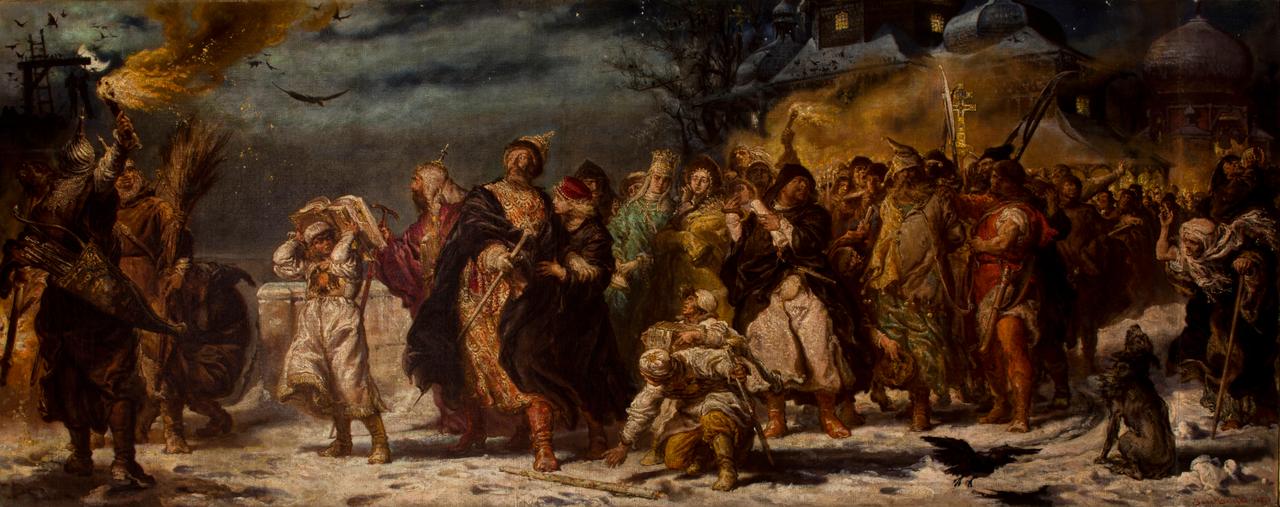
Jan Matejko’s 1875 Painting Ivan the Terrible (Look and Learn)
The prolonged war placed a heavy burden on the Russian economy. Extended campaigns led to the depletion of financial resources and increased tax burdens. The new political structure formed by the union of Poland and Lithuania in 1569 became a formidable rival to Moscow. The Truce of Jam Zapolski with Poland-Lithuania in 1582 and the Truce of Plussa with Sweden in 1583 brought the war to an end. As a result of these agreements, Russia lost its gains on the Baltic coast but retained its eastern expansions.
The Livonian War was not merely a military conflict but also viewed as Ivan’s attempt to open Russia toward the West. Diplomatic contacts established with Queen Elizabeth I of England also date to this period. However, economic and diplomatic balances ultimately failed to enable Russia’s permanent opening to the Baltic.
The defection of Prince Andrei Kurbsky to Lithuania in 1564 symbolized the beginning of a new era in Ivan’s rule. Kurbsky was both a military commander and a former close associate of the tsar. His defection was interpreted not merely as an act of personal betrayal but as an indicator of a deep crisis of trust between the tsar and the aristocracy. The letters Kurbsky wrote after fleeing to Lithuania contained criticisms of Ivan’s governance; these writings are among the earliest texts in Russian political literature addressing the relationship between ruler and subjects.
Following this event Ivan withdrew from Moscow and relocated to Aleksandrova Sloboda, temporarily halting state affairs. In his proclamation of 3 January 1565 he returned to governance, justifying his authority by invoking “divine right”; however, he established the Oprichnina system, dividing the country into two distinct zones: a special territory under the tsar’s direct control and the Zemshchina, where traditional institutions continued to operate.
The Oprichnina was a political, military, and social reorganization under Ivan IV aimed at redefining central authority. This system included territories designated as the tsar’s personal property and a special guard force selected by him personally. These forces, known as oprichniki, were directly loyal to the tsar and tasked with surveillance, punishment, confiscation, and suppression of dissenting elements. The system sought to break the power of the Moscow aristocracy and rapidly evolved into a repressive mechanism.
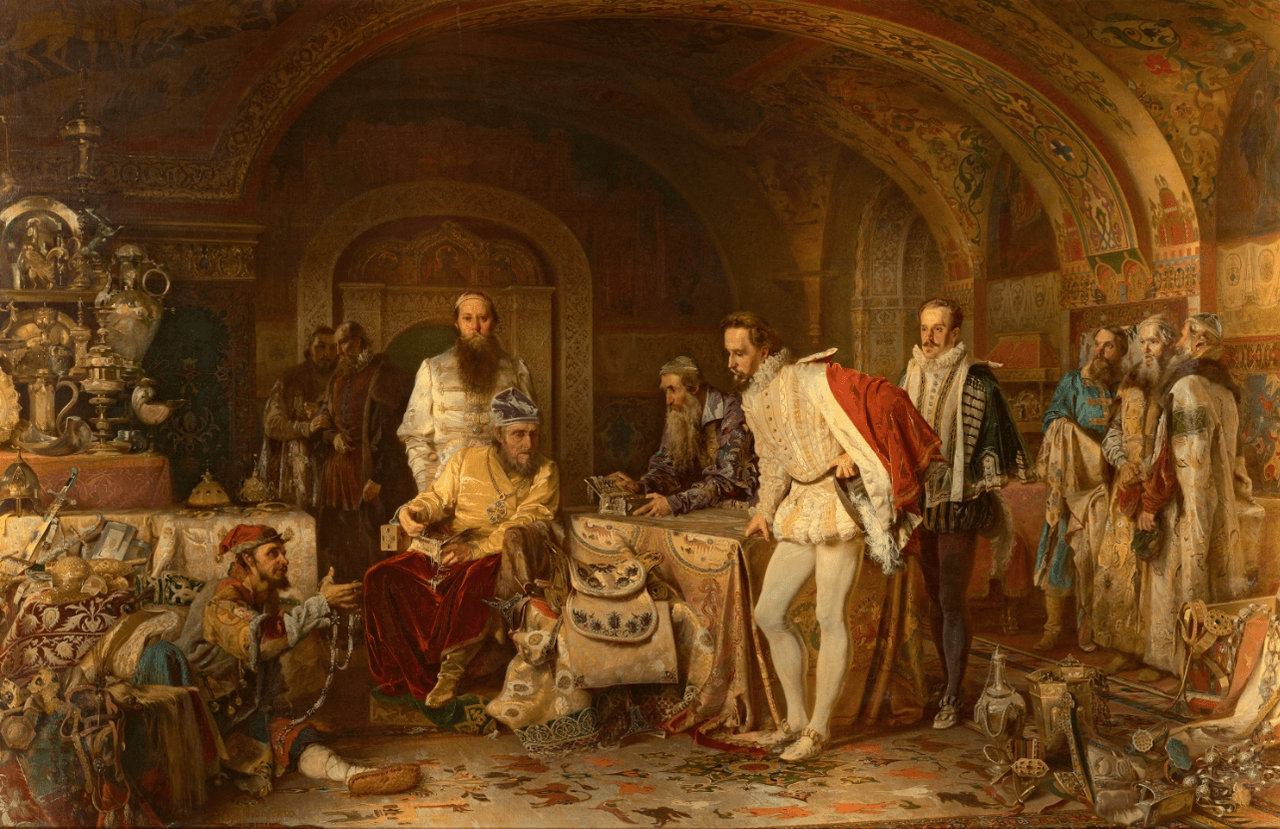
Ivan the Terrible Showing His Treasures to the English Ambassador Jerome Horsey (The Virtual Russian Museum)
During the Oprichnina period many boyar families lost their property, and widespread exiles and executions occurred. A system of governance based on absolute loyalty to the tsar emerged within his inner circle. Tensions with the church during this period were also notable. Metropolitan Philip openly criticized Ivan’s policies and was consequently removed from office in 1568, confined to a monastery, and murdered shortly thereafter.
One of the harshest applications of the Oprichnina was the Novgorod campaign of 1569–1570. Ivan believed Novgorod had secretly contacted Lithuania and was preparing treason; in response he sent a large army to the city. The siege lasted for weeks, after which the city was plundered and numerous individuals, including clergy and nobles, were executed. Monasteries and churches in Novgorod were also destroyed. The campaign caused severe economic and demographic devastation.
The city’s commercial vitality disappeared, and the wealthy merchant class of northwestern Russia was dispersed. Forces advancing toward Pskov after the campaign created a similar atmosphere of fear there, though no large-scale massacre occurred. These events marked the peak of the Oprichnina and represented the most visible manifestation of Ivan’s absolutist tendencies.
In 1571, the Crimean Khan Devlet I Giray launched a major raid on Moscow with a large army, becoming a turning point in the Oprichnina period. Due to the ineffectiveness of the oprichniki in defense, Moscow was almost entirely burned. This destruction undermined confidence in the tsar’s special administrative system and clearly exposed the weaknesses of his military organization.
A year later, in 1572, at the Battle of Molodi, Russian forces defeated the Crimean army, preventing the reoccupation of the capital. Following this victory, the Oprichnina was formally abolished. The country’s administration was reunified, and state affairs returned to normal within the institutional framework of the Zemshchina. However, the social fear, property losses, and institutional collapse caused by the Oprichnina continued to have effects for many years.
After 1572 Ivan IV’s governing approach underwent a clear transformation. Following the abolition of the Oprichnina, the central administrative structure was reunified; however, the tsar continued to maintain tight control over the country’s administrative and social fabric. Loyalty-based appointments were strengthened, and the nobility’s control over provincial regions was reduced. During this period the state’s financial resources were strained by the effects of the Livonian War and the confiscations of the Oprichnina era; measures were taken to reorganize production and taxation systems.
By the mid-1570s internal security, migration, and property mobility had become major problems in Russia. In 1581 a policy was introduced restricting peasants from leaving their land (“zapovednye gody” – forbidden years). This regulation is regarded as a precursor to the serfdom system that would bind peasants to the land in subsequent centuries. The policy aimed to preserve the tax base and ensure production continuity.
In 1575 a brief and unusual event occurred: Simeon Bekbulatovich was appointed nominal ruler with the title “Grand Prince of All Rus.” During this period Ivan appeared to withdraw from public view; however, actual power remained firmly in his hands. This move is interpreted as an attempt to symbolically redefine the boundaries of tsarist authority, both divine and secular. After a short time Simeon was removed from office and the system reverted to its previous form.
The year 1581 is remembered for a major crisis on the dynastic front. During a heated argument with his father, the heir apparent, Tsarevich Ivan, suffered severe injuries and died four days later. Contemporary sources provide no clear account of the circumstances surrounding the incident; however, later narratives widely claimed that Ivan had killed his son in a fit of rage. This death created a profound shock both for dynastic continuity and for the tsar’s personal life. With the heir’s death, the succession became precarious, leaving only Feodor Ivanovich as the sole heir.
Ivan IV died in Moscow on 18 March 1584 after a prolonged illness. Accounts of his death describe him collapsing while preparing to play chess and dying shortly thereafter. Contemporary diplomatic reports and observer testimonies indicate signs of physical exhaustion, nervous disorders, and possible poisoning in his final years. Scientific examinations conducted in the 20th century found high levels of mercury and arsenic in Ivan’s remains. This discovery revived speculation about poisoning; however, since mercury-based medicines were commonly used in medical practice of the time, no conclusive evidence confirms poisoning as the cause of death. Ivan’s death initiated a transitional period in Russian history. His successor, Feodor Ivanovich, saw the rise of Boris Godunov to prominence in state administration, who would later ascend the tsarist throne and lay the groundwork for the turbulent era known as the “Smutnoe Vremya” (Time of Troubles).
Ascher, Abraham. Kısa Rusya Tarihi. Translated by Yavuz Alogan. Istanbul: Say Yayınları, 2020.
Chernyshev, S. A. “Ivan the Terrible – the First Publicist and Political Technologist on the Moscow Throne.” *Izvestiya Irkutskogo Gosudarstvennogo Universiteta. Seriya «Politologiya. Religiovedenie»* 33 (2020): 34–49. Accessed January 12, 2026.https://doi.org/10.26516/2073-3380.2020.33.34
Halperin, Charles J. Ivan the Terrible: Free to Reward and Free to Punish. Pittsburgh: University of Pittsburgh Press, 2019.
Litovchenko, Aleksandr D. *Ivan the Terrible Showing Treasures to the English Ambassador Jerome Horsey*. 1875. Oil on canvas, 153 × 236 cm. Ж-4401. Virtual Russian Museum (Russian Museum). Accessed January 12, 2026.https://rusmuseumvrm.ru/data/collections/painting/19_20/zh_4401/index.php?lang=en.
Look and Learn. "Ivan the Terrible." Accessed January 12, 2026.https://www.lookandlearn.com/history-images/YNK1071360/Ivan-the-Terrible.
Vernadsky, George. Rusya Tarihi. Translated by Doğukan Mızrak and Egemen Ç. Mızrak. Istanbul: Selenge Yayınları, 2009.
Von Staden, Heinrich. Korkunç İvan Zamanında Rusya. Translated and annotated by Serkan Acar and Gülşah Hasgüçmen. Istanbul: Selenge Yayınları, 2016.
World History Encyclopedia. "Portrait of Ivan IV." Image. Accessed January 12, 2026.https://www.worldhistory.org/image/18196/portrait-of-ivan-iv/.
de Madariaga, Isabel. Ivan the Terrible: First Tsar of Russia. New Haven and London: Yale University Press, 2005.

IV. Ivan (WorldHistory)
Full Name | Ivan Vasilyevich | ||||||||
|---|---|---|---|---|---|---|---|---|---|
Spouse | Anna Koltovskaya (1572) Anna Vasilchikova (1575) Maria Nagaya (1581) Vasilisa Melentyeva Anastasia Romanovna (1547–1560) Maria Temryukovna (1561–1569) Marfa Sobakina (1571) | ||||||||
Nickname | Grozny (Грозный) Terrible | ||||||||
Date of birth | 1530-08-25 | ||||||||
Date of death | 1584-03-18 | ||||||||
Mother | Elena Glinskaya | ||||||||
Father | Vasili III (Grand Prince of Moscow) | ||||||||
Dynasty | Rurik Dynasty | ||||||||
Offices and Titles | Tsar of Russia (First Tsar): 1547–1584 Grand Prince of Moscow: 1533–1547 | ||||||||
Child | Dmitrii Ivanovich (1582–1591) Ivan Ivanovich (1554–1581) Fyodor Ivanovich (1557–1598) | ||||||||
Religion | Eastern Orthodox Christianity | ||||||||
Successor | Fyodor Ivanovich (1584–1598) | ||||||||
Designations in Russia and Europe: “Grozny” and “The Terrible”
Family, Childhood, and Regency (1530–1547)
Reign Period 1549–1560
Expansion along the Volga
The 1553 Succession Crisis
Livonian War and Foreign Policy Framework (1558–1583)
Kurbsky’s Defection and the Path to the Oprichnina (1564–1565)
The Oprichnina (1565–1572): Structure, Operational Areas, and Key Events
The Novgorod Campaign (1569–1570)
The 1571 Moscow Raid, the Battle of Molodi (1572), and the End of the Oprichnina
Final Period (1572–1584)
Death and Aftermath