


This article was automatically translated from the original Turkish version.
+1 More
Islimye Çuka Factory is a state-operated woolen textile manufacturing facility established in 1835 in Sliven (now within the borders of Bulgaria) by the Ottoman State. It was the first modern factory built by the Ottoman State in Rumelia. The factory’s primary objective was to meet the Ottoman army’s demand for çuka fabric—particularly used in winter uniforms—through local production and reduce dependence on imports.
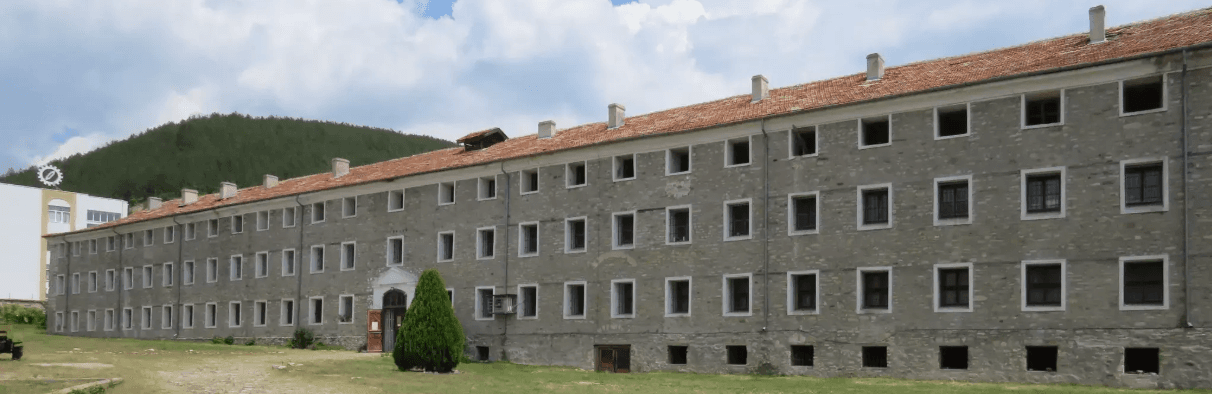
Çuka Factory Today (Oink)
Çuka is a durable and thick woolen fabric widely used during the Ottoman period for military uniforms and various official and civilian garments. The Islimye Çuka Factory is among the major state investments established in the 19th century for the production of this fabric, alongside the Feshane-i Âmire, İzmit Çuka Factory and Hereke Weaving Factory.
The Islimye Çuka Factory was established in 1835 to meet the Ottoman State’s military textile needs. The establishment process began with Dobro Celasko, a local entrepreneur in Sliven, who studied çuka factories in Germany and Russia. Following these visits, Celasko established a small-scale weaving workshop using his own resources in Sliven.
The Ottoman State supported this initiative by allocating 200,000 guruş in capital to Celasko and guaranteeing to purchase the çuka fabric he produced at a fixed unit price. Under the agreement, the state accepted payment of 21 guruş 10 pare per zira (approximately 68 cm) of fabric. Celasko committed to producing 20,000 zira of çuka annually. The core of the factory consisted of 12 weaving looms and basic wool-processing machines established in these early years. Production began in 1836, but output in the first year was limited to only 900 zira due to the lack of experience among local workers in çuka weaving.
To increase capacity and improve quality, the Ottoman administration provided technical support and invested in modernizing production equipment. In 1842, ten new machines were purchased from France for 80,000 guruş. In the same year, additional buildings were constructed and the process of expanding capacity began.
From its inception, the Islimye Çuka Factory operated as a partially mechanized facility aligned with the industrial standards of its time. The production technology used in the factory’s early years was developed based on models from modern çuka factories in Europe. The factory’s machinery was gradually upgraded and expanded to increase output and improve fabric quality. In 1836, the core machinery consisted of 12 weaving looms and various wool-processing machines, all inspired by examples from Germany and Russia.
The machines used in the factory’s early period included:
All stages of fabric production—wool cleaning, carding, yarn spinning, and weaving—were carried out within the same factory.
The mechanization process accelerated significantly in 1842, when 80,000 guruş was spent to purchase an additional 10 machines from France. These included:
Parallel to mechanization, new buildings were constructed within the factory complex. These included yarn storage rooms, fabric drying areas, soap and glue vats, carpentry workshops, ironworks, foundries, and machine maintenance workshops. The factory’s energy needs were met by a large water-driven shaft system. Water-powered shafts operated the weaving looms and yarn machines.
Factory Establishment and Present-Day Museum from a Bulgarian Perspective (Discovery of Passenger)
The acceleration of mechanization increased both the quantity and quality of production. Output rose from only 5,500 zira in 1837 to 20,000 zira by 1839. By 1844, with new buildings and machinery investments, the targeted annual production capacity was set at 100,000 zira.
The factory’s technological infrastructure also reflected the Ottoman State’s dependence on imported machinery and technical expertise. However, during the same period, local artisans began developing prototypes of some machines, achieving partial success in domestic machine production.
The Islimye Çuka Factory began operations with an annual production target of 20,000 zira of çuka. In 1837, output reached 5,500 zira; in 1838, it rose to 12,000 zira; and by 1839, it reached the target of 20,000 zira. By 1844, production had reached 50,000 zira, and after the Tanzimat reforms, the goal was to increase capacity to 100,000 zira, though this target was never consistently achieved. The factory’s financial structure was largely supported by capital from the Hazine-i Hassa. The initial funding of 200,000 guruş allocated to Dobro Celasko increased as the factory expanded. In 1842, 588,051 guruş was spent on construction and equipment for expansion, and an additional budget requirement of 583,742 guruş was identified for further buildings and machinery. Thus, the total investment cost during the expansion phase reached 1,171,793 guruş. Sales prices for the fabric were determined based on production costs and market conditions. In 1842, the selling price of the produced çuka was set at 24 guruş per zira, with lower quality fabric priced at 16 guruş and higher quality at 28 guruş.
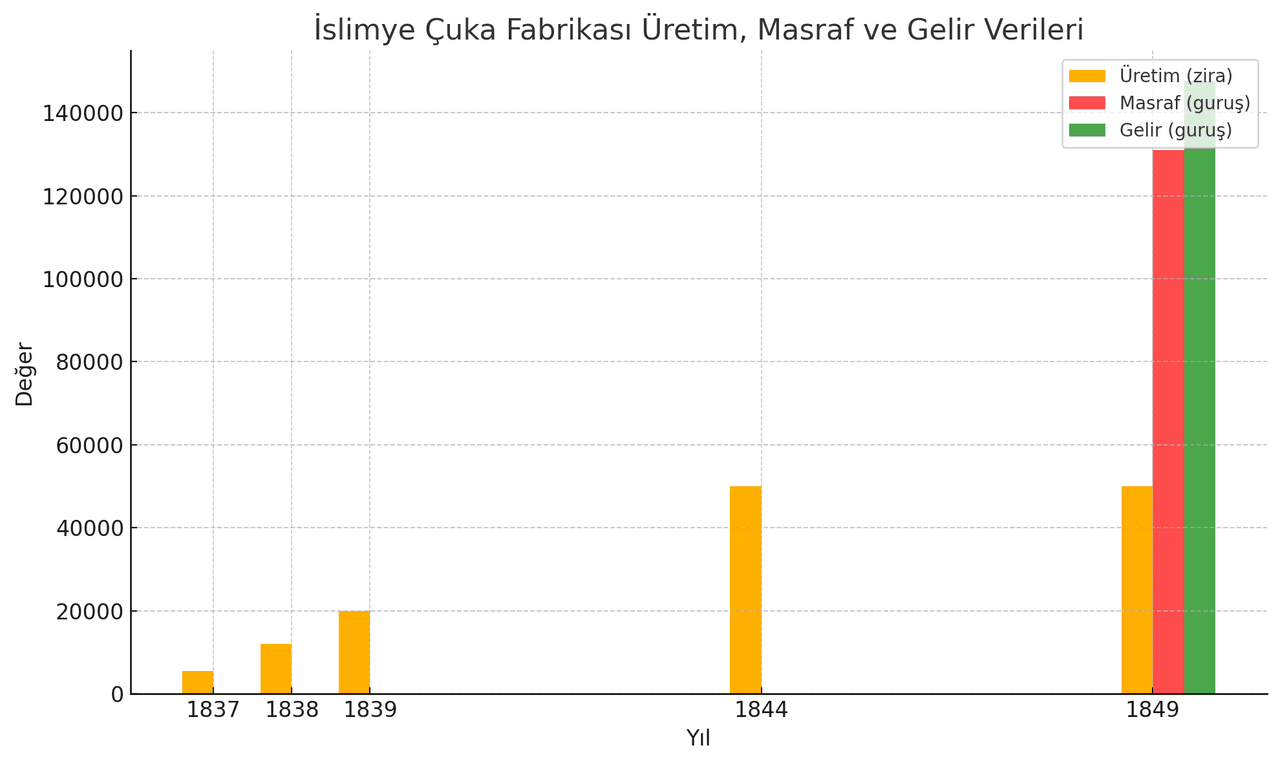
Production, Expenses and Revenue Graph 1836-1849 (Source: Mehmet Salih Çoban)
The factory’s operational model was managed under changing administrative structures over time. Initially, management was handled by Dobro Celasko, who was responsible for producing çuka fabric according to specified samples and quality standards. He received 21 guruş 10 pare per zira produced and committed to an annual output of 20,000 zira. In 1842, Mustafa Kani Bey, the local governor of Sliven, was appointed as factory manager, and the roles of governor and factory manager were merged. Mustafa Kani Bey received a salary of 7,000 guruş for both positions. After Kani Bey’s death in 1844, Ali Rıza Efendi was appointed manager, and the production model shifted to a contracted production system. Under this system, the manager committed to producing fabric at a specified average cost and bore any excess costs from his own income. In 1852, Salih Efendi was appointed manager and accepted a production cost of 14 guruş per zira, with a production target of 60,000 zira for that year. This cost was lower than those of previous managers: Mustafa Efendi operated at 17.5 guruş, Ali Rıza Efendi at 17 guruş 4 pare, and Hurşit Ağa at 16 guruş 2 akçe. This system incentivized managers to achieve lower production costs, but it also required continuous oversight by the administration to ensure market conditions, raw material costs, and production quality were maintained.
The factory’s primary raw material, wool, was sourced from Sliven and surrounding regions including Silistra, Dobrich, and Karınabad. Each year during the sheep shearing season, approximately 50,000 kıyye (about 64,000 kilograms) of wool was purchased; by the 1850s, this amount increased to 80,000 kıyye. To meet demand for high-quality wool, the Ottoman State purchased 1,500 Merino sheep for the Vidin Müşir and 500 Merino sheep for the Silistra and Rumelia Müşirs in 1842. These sheep were placed in nearby pastures—Hamza, Berat, Azab, Eğriboyun, and Sekban—and a systematic breeding program was implemented. By 1847, the total number of sheep in the pastures reached 12,227, of which 37 percent were Merino. In 1849, the number rose to 13,725 and by 1851 to 16,804, with the Merino proportion reaching 50 percent. However, due to high costs and maintenance challenges, Merino sheep breeding was discontinued in 1853. That year, the state decided to sell all sheep in the pastures through public auction and revoked the tax exemption on wool from Merino sheep.
According to the factory’s financial records, in 1845 total expenses amounted to 74,437 guruş and income to 59,295 guruş, resulting in a deficit of 15,142 guruş covered by the Sliven district administration. In 1849, income reached 147,657 guruş and expenses 131,013 guruş, yielding a surplus of 16,644 guruş transferred to the treasury. The year with the lowest production cost was 1852, when manager Salih Efendi achieved an average cost of 14 guruş per zira. In contrast, earlier years saw costs generally ranging between 17 and 18 guruş. However, by 1855, rising wool prices—reaching 13–14 guruş per kıyye—and increased labor costs pushed the average production cost to 20 guruş. The selling price of the produced çuka varied over time: in 1842, it was set at 24 guruş per zira, with lower quality priced at 16 guruş and higher quality at 28 guruş. The total cost of construction and technical equipment amounted to 588,051 guruş, with an additional 583,742 guruş spent on extra buildings and equipment, bringing the total expansion cost to 1,171,793 guruş.
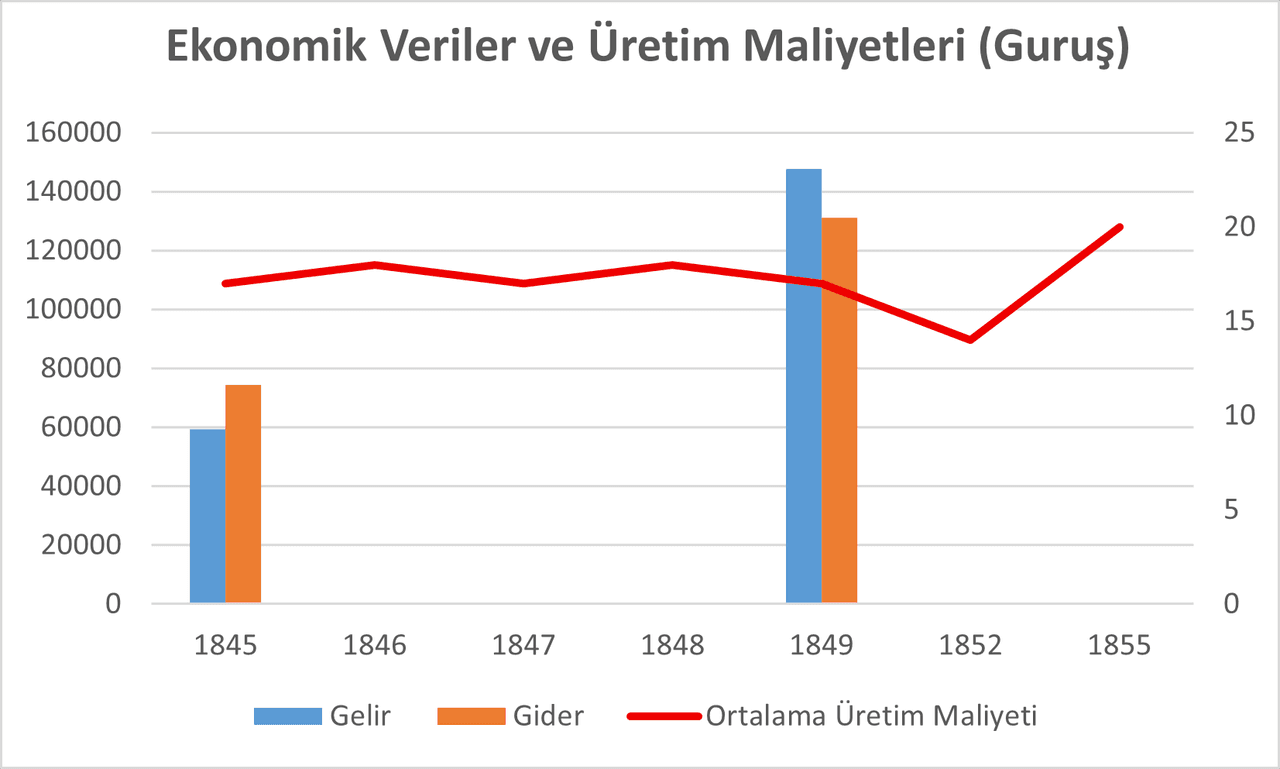
Economic Data and Production Costs (Source: Mehmet Salih Çoban)
The factory gradually reduced its operations from the 1860s onward, with production volume declining sharply. By 1890, its production capacity had been halved and some production lines were completely shut down. In 1895, the factory effectively ceased operations; most workers were dismissed and a significant portion of the machinery was dismantled and relocated to the İzmit and Hereke factories. By 1900, the Islimye Çuka Factory had closed completely.
After its closure, the buildings and land were used for various purposes for many years. In the early 20th century, the factory structures were repurposed as military warehouses and barracks. By the mid-20th century, some buildings were demolished while others were converted into local industrial facilities or storage spaces.
Today, some structures of the Islimye Çuka Factory remain partially standing within the city of Sliven, now in Bulgaria. Certain sections of the former factory buildings have been restored and are used as a municipal museum, cultural center, or exhibition hall. However, much of the factory has been destroyed or surrounded by modern constructions. Local authorities have undertaken various initiatives to preserve the industrial heritage of the past. Cultural memory of çuka weaving is still alive in Sliven, with small-scale production and exhibitions of traditional techniques carried out in some artisan workshops.
Baş, Yaşar. “III. Ahmed Devrinde İstanbul Çuha Fabrikasının Kuruluşu ve İşleyişi.” Bingöl Üniversitesi Sosyal Bilimler Enstitüsü Dergisi 8, no. 15 (2018): 123–145.https://doi.org/10.29029/busbed.376489
DISCOVERY OF PASSENGER. Tekstil Müzesi ve Fabrikası – #Sliven. YouTube video, 6:35. June 7, 2023. Accessed June 25, 2025.https://www.youtube.com/watch?v=dKaYJKzvlSQ
Ersoy İnci, Petek. “Geleneksel Bir El Sanatı: Çuha Dokuma.” Uluslararası Türk Dünyası Bilimsel Araştırmalar Dergisi 4, no. 1 (2023): 19–34. Accessed June 24, 2025.https://doi.org/10.54970/turkuaz.1299856
Güran, Tevfik. "Feshane." TDV İslâm Ansiklopedisi. Accessed June 24, 2025. https://islamansiklopedisi.org.tr/feshane.
OINK Bulgaria. “Национален Музей на Текстила и Облеклото – Сливен” [National Museum of Textile and Clothing – Sliven]. Accessed June 24, 2025.https://www.oink.bg/biz/nacionalen_muzey_na1.
Odabaşı, Necmi. “Mihaliç Çiftlikât-ı Hümâyûnu’nda Merinos Koyunu Yetiştiriciliği.” Uludağ Üniversitesi Fen-Edebiyat Fakültesi Sosyal Bilimler Dergisi 14, no. 25 (2013): 289–293. Accessed June 24, 2025.https://dergipark.org.tr/en/pub/sosbilder/issue/27477/290273
Uzun, Ahmet. “İslimye Çuka Fabrikası.” *İstanbul Üniversitesi Siyasal Bilgiler Fakültesi Dergisi*, no. 21-22 (January 2012). Accessed June 25, 2025.https://dergipark.org.tr/tr/pub/iusiyasal/issue/616/6219#article_cite

No Discussion Added Yet
Start discussion for "Islimye Çuka Factory" article
Establishment of the Islimye Çuka Factory
Mechanization and Technological Infrastructure
Production Capacity and Financial Structure
Management System and Operational Model
Raw Material Supply and Merino Breeding
Economic Data and Production Costs
Closure and Current Status