


This article was automatically translated from the original Turkish version.
Every morning when we wake up, touching our phone screens, swiping through notifications, and transferring fragments of our lives into the digital world has become an inseparable part of our daily routine. Throughout the day, the photos we share, the private messages we send, the playlists we create, the documents we store in cloud systems, and our instant interactions on social media leave behind a digital footprint.
But what if one day you leave behind only your digital traces? Have you ever considered what happens to this infinite digital universe we have built when our physical bodies depart this world? Despite spending such a large portion of our lives so openly in the online environment, we still do not take seriously enough the question of what becomes of our accounts and data after death.
Even though our physical existence ends, our digital footprints in the cyber world continue to persist. When a person dies, their social media accounts remain active and alive as if nothing has happened until their relatives or family members formally notify the relevant platform of the death.
The question of what happens to thousands of photos stored on your phone after your death creates profound uncertainty. The volume of data we have recorded in digital spaces during our lifetimes has grown far beyond anything we accumulated in the physical world. Yet the ownership, privacy, and posthumous management of this data remain vast unknowns.
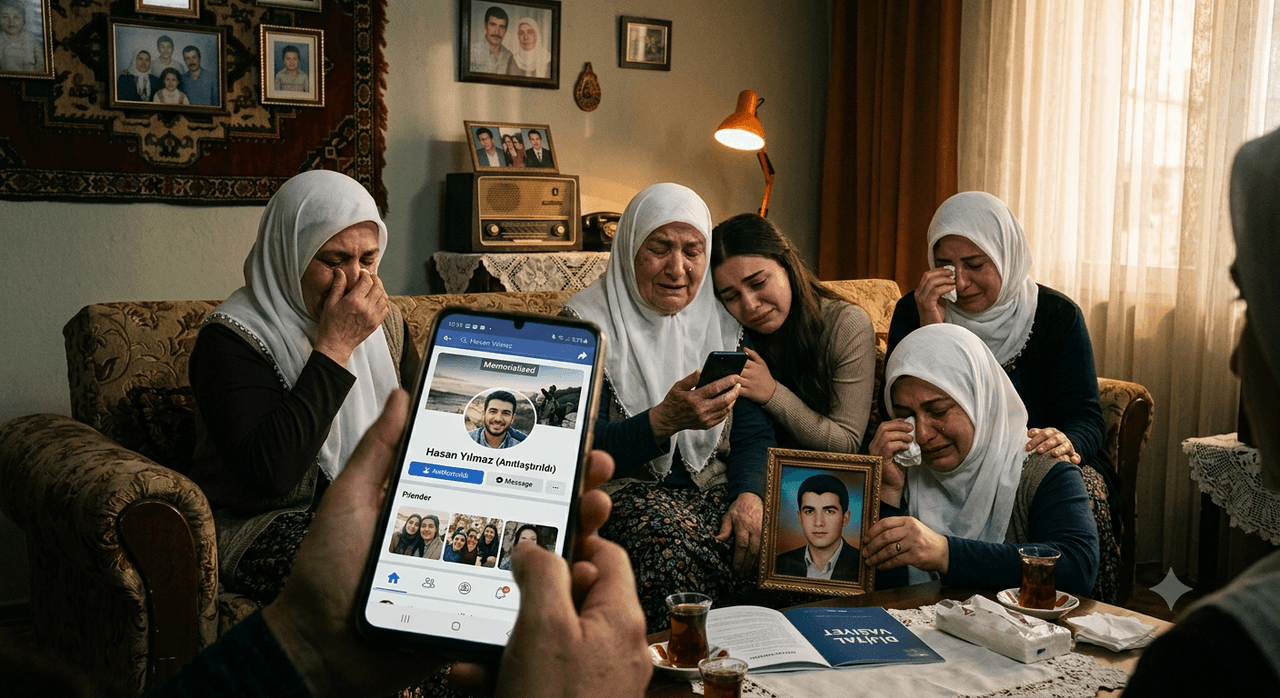
Yas Sürecinde Anıtlaştırılmış Sosyal Medya Hesaplarının Ziyaret Edilmesi (Yapay Zeka ile Oluşturulmuştur.)
To understand this situation, it is enough to examine real-life stories. In 2011, 15-year-old Eric Rash died by suicide, prompting his family and close friends to launch a major investigation to understand the reasons behind this heartbreaking loss and find answers to their questions. They wanted to look at Eric’s Facebook account to learn what he had been experiencing in his final days.
Unable to guess his password, they contacted Facebook officials directly to request access. Facebook, however, rejected their request, clearly stating that granting access to anyone other than the account holder would violate its user privacy policies.【1】 The Rash family, residing in the state of Virginia in the United States, responded by initiating legal action and filing a lawsuit; yet they were confronted with the reality that no legal framework existed at the time to regulate the posthumous administration or legal status of digital assets. This experience of the Rash family became one of the most prominent examples in history revealing how unprepared the internet world and technology giants were for handling death-related matters.
A similar tragic situation occurred to Hayley Smith in the United Kingdom. Hayley lost her 28-year-old husband, Matthew, to cancer in 2016. After his death, she felt uncertain about what to do with his social media accounts. The continued flow of birthday messages on Matthew’s Facebook wall from people unaware of his death became deeply distressing for the grieving widow. To prevent this and transform his profile into a memorial page, Hayley attempted more than twenty times to upload his official death certificate to Facebook’s system, but achieved no success.【2】 With no strength or energy left to directly contact the technology company to resolve the issue, Hayley described the emotional toll of constantly having to view the death certificate.【3】 Hayley, who said that in Matthew’s final days he was no longer himself and avoided talking about death, emphasized that companies must make this process easier for the families of the deceased.
It is precisely at this point that the policies and technical mechanisms applied by platforms regarding the digital accounts of deceased individuals come into play. Although social media platforms and technology giants vary in their approaches to death-related cases, all share a common priority: protecting user privacy.
For example, Meta, the parent company of Instagram and Facebook, offers two options upon receiving an official death certificate: either permanently remove the account from the system or freeze it using a process called “memorializing the account.” When a profile is memorialized, the word “In Memory of” appears next to the user’s name. Family and friends of the deceased can continue to share memories and photos on the memorialized page. Additionally, these accounts do not appear in “People You May Know” suggestions, and birthday reminder notifications are no longer sent to the deceased person’s friends.【4】 However, unless the account holder granted official authorization or permission while alive, no one can manage the account’s past content or request its complete deletion.
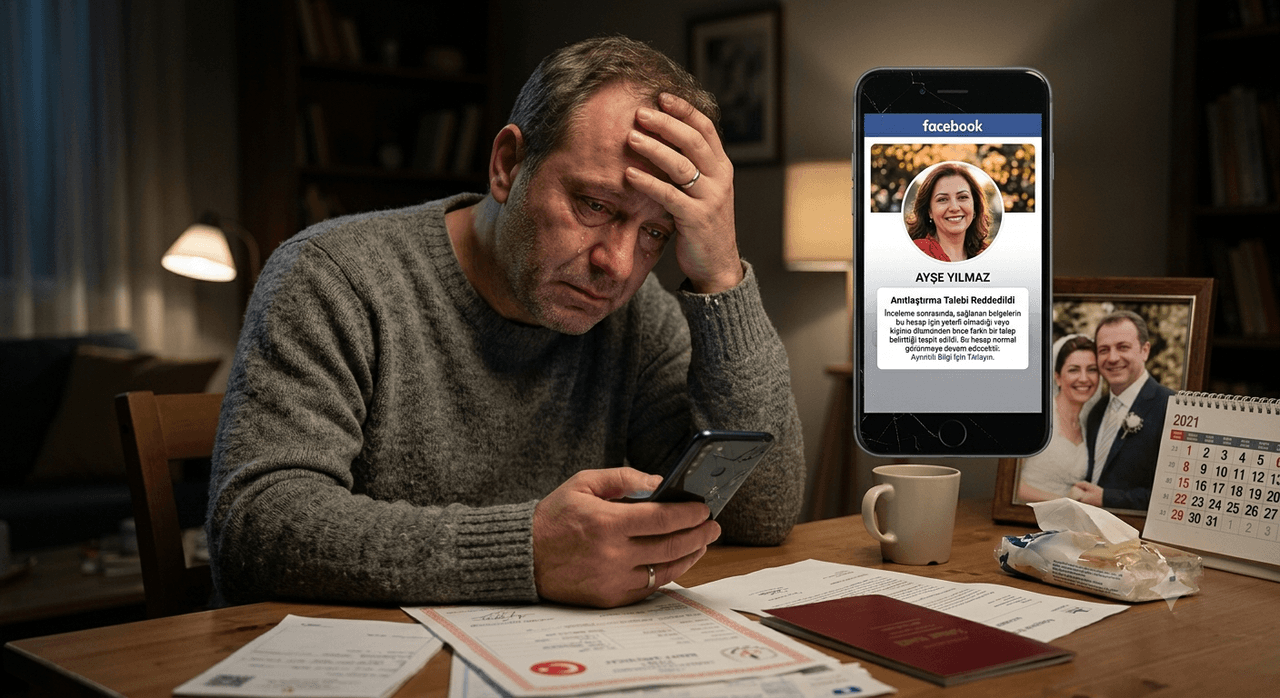
Eşini Kaybeden Bir Adamın, Resmi Süreçler Yetersiz Kaldığı İçin Facebook Hesabını Anıtlaştıramaması (Yapay Zeka ile Oluşturulmuştur.)
Different platforms may adopt entirely different policies in death-related cases. For instance, Google, which owns services such as YouTube, Gmail, and Google Photos, allows users while still alive to plan what happens to their data if their accounts remain inactive for a specified period. In email accounts without pre-established user instructions, Google carefully reviews posthumous requests and may provide content to family members.【5】
On the other hand, X (formerly known as Twitter) offers no option to memorialize the account of a deceased user; the only available option is complete removal of the account. Platforms like Yahoo and Facebook do not decrypt any private data from accounts without a court order.【6】 Technology experts and journalists emphasize that platforms do not directly share access credentials and that data such as photos and videos can only be accessed through specific requests and court orders issued under particular circumstances.【7】
When we examine the core of the issue, we must question why no action has been taken regarding what happens to internet accounts after death. One major reason for the neglect of digital inheritance is that most internet users are too young to contemplate their own mortality. However, as societies and the population of internet users age, the need to prepare digital wills becomes increasingly urgent. Today, it is impossible to directly include our digital details and passwords in traditional legal wills, because wills are public legal documents accessible to everyone. Instead, in classical wills, one can specify how to access these digital details and passwords. However, since usernames and access passwords are constantly updated and changed over time, there is a continuous need to keep the institutions or systems storing this information regularly informed.
In response to this legal and technical need, a new business model called “digital estate planning” has emerged and rapidly gained popularity. Companies like Cirrus Legacy, which securely store users’ login credentials for all their internet accounts and allow them to transfer access to a trusted individual, report that thousands of people have registered with their systems. The founders of these companies say they gradually realized how great the risk is for individuals to lose vast amounts of data and memories upon death.【8】 The range of services offered by companies in this sector is broad. For example, the online business My Wonderful Life allows its members to leave private messages to be delivered to loved ones after death, while the Facebook application ifidie enables users to schedule a joke, anecdote, or confession video to be posted on their profile after their death.【9】
However, “digital estate planning” services and password storage systems carry their own security risks and legal contradictions. Consolidating all sensitive access information for every internet account in a single third-party center could leave users completely vulnerable and exposed if that center falls victim to a cyberattack by hackers. Moreover, these storage companies are legally obligated to comply with court orders and hand over password information if formally requested by judicial authorities.
Another legal dimension is strikingly alarming: using a deceased family member’s login credentials and password to access their account is actually illegal.【10】 All established internet sites and service providers explicitly state in their terms of use that only the account holder is permitted to access the account. Furthermore, the revelation after death of a hidden aspect of the deceased that they had concealed or kept secret from their loved ones during life can produce unintended and undesirable consequences for the memory of the deceased.
But what if one day you face the risk that your data might fall into the hands of others? Cybercrime and advanced technology expert Sasa Zivanović issues critical warnings about the possibility that data, photos, and personal content belonging to deceased individuals could end up in the wrong hands or those of cybercriminals. Malicious actors can download profile data from systems to take full control of accounts or create fake accounts using the deceased person’s name.【11】 Using the deceased person’s photos, videos, and personal information, these fake accounts send messages to relatives and friends who are still unaware of the death, and in some cases even attempt to extract money from these loved ones.
Amid all these security risks and legal complexities, experts emphasize the urgent need for concrete measures. James Morris argues that everyone should back up all their online data.【12】 Indeed, on platforms like Facebook, it is possible to download your entire photo and video archive with a single click and safely transfer it to a family member. Morris describes the steps he would take if he were to contract a fatal illness: first, he would download all his photos and videos; second, he would permanently delete private messages he does not want his children to see.【13】 Then, he would collect his favorite photos in one place and write a short note or story for each one.【14】 Morris reminds us that social media platforms are ultimately commercial enterprises with no responsibility to act as custodians of people’s digital legacies, and he stresses the vital importance of creating a digital and social media legacy.【15】
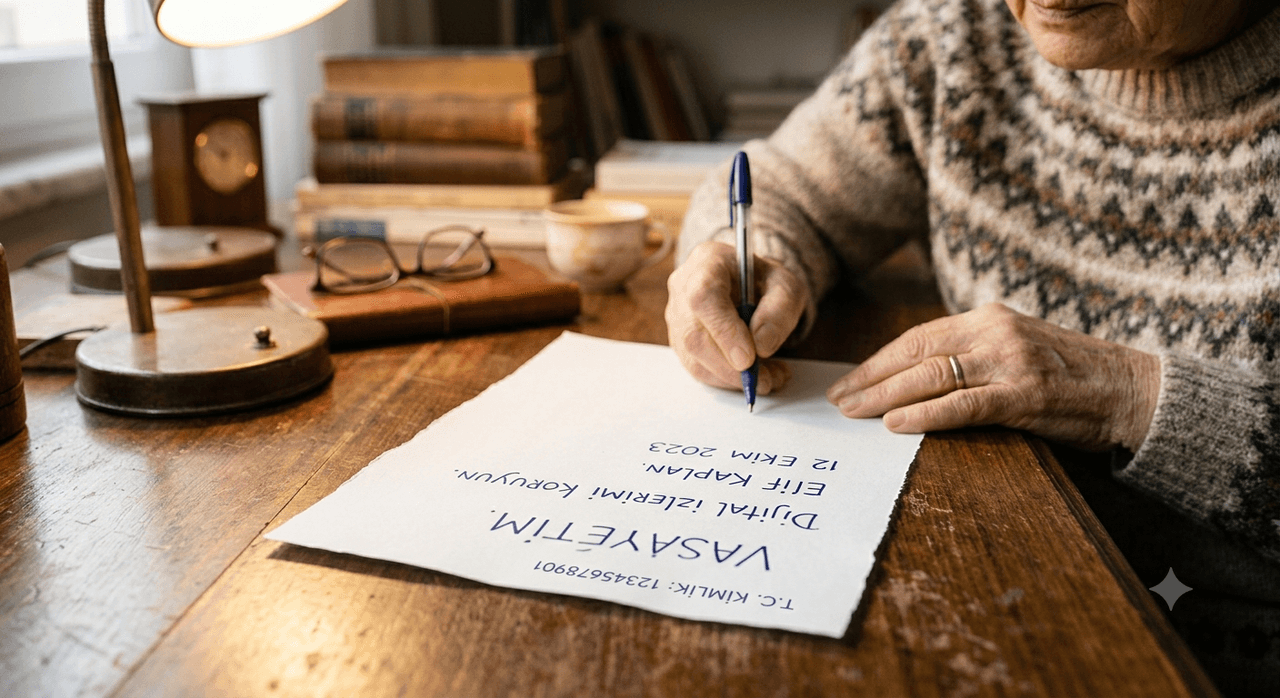
Dijital Vasiyet Hazırlama (Yapay Zeka ile Oluşturulmuştur.)
The digital legacy we leave behind after death is certainly not limited to our social network profiles or photo albums. Sarah Stanley from the Marie Curie charity, which supports people with terminal illnesses and their families, says individuals must plan for the management of all digital data they have created online, not just their social media accounts.【16】
Cloud computing systems, which enable access to services and data from anywhere in the world via the internet, store financial information, emails, music collections, social media interactions, and much more. Online banking has become commonplace. Beyond that, online games are growing increasingly popular among wider audiences, and people invest significant time and effort into creating avatars and establishing virtual lives within these digital universes. Thus, digital inheritance encompasses all these virtual creations.
Precisely for this reason, every individual must ask themselves some fundamental questions. Do you want a close relative to take full control of your social media accounts after your death, or do you prefer to be remembered respectfully through those accounts? Do you want to leave your thousands of digital photos as a digital album in computer folders for your children, or would you prefer to print them physically and pass them on as tangible photo albums? Since ownership policies for financial data, emails, music collections, and virtual avatars stored in cloud systems vary greatly between companies and have not yet been fully codified into legal frameworks, it has become a necessity to deeply reflect on these questions and discuss them openly with family members.
Despite all these complex digital estate planning tools and legal uncertainties, the most practical and secure solution offered by digital experts is remarkably simple. Evan Carroll from the Digital Beyond platform recommends writing down the usernames and passwords for all your online accounts on a piece of paper and giving it to a trusted person.【17】
Yet you can never know how profoundly meaningful a single photo, email, or message—seemingly insignificant while you are alive—can become to your loved ones after your death. In today’s world, where the boundary between the physical and digital realms has completely vanished, every trace we leave on the internet transforms into a digital echo that continues to exist long after we have departed this world.
BBC. "'Dijital vasiyet': Öldükten sonra sosyal medya hesaplarına ne oluyor, veri güvenliği için nasıl önlem alabiliriz?". Accessed July 23, 2026.https://www.bbc.com/turkce/articles/c51n9lk4lx1o.
BBC. "Öldükten sonra internet hesaplarımıza ne olacak?". Accessed July 23, 2026.https://www.bbc.com/turkce/haberler/2013/10/131010_dijital_vasiyet.
[1]
BBC, "Öldükten sonra internet hesaplarımıza ne olacak?", BBC, erişim 23 Temmuz 2026, https://www.bbc.com/turkce/haberler/2013/10/131010_dijital_vasiyet.
[2]
BBC. "'Dijital vasiyet': Öldükten sonra sosyal medya hesaplarına ne oluyor, veri güvenliği için nasıl önlem alabiliriz?" Accessed July 23, 2026.https://www.bbc.com/turkce/articles/c51n9lk4lx1o.
[3]
BBC. "'Digital will': What happens to social media accounts after death, and how can we take precautions for data security?"
[4]
BBC, "'Digital Will': What Happens to Social Media Accounts After Death, and How Can We Take Precautions for Data Security?"
[5]
BBC, "Öldükten sonra internet hesaplarımıza ne olacak?".
[6]
BBC, "Öldükten sonra internet hesaplarımıza ne olacak?".
[7]
BBC, "Öldükten sonra internet hesaplarımıza ne olacak?".
[8]
BBC, "Öldükten sonra internet hesaplarımıza ne olacak?".
[9]
BBC, "Öldükten sonra internet hesaplarımıza ne olacak?".
[10]
BBC, "Öldükten sonra internet hesaplarımıza ne olacak?".
[11]
BBC, "'Digital Will': What Happens to Social Media Accounts After Death, and How Can We Take Precautions for Data Security?"
[12]
BBC, "'Digital Will': What Happens to Social Media Accounts After Death, and How Can We Take Precautions for Data Security?"
[13]
BBC. "'Digital Will': What Happens to Social Media Accounts After Death, and How Can We Take Precautions for Data Security?"
[14]
BBC, "'Digital Will': What Happens to Social Media Accounts After Death, and How Can We Take Precautions for Data Security?"
[15]
BBC. "'Digital Will': What Happens to Social Media Accounts After Death, and How Can We Take Precautions for Data Security?"
[16]
BBC. "'Digital Will': What Happens to Social Media Accounts After Death, and How Can We Take Precautions for Data Security?"
[17]
BBC, "Öldükten sonra internet hesaplarımıza ne olacak?".
