This article was automatically translated from the original Turkish version.
+2 More
Ironwood TPU
Publication Date | 2025-04-09 | ||||||||
|---|---|---|---|---|---|---|---|---|---|
Website | https://blog.google/products/google-cloud/ironwood-tpu-age-of-inference/ | ||||||||
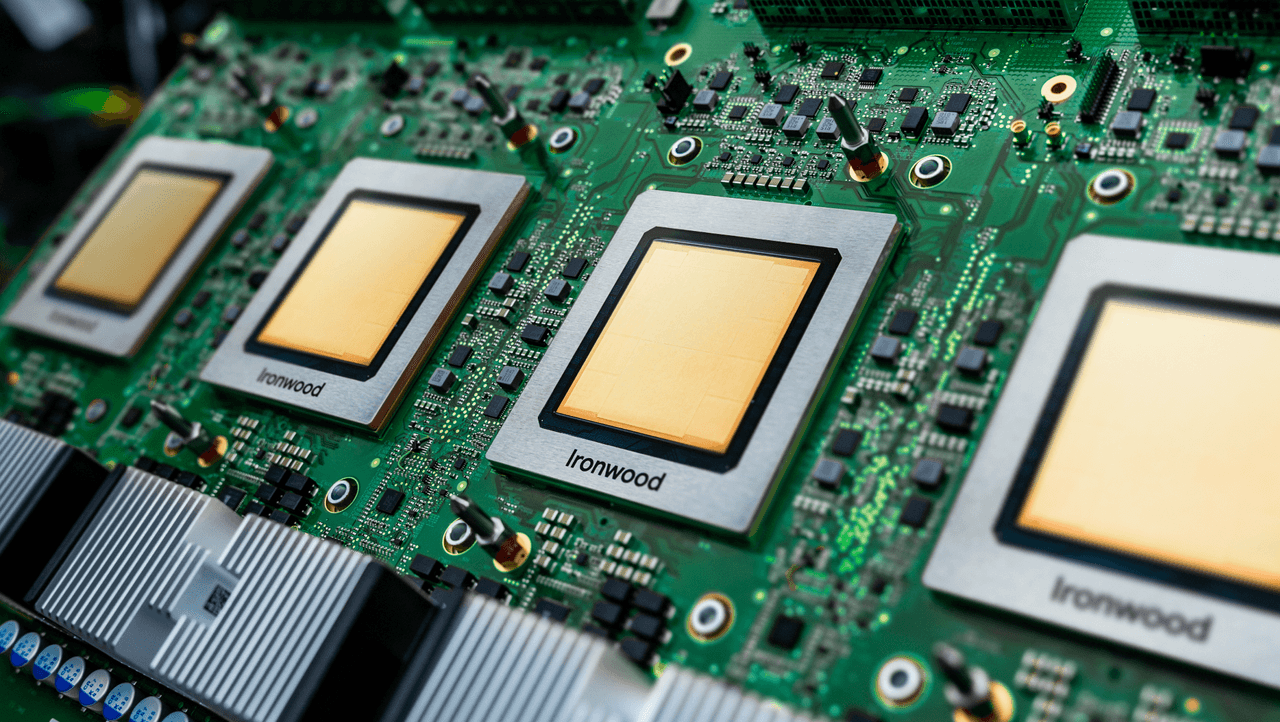
Ironwood is the seventh-generation Tensor Processing Unit (TPU) chip developed by Google and introduced at the Google Cloud Next 2025 event. Unlike previous TPU models designed primarily for training, Ironwood is specifically engineered for inference operations. It serves applications requiring high computational capacity such as large language models (LLMs), Mixture of Experts (MoE) architectures, and inference tasks.
Each Ironwood chip delivers 4.614 TFLOPS of processing power in FP8 format. It features 192 GB of high bandwidth memory (HBM), six times the capacity of the previous generation Trillium TPU. Memory bandwidth reaches 7.2 TBps per chip. Ironwood’s architecture aims to minimize data transfer latency and enhance efficiency in large tensor operations.
Ironwood chips are interconnected via a high-bandwidth Inter-Chip Interconnect (ICI) technology and grouped into structures called “pods.” A single pod can accommodate 9,216 chips. This configuration provides 42.5 exaflops of computational capacity—24 times the processing power per pod of El Capitan, one of the world’s most powerful supercomputers today. Google offers two configurations: a 256-chip setup and a full pod of 9,216 chips.
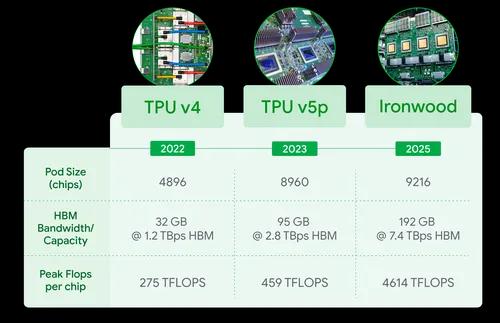
Technical Comparison of Ironwood with Previous Generation TPUs (Source: Google)
Ironwood chips are equipped with liquid cooling systems. This system enables chips to operate at high frequencies under sustained heavy workloads. It provides twice the energy efficiency of Trillium and approximately 30 times greater energy savings compared to Google’s first-generation TPU.
Ironwood is compatible with Google DeepMind’s Pathways execution system. Pathways supports distributed computation across chips and enables thousands of Ironwood chips to operate in unison across multiple pod configurations. This architecture is used for training and inference of large models.
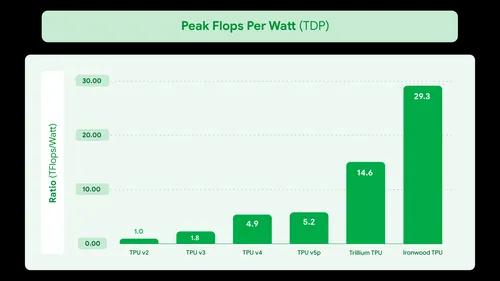
Energy Consumption Comparison Among TPUs (Source: Google)
Ironwood is used as a scalable artificial intelligence infrastructure in finance, retail, telecommunications, and healthcare. In finance, it supports market data analysis; in retail and services, it powers customer service systems; and in healthcare, it enables medical data processing and decision support systems.
Ironwood chips feature a specialized accelerator called SparseCore, designed to enhance performance in large embedding processing tasks and recommendation systems. Expanded SparseCore support enables its use in models within financial and scientific domains.
Initially, Ironwood is configured for internal use within Google’s systems. Models such as Gemini 2.5 are already running on this infrastructure. Its release to developers will follow the completion of performance optimization within Google’s internal systems.
Ironwood delivers a four to fivefold improvement in overall performance compared to Trillium TPU. ICI bandwidth reaches 1.2 TBps bidirectional communication capacity. Memory capacity has increased sixfold and memory bandwidth by 4.5 times. These enhancements enable more efficient operation of high-dimensional models.
The computational density and energy efficiency of Ironwood enable AI applications to be delivered at lower costs. Reduced energy consumption represents a significant advantage aligned with sustainability criteria. Shorter processing times reduce model development and deployment cycles.
Google positions Ironwood as a strategic component of its AI infrastructure. A $7.5 billion capital investment underscores its role within the company’s full-stack AI strategy. Ironwood serves as the foundational hardware component of a three-layered architecture encompassing hardware, foundational models, and software tools for multi-agent systems.
Ironwood is one of the high-performance chip architectures designed for the era of inference-driven artificial intelligence. With its high computational power, memory capacity, and energy efficiency, it meets the technical demands of inference workloads. Its enterprise applicability and distributed computing-enabled architecture facilitate the deployment of AI applications across diverse industries.
Forbes. "Google Cloud’s Ironwood TPU Forges Better Enterprise AI." Accessed April 15, 2025.https://www.forbes.com/sites/maribellopez/2025/04/14/google-clouds-ironwood-tpu-forges-better-enterprise-ai/.
Observer Voice. "Google Unveils Powerful Ironwood TPU for AI." Accessed April 15, 2025.https://observervoice.com/google-unveils-powerful-ironwood-tpu-for-ai-110301/
Reuters. "Google Launches New Ironwood Chip to Speed AI Applications." Accessed April 15, 2025.https://www.reuters.com/technology/google-launches-new-ironwood-chip-speed-ai-applications-2025-04-09/
TechCrunch. “Google Unveils Ironwood, a New AI Accelerator Chip.” Accessed April 15, 2025.https://techcrunch.com/2025/04/09/google-unveils-ironwood-a-new-ai-accelerator-chip/.
The New Stack. "Ironwood: Google’s Answer to Nvidia in the AI Chip Wars." The New Stack. Accessed April 15, 2025.https://thenewstack.io/ironwood-googles-answer-to-nvidia-in-the-ai-chip-wars/

Ironwood TPU
Publication Date | 2025-04-09 | ||||||||
|---|---|---|---|---|---|---|---|---|---|
Website | https://blog.google/products/google-cloud/ironwood-tpu-age-of-inference/ | ||||||||
Technical Specifications
Application Areas
Structural Components
Enterprise-Level Benefits