


This article was automatically translated from the original Turkish version.
The first underwater vehicle was developed in Austria in 1864 by Luppis-Whitehead Automobile. This vehicle was a remotely controlled torpedo-shaped underwater device. The first model resembling modern vehicles was the Poodle, designed by Dimitri Rebikoff in 1953.
The first significant advances in unmanned underwater vehicles were made by the British Royal Navy and the US Navy. Initially these vehicles lacked autonomous movement capabilities and were controlled via remote command. Their purposes included mine clearance, explosive disposal, and mapping ocean floors for military applications. Due to insufficient energy technology of the era, these vehicles could not operate for extended periods. Additionally, control by operators was very difficult as signals could not be reliably transmitted through water. However, they were still used for long periods by the US Navy and the British Royal Navy. During the Iran-Iraq War, they were effectively deployed in the Hormuz Strait to detect mines.
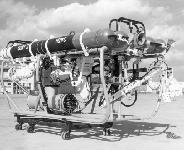
US Navy CURV II-Intelligence Resource Program
Turkey’s first serious effort in this field was the ULİSAR project conducted under the TÜBİTAK-1001 program. It was developed within the framework of Middle East Technical University. Although the project did not fully achieve its intended goals, it resulted in a system equipped with visual navigation, cameras, projectors, sonar, sonar modems, acoustic sensors, and similar devices. The relevant electronic circuits were designed and manufactured, software for these devices was developed, and an operator console was created to facilitate user interaction.
The first autonomous vehicle was the AUVTECH project initiated by Istanbul Technical University. It can navigate autonomously underwater based on image and signal processing inputs. It can execute pre-programmed missions autonomously. It is equipped with artificial intelligence capable of responding to underwater stimuli. It also has a pneumatic system for specialized tasks such as torpedo deployment, marker release, or deployment of auxiliary equipment.
One of the earliest locally developed high-tech vehicles is SAGA, a project of Middle East Technical University. SAGA is a mini-ROV class exploration and observation vehicle whose entire design and production was carried out using 100% domestic capabilities by DESİSTEK. It is equipped with advanced technology and can perform geological, hydrographic, and archaeological research, oil and gas exploration, and missions such as ship and port security.
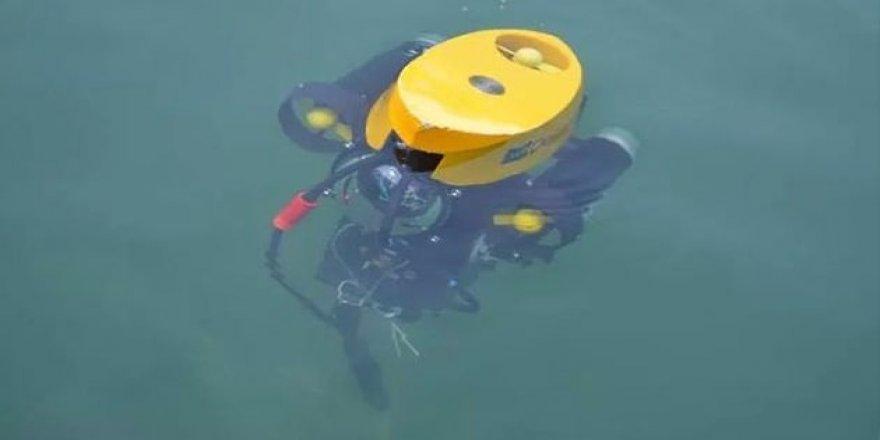
METU SAGA- Vira Haber
Developed by STM Defense, the NETA 300 is a modern autonomous underwater vehicle. It has a broad mission spectrum including MKT operations, search and rescue missions, military operations, and civil and industrial applications. This vehicle can dive up to 300 meters and operate continuously for 24 hours. It has a maximum speed of 5 nautical miles per hour and is light enough to be transported by two personnel. It features a flexible and modular design.

STM NETA 300-STM DEFENSE
Developed by Aselsan, the Deringöz can dive to a depth of 600 meters. Powered by a single battery, it can operate for five hours and achieves a maximum speed of 5.5 knots with a survey speed of 3 knots. It operates wirelessly and can execute multiple mission scenarios.

Aselsan Deringöz 100M/600 - Aselsan
Primarily designed as a kamikaze system, ÇAKA is being developed by HAVELSAN. ÇAKA is capable of operating both underwater and on the surface. It exhibits a deterrent profile through continuous surface engagement, the ability to carry high-explosive payloads, underwater stealth and surprise attack capability, and the ability to conduct integrated operations with other unmanned systems.

ÇAKA-HAVELSAN
ASELSAN. "DERİNGÖZ 100M/600." Accessed February 8, 2025.https://www.aselsan.com/tr/savunma/urun/3335/deringoz-100m600.
Avcı, Ahmet, and others. "AUVTECH OPENROV’un Hibrit AUV’sinin Tanıtımı ve Konsept Tasarımı." AUVSI & ONR'sRoboSub Yarışması Journal Article 17 (2014).
Avcı, Ahmet, and others. "AUVTECH OPENROV’un Hibrit AUV’sinin Tanıtımı ve Konsept Tasarımı." AUVSI & ONR'sRoboSub Yarışması Journal Article 17 (2014).
Canlı, G. A., İ. Kurtoğlu, M. O. Canlı, and Ö. S. Tuna. "Dünyada ve Ülkemizde İnsansız Sualtı Araçları: ISAA-AUV & ROV Tasarım ve Uygulamaları."GİDB Dergi 04 (2016): 43-75.
HAVELSAN. “ÇAKA: Dalış Yapabilen Kamikaze İDA.” Accessed February 8, 2025.https://www.havelsan.com/tr/urunler/caka-dalis-yapabilen-kamikaze-ida.
STM. "STM-NETA." Accessed February 8, 2025.https://www.stm.com.tr/tr/cozumlerimiz/deniz-projeleri/stm-neta.
Star Gazetesi. “Yerli İnsansız Su Altı Gözlem Aracı SAĞA.” Accessed February 8, 2025.https://www.star.com.tr/teknoloji/yerli-insansiz-su-alti-gozlem-araci-saga-haber-1268006/.

No Discussion Added Yet
Start discussion for "Introduction and Development of Unmanned Underwater Vehicles in Türkiye's Defense Industry" article
Early Stages of Unmanned Underwater Vehicles
Turkey’s First Unmanned Underwater Vehicles
Current Vehicles
STM NETA 300
ASELSAN DERİNGÖZ 100M/600
ÇAKA