


This article was automatically translated from the original Turkish version.
+2 More
Interplanetary societies refer to a large-scale civilizational model in which humanity establishes permanent settlements on multiple celestial bodies and develops interconnected social, economic, and cultural systems. This concept encompasses not only physical presence in space but also the redefinition of social institutions communication networks and identity forms at an interplanetary scale. Such a social structure requires new forms of organization not only through technological advancement but also in cultural political and ethical dimensions.
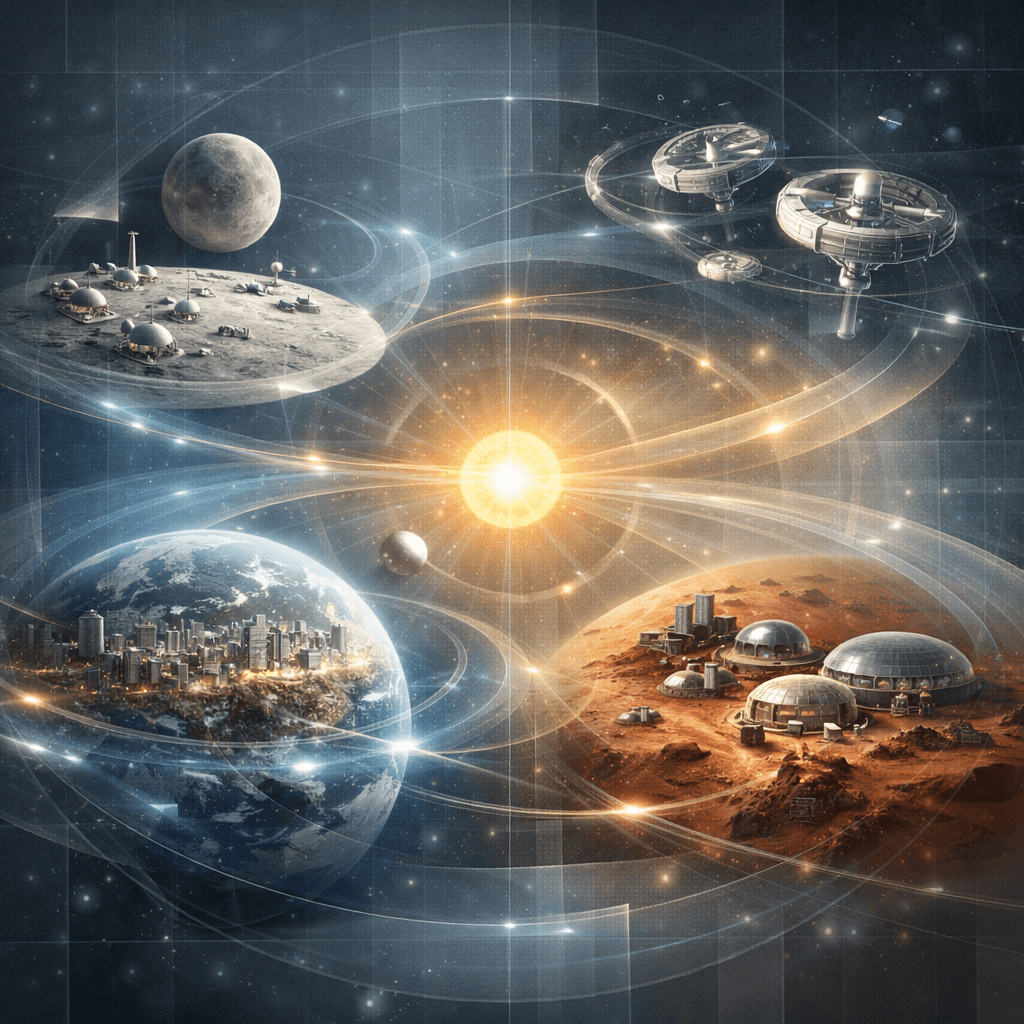
A Visual Representing Interplanetary Societies (Generated by Artificial Intelligence).
The idea of interplanetary societies is addressed within a newly emerging field of research called astrosociology. Astrosociology examines the conditions of human existence in space how social relationships might form and how cultural norms could evolve. In this context space settlements are viewed not merely as engineering projects but also as sociological laboratories. Colonies established in space may develop value systems authority structures and senses of belonging distinct from those on Earth. The contribution of the social sciences is decisive in understanding the societal consequences of technological progress.
One of the fundamental elements of interplanetary societies is how communities living on different celestial bodies will be institutionally organized. Establishing economic and political relations among distinct settlement units such as Earth the Moon Mars and orbital stations determines the sustainability of these societies. Common principles must be developed in areas such as resource management production systems legal frameworks and information sharing. However since each settlement unit faces different environmental conditions these institutions must possess high adaptive capacity. This necessitates a multilayered governance model in which centralized coordination between planets is balanced with local autonomy.
In interplanetary societies cultural identity evolves in distinct ways due to spatial distance and communication delays. Earth-centered identities may be replaced by new identity structures based on multiple affiliations. Individuals born and raised in colonies on Mars or the Moon may define themselves not only as members of humanity but also through the unique environmental and cultural context of their home planet. Over the long term this differentiation could lead to increased interplanetary cultural diversity. Simultaneously cultural expressions such as art language architecture and rituals may evolve in new directions adapting to altered living conditions.
The economic structure of interplanetary societies relies on the large-scale coordination of energy information and material flows. Space mining energy production life support systems and transportation networks form the infrastructure of this economy. Artificial intelligence and autonomous systems play a critical role in maintaining coordination between distant colonies. Logistics networks and data communication become essential tools for interplanetary cooperation. The economic system encompasses not only production and distribution relationships but also information sharing and collaborative scientific research activities.
The political organization of interplanetary societies necessitates a reevaluation of fundamental concepts such as sovereignty property and representation. The degree of independence of space settlements their legal relationship with Earth and the sharing of resources must be debated. This situation brings forward the concept of a new “cosmic law.” Beyond international agreements communities living on different planets are expected to develop their own unique laws and governance systems. Democratic representation may be affected by physical constraints such as communication delays and distance. Therefore governance systems must balance centralized decision-making with local autonomy.
Interplanetary societies fundamentally redefine humanity’s relationship with nature and the universe. In this context ethical questions must be addressed not only from a human-centered perspective but also at a universal level. Humanity’s responsibility must be reconsidered in light of other planetary ecosystems potential microbial life or future artificial intelligence communities. Moreover given the historical connotations of the term colonization the concept of “settlement” must be clearly distinguished from colonialist approaches. Building new societies in space must occur within an ethical framework aligned with principles of justice equality and sustainability.
The cohesion of interplanetary societies depends on the effectiveness of communication and transportation systems. Technical limitations such as delayed data transmission signal attenuation and energy costs directly affect social interaction. Consequently research is intensifying on advanced quantum communication methods and highly efficient transportation systems. These technologies create an infrastructure that supports not only information exchange but also social solidarity.
The concept of interplanetary societies offers a comprehensive intellectual framework for envisioning humanity’s future forms of civilization. These potential societies represent a new evolutionary stage that redefines human identity institutions and value systems beyond technological advancement. This subject situated at the intersection of sociology political science ethics law and engineering holds fundamental importance for understanding how humanity might sustain its existence on a cosmic scale.
Arguello, Edgar, Sam Carter, Cristina Grieg, Michael Hammer, Chris Prather, Clark Petri, and Anamaria Berea. “An Exploration of Mars Colonization with Agent-Based Modeling.” *arXiv preprint*, 2023. Accessed December 20, 2025.https://arxiv.org/abs/2308.05916
Berea, Anamaria, Celia Blanco, Jacob Haqq-Misra, Sanjoy Som, George Profitiliotis, and Graham Lau. “Space Settlement and Astrobiology: Connections and Overlaps.” SSRN Working Paper, October 7, 2025. Accessed December 20, 2025.https://ssrn.com/abstract=5124328
Bruhns, Sara, and Jacob Haqq-Misra. “A Pragmatic Approach to Sovereignty on Mars.” *Space Policy* 38 (2016): 57–63. Accessed December 20, 2025.https://doi.org/10.1016/j.spacepol.2016.05.008
Crawford, Ian A. “Stapledon’s Interplanetary Man: A Commonwealth of Worlds and the Ultimate Purpose of Space Colonisation.” *Journal of the British Interplanetary Society*. 2012. Accessed December 20, 2025.https://arxiv.org/abs/1207.1498
Dickens, Peter and James S. Ormrod. Cosmic Society: Towards a Sociology of the Universe. London: Routledge, 2007.
Eller, Jack David. “Space Colonization and Exonationalism: On the Future of Humanity and Anthropology.” *Humans* 2, no. 3 (2022): 148–160. Accessed December 20, 2025.https://doi.org/10.3390/humans2030010
Mihăescu, Tudor. “Imagining a Community in Outer Space: The Sociological Challenges Contained in the Winning Projects of NASA’s Space Settlement Contest.” *Noah’s Ark: An Improbable Space Survival Kit.* ed. Corina Ilea and Stefan Constantinescu. 2021: 72–79. Accessed December 20, 2025.https://www.academia.edu/103440966/Imagining_a_Community_in_Outer_Space_The_Sociological_Challenges_Contained_in_the_Winning_Projects_of_NASAs_Space_Settlement_Contest
Neukart, Florian. “Towards Sustainable Horizons: A Comprehensive Blueprint for Mars Colonization.” *Heliyon* 10, no. 4 (2024): e26180. Accessed December 20, 2025.https://doi.org/10.1016/j.heliyon.2024.e26180
Pass, Jim. “The Astrosociology of Space Colonies: Or the Social Construction of Societies in Space.” *AIP Conference Proceedings* 8713, no. 1 (2006): 1153–1161. Accessed December 20, 2025.https://doi.org/10.1063/1.2169297
Smiles, Deondre. “The Settler Logics of (Outer) Space.” Society and Space. Accessed December 20, 2025.https://www.societyandspace.org/articles/the-settler-logics-of-outer-space

No Discussion Added Yet
Start discussion for "Interplanetary Societies" article
Theoretical Background
Social Organization and Institutions
Cultural Evolution and Identity Formation
Economic and Technological Networks
Political Structures and Legal Frameworks
Ethical and Philosophical Dimensions
Communication Transportation and Social Connectivity