


This article was automatically translated from the original Turkish version.
Intermodal transportation is a modern logistics system that integrates different modes of transport—including road, sea, rail, and air as well as—to transfer cargo without handling it outside a standard unit such as a container. This method enhances the cost efficiency, traceability, and sustainability of global supply chains by enabling fast, secure, and efficient transfers between modes. In international logistics, it offers strategic advantages such as accelerating cross-border trade, reducing environmental impacts, and optimizing transport resources.
The term “intermodal” derives from the Latin “inter” (between) and “moda” (method, style). It entered logistics literature in the mid-20th century and became one of the foundational concepts of modern supply chain management. With the development of containerization technology from the 1950s onward, intermodal transportation became widespread. The first modern intermodal terminals were established in the USA in the 1960s and later spread to Europe and Asia. Today, it operates integrated with digital tracking systems, satellite-based route optimization, and carbon emission reduction technologies, gaining increasing value as an indispensable component of global trade.
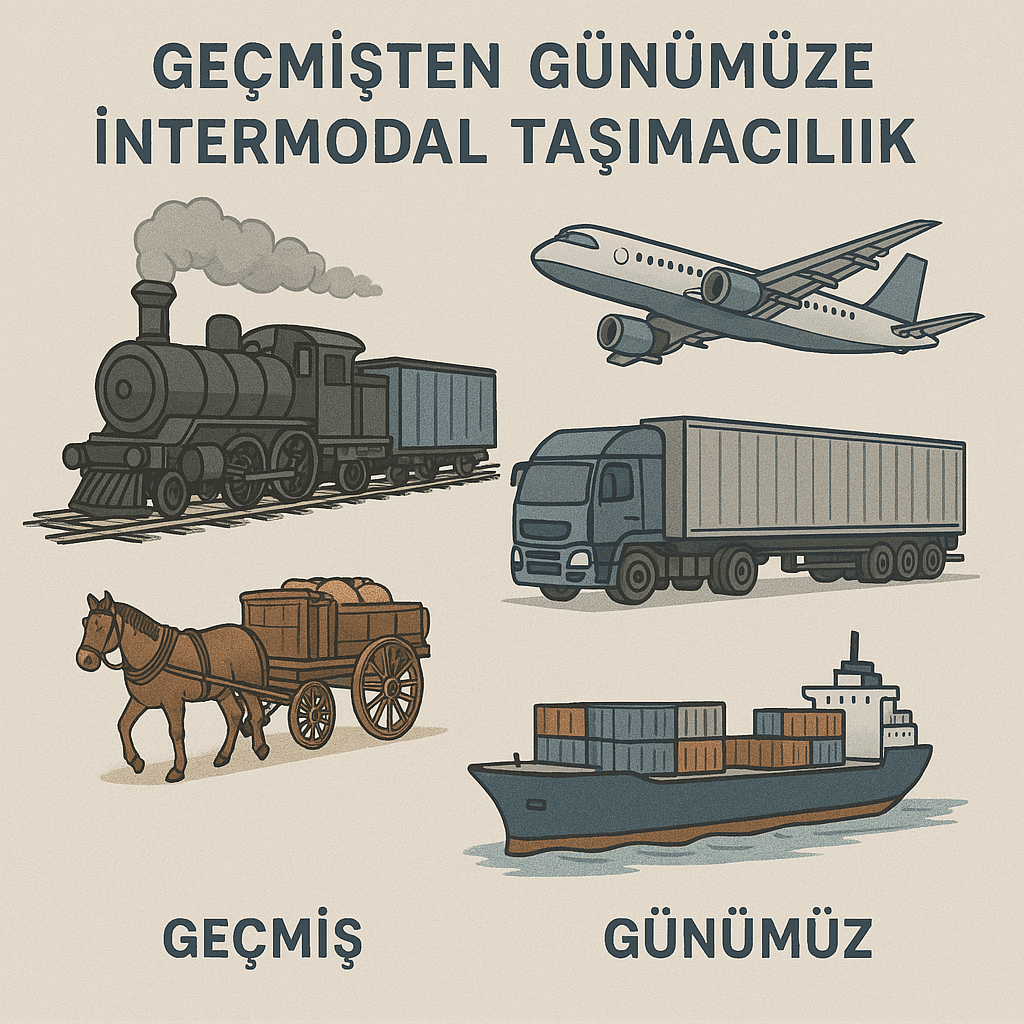
(Image Generated by Artificial Intelligence)
Intermodal transportation provides a strategic logistics solution for both public and private sectors. Its primary applications across various fields include:
International Trade
It enables the timely and cost-effective transport of goods from ports to inland areas or across borders.
It offers fast and organized solutions for integrated shipments between warehouses and distribution centers.
It is used to transport raw materials and semi-finished goods to production facilities and finished products to distribution centers.
In projects developed by institutions such as the Ministry of Transport and Infrastructure, intermodal solutions are preferred as a component of sustainable transportation.
It contributes to eco-friendly transportation by reducing carbon emissions.
Thanks to its ability to rapidly integrate multiple transport modes, it plays a critical role in emergency relief and evacuation operations.
Intermodal solutions are studied as research topics in disciplines such as logistics engineering, urban planning, and sustainable mobility strategies.
2053 Transportation and Logistics Master Plan https://www.uab.gov.tr/uploads/pages/bakanlik-yayinlari/20221025-2053-ulastirma-ve-lojistik-ana-plani-tr.pdf
Chopra, Sunil, and Peter Meindl. Supply Chain Management: Strategy, Planning, and Operation. Pearson, 2012.
Christopher, Martin. Logistics & Supply Chain Management. FT Press, 2016.
Rodrigue, Jean-Paul. The Geography of Transport Systems. Routledge, 2020.
T.C. Ulaştırma ve Altyap Bakanlığı.
Tsamboulas, Dimitrios, and Yannis Kapros. "Intermodal Transport and Logistics." Transportation Research Procedia, vol. 25, 2017, pp. 1182–1195.
United Nations Economic Commission for Europe (UNECE). Intermodal Transport and Logistics. UN Publications, 2021.

No Discussion Added Yet
Start discussion for "Intermodal Transportation" article
Origin and History
Application Areas and Interdisciplinary Use
E-Commerce and Distribution Systems:
Industry and Manufacturing Sector:
Public Infrastructure Projects:
Environmental Sustainability:
Crisis and Disaster Management:
Academic and Engineering Fields: