


This article was automatically translated from the original Turkish version.
+1 More
Intermittent Explosive Disorder (IED) is a clinical condition classified under the category of Impulse-Control Disorders in the DSM-5 diagnostic criteria. The core feature of this disorder is the individual’s inability to resist impulses, urges, or provocations that may result in harm to oneself or others. Within the framework of psychodynamic theories, this condition is described as a weakening or collapse of the self-regulatory mechanism between the impulsive "id" and the controlling "superego".【1】
Epidemiological studies indicate that Intermittent Explosive Disorder follows a widespread pattern in the general population. Data show a lifetime prevalence of 7.3 percent and a 12-month prevalence of 3.9 percent. When examining gender distribution, the disorder is found to occur approximately twice as frequently in males as in females.【2】
The onset of the disorder typically occurs during adolescence. Aggressive outbursts peak in the twenties and thirties and tend to decline from the forties onward. Low educational attainment, low socioeconomic status, and being unmarried are among the key risk factors associated with the disorder.

Visual representation of Anger Control Disorder (generated by artificial intelligence)
The origins of anger control disorders are explained by the interaction of genetic, neurobiological, and environmental factors:
Neurobiology and Genetics: Low levels of serotonin metabolites in cerebrospinal fluid are directly associated with impulsive aggression. Additionally, neurotransmitters such as testosterone, dopamine, and GABA play roles in this process. Brain imaging studies have revealed that reduced activation in the ventromedial prefrontal cortex and amygdala impairs the ability to inhibit anger responses.
Psychosocial Factors: Exposure during childhood to physical or emotional neglect, abuse, witnessing violence, and an unstable family environment are significant risk factors. Individuals raised in such environments may internalize violence as a strategy for problem solving.
In Intermittent Explosive Disorder, anger outbursts are disproportionate, unplanned, and sudden in relation to the stressors encountered. These episodes generally do not serve a secondary gain. Physiologically, the "fight-or-flight" response is triggered during aggressive acts; blood pressure rises and muscle tension intensifies. Although the individual may experience brief relief during the outburst, they typically feel intense guilt and remorse afterward.【3】
In clinical literature, anger is categorized into three subtypes based on expression patterns:

Visual representation of Anger Control Disorder (generated by artificial intelligence)
A significant proportion of individuals diagnosed with Intermittent Explosive Disorder also meet criteria for comorbid conditions such as major depression, anxiety disorders, attention-deficit/hyperactivity disorder (ADHD), or substance use disorders.【5】
During diagnosis, IED must be distinguished from Obsessive-Compulsive Disorder, where obsessions dominate; Oppositional Defiant Disorder, where defiance is prominent; and Conduct Disorder, where violations are planned and systematic. In IED, reactions are reactive and impulsive, not systematic.
While temper tantrums in early childhood are considered developmentally normal, increased severity and frequency can indicate a pathological condition requiring clinical intervention. In children aged two to three, increased frequency of tantrums expressed through crying, yelling, or hitting objects is developmentally typical due to limited vocabulary and difficulty expressing emotions. However, if a child experiences more than three tantrums per day lasting longer than ten minutes, continues to have severe outbursts beyond age four, harms themselves or others, or exhibits involuntary muscle contractions during anger episodes, these constitute pathological conditions requiring urgent specialist evaluation.【6】

Visual representation of Anger Control Disorder (generated by artificial intelligence)
In psychiatric literature, such destructive behaviors in children and adolescents are generally examined under the categories of Oppositional Defiant Disorder (ODD), Conduct Disorder (CD), and Disruptive Mood Dysregulation Disorder (DMDD). In children diagnosed with ODD, irritability, defiance, and vindictiveness are prominent; in Conduct Disorder (CD), deliberate violation of others’ rights, theft, property destruction, and planned physical aggression toward people or animals are characteristic.【7】
Major causes of anger and aggression in children include inability to dissipate excess energy due to modern dietary habits, direct exposure to domestic violence or conflict, parents reinforcing aggressive behaviors through early reward, and children learning that aggression is an effective means to obtain desired outcomes.
Trauma and abuse histories during childhood play a critical role in the etiology of anger control problems, impulsivity, and destructive behaviors. Neurobiological and psychological evidence confirms that children exposed to physical, emotional, or sexual abuse in early developmental stages later struggle to evaluate consequences, inhibit responses, and make impulsive decisions.
Child abuse victims, unable to verbalize the intense stress caused by trauma, often externalize these emotions through uncontrolled actions or internalize them as overly controlled behaviors.
These deficits in impulse control and emotional regulation lead to risky behaviors in adolescence and adulthood that endanger the individual’s life. Individuals with histories of abuse are more likely to engage in high-speed driving, driving under the influence of alcohol, failure to use seat belts or helmets, substance and alcohol dependence, gambling, rapid escalation into physical altercations, and carrying sharp or firearms.
This dangerous link between impulsivity and risky behavior is attributed to increased sensitivity to reward, inability to rationally assess potential harm, and failure to inhibit the pursuit of intense stimulation.
According to the General Aggression Model (GAM), aggressive behaviors arise from the interaction between environmental and situational factors and an individual’s internal and cognitive structure. Exposure to violent video games, which are highly prevalent among children, adolescents, and young adults, is one of the most significant environmental risk factors in this context.【8】

Visual representation of Anger Control Disorder (generated by artificial intelligence)
Violent video games that vividly and realistically depict harm to others lead players to experience moral disengagement, cognitively justifying unethical actions. Individuals with heightened moral disengagement employ mechanisms such as dehumanizing victims or distorting harmful consequences. When these mechanisms combine with the individual’s internal anger and hostility, prolonged exposure to violent games establishes a direct link between gaming and physical and verbal aggression, permanently lowering the threshold for violent behavior.
The neurobiological underpinnings of anger and impulsive aggression involve brain regions such as the prefrontal cortex, orbitofrontal cortex, striatum, amygdala, and hypothalamus, along with complex neurotransmitter systems. Specifically, low levels of 5-hydroxyindoleacetic acid, a primary serotonin metabolite in cerebrospinal fluid, are directly associated with impulsive aggression, violent tendencies, and anger outbursts. Reduced activation in the ventromedial prefrontal cortex, responsible for decision-making, response inhibition, and social and moral judgment, contributes to weakened inhibitory control in impulsive individuals.【9】
In clinical psychiatry, impulse-control disorders are often compared to Obsessive-Compulsive Disorder (OCD) due to the individual’s inability to resist internal urges. However, these two disorder categories differ significantly in phenomenological, cognitive, and biological aspects. In OCD, obsessions and compulsions typically cause distress and are performed ritualistically to reduce rising anxiety. In contrast, behaviors in Intermittent Explosive Disorder (IED) and pathological gambling are sudden, unplanned, and accompanied by pleasure, excitement, or profound relief at the moment of enactment. Functional brain imaging studies show that OCD patients typically exhibit hyperactivation in prefrontal-striatal circuits, whereas individuals with impulsive aggression show reduced activation and blunted responsiveness.【10】
Anger is classified into three main types based on expression patterns: masked, explosive, and chronic anger. Masked anger involves expressing resentment passively-aggressively or turning it inward. Explosive anger refers to sudden reactions in which an individual disproportionately damages objects or people due to loss of tolerance. In adults and workplace settings, anger is often triggered by situational stressors such as perceived injustice, poor communication, incompetence, micromanagement, and insecurity.
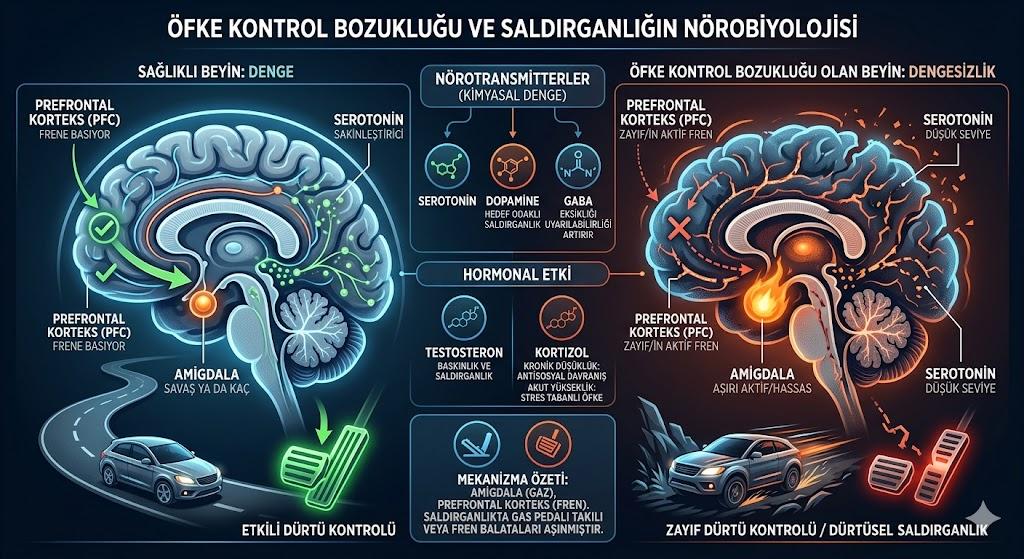
Visual representation of Anger Control Disorder (generated by artificial intelligence)
In organizational psychology, anger is explained by the "Double Threshold Model"; when an individual expresses anger constructively through communication rather than suppression, they cross the expression threshold. However, when they escalate to yelling or violence, they cross the inappropriateness threshold, causing lasting damage to the organizational climate.【11】
Biologically, chronic unmanaged anger leads to sustained autonomic arousal and continuous secretion of stress hormones, which over time invite life-threatening physiological conditions such as cardiovascular disease, hypertension, loss of vascular elasticity, diabetes, immune system collapse, and activation of cancer-prone genetic pathways.
Untreated anger control disorder can lead to serious physical health problems such as hypertension, cardiovascular disease, and diabetes. Socially, it can result in destructive outcomes including academic failure, unemployment, domestic violence, and legal problems. Early diagnosis and integrated treatment approaches are critical for preventing these risks.
Treatment involves a combination of pharmacological and psychotherapeutic methods:
Pharmacotherapy: Selective Serotonin Reuptake Inhibitors (SSRIs) are commonly prescribed to correct serotonergic deficits. Mood stabilizers may be used in treatment-resistant cases.【12】
Cognitive Behavioral Therapy (CBT): Aims to restructure maladaptive cognitions and develop social problem-solving and emotion-regulation skills.
Parent Management Training (PMT): Applied in child and adolescent cases to regulate family interactions and eliminate factors that reinforce aggressive behaviors.
Anger Management Techniques: Concrete strategies such as breathing exercises, muscle relaxation, and taking time-outs are used to help individuals control immediate reactions.
Warning: The content in this article is provided solely for general encyclopedic informational purposes. The information here should not be used for diagnosis, treatment, or medical guidance. Always consult a physician or qualified healthcare professional before making any health-related decisions. The author and KÜRE Encyclopedia assume no responsibility for any consequences arising from the use of this information for diagnostic or therapeutic purposes.
Adıyaman İl Milli Eğitim Müdürlüğü. "Şiddet Nedir? Şiddet Çeşitleri Nelerdir?" DergipDR. Adıyaman: MEB, 2020. Accessed May 22, 2026. https://adiyaman.meb.gov.tr/meb_iys_dosyalar/2020_11/30170308_1_DERGY_Yiddet.pdf.
Erel, Özge. "Üniversite Öğrencilerinde Dürtüsellik, Riskli Davranışlar ve İstismar Arasındaki İlişkinin İncelenmesi." Master's thesis, İstanbul Üniversitesi, 2012. Accessed May 22, 2026. https://nek.istanbul.edu.tr/ekos/TEZ/50589.pdf.
Eroğlu, Feyzullah, and Şeyda İrdem. "Örgütlerde Öfke Olgusu ve Öfke Yönetimi." Yeni Fikir Dergisi 8, no. 16 (2016): 43–62. Accessed May 22, 2026. https://dergipark.org.tr/en/download/article-file/1721363.
Fariba, Kamron A., and Srinivasa B. Gokarakonda. "Dürtü Kontrol Bozuklukları." In StatPearls. Treasure Island, FL: StatPearls Publishing, 2024. Accessed May 22, 2026. https://www.ncbi.nlm.nih.gov/books/NBK562279/.
Ordu İl Milli Eğitim Müdürlüğü. "Çocuklarda Öfke ve Öfke Kontrolü." Ordu: MEB, 2022. Accessed May 22, 2026. https://ordu.meb.gov.tr/meb_iys_dosyalar/2022_05/10110442_COCUKLARDA_OFKE_KONTROLU_1.pdf
Potenza, Marc Nicholas, Lorrin Michael Koran, and Stefano Pallanti. "The Relationship Between Impulse-Control Disorders and Obsessive–Compulsive Disorder: A Current Understanding and Future Research Directions." Psychiatry Research 170, no. 1 (2009): 22–31. Accessed May 22, 2026. https://doi.org/10.1016/j.psychres.2008.06.035.
Sukhodolsky, Denis G., Stephanie D. Smith, Spencer A. McCauley, Karim Ibrahim, and Justyna B. Piasecka. "Çocuklarda ve Ergenlerde Öfke, Sinirlilik ve Saldırganlık İçin Davranışsal Müdahaleler." Journal of Child and Adolescent Psychopharmacology 26, no. 1 (2016): 58–64. Accessed May 22, 2026. https://doi.org/10.1089/cap.2015.0120.
Tatlılıoğlu, Kasım, and Mehmet Karaca. "Öfke Olgusu Hakkında Sosyal Psikolojik Bir Değerlendirme." Bingöl Üniversitesi Sosyal Bilimler Enstitüsü Dergisi 3, no. 5 (2013): 117–134. Accessed May 22, 2026. https://www.bingol.edu.tr/documents/%C3%96fke%20Olgusu%20Hakk%C4%B1nda%20Sosyal%20Psikolojik%20Bir%20De%C4%9Ferlendirme(1).pdf.
Yao, Mengyun, Yuhong Zhou, Jiayu Li, and Xuemei Gao. "Violent Video Games Exposure and Aggression: The Role of Moral Disengagement, Anger, Hostility, and Disinhibition." Aggressive Behavior 46, no. 1 (2020): 89–105. Accessed May 22, 2026. https://doi.org/10.1002/ab.21860.
[1]
Marc Nicholas Potenza, Lorrin Michael Koran ve Stefano Pallanti, "The Relationship Between Impulse-Control Disorders and Obsessive–Compulsive Disorder: A Current Understanding and Future Research Directions," Psychiatry Research 22, Erişim Tarihi: 16 Nisan 2026, https://doi.org/10.1016/j.psychres.2008.06.035.
[2]
Marc Nicholas Potenza, Lorrin Michael Koran ve Stefano Pallanti, "The Relationship Between Impulse-Control Disorders and Obsessive–Compulsive Disorder: A Current Understanding and Future Research Directions," Psychiatry Research 22, Erişim Tarihi: 16 Nisan 2026, https://doi.org/10.1016/j.psychres.2008.06.035.
[3]
Kamron A. Fariba ve Srinivasa B. Gokarakonda, "Impulse-Control Disorders," StatPearls (Treasure Island, FL: StatPearls Publishing, 2024), Erişim Tarihi: 16 Nisan 2026, https://www.ncbi.nlm.nih.gov/books/NBK562279/.
[4]
Kamron A. Fariba ve Srinivasa B. Gokarakonda, "Impulse-Control Disorders," StatPearls (Treasure Island, FL: StatPearls Publishing, 2024), Erişim Tarihi: 16 Nisan 2026, https://www.ncbi.nlm.nih.gov/books/NBK562279/.
[5]
Marc Nicholas Potenza, Lorrin Michael Koran ve Stefano Pallanti, "The Relationship Between Impulse-Control Disorders and Obsessive–Compulsive Disorder: A Current Understanding and Future Research Directions," Psychiatry Research 22, Erişim Tarihi: 16 Nisan 2026, https://doi.org/10.1016/j.psychres.2008.06.035.
[6]
Ordu İl Milli Eğitim Müdürlüğü, "Anger and Anger Control in Children ", Ordu İl Milli Eğitim Müdürlüğü, Erişim Tarihi: 16 Nisan 2026, https://ordu.meb.gov.tr/meb_iys_dosyalar/2022_05/10110442_COCUKLARDA_OFKE_KONTROLU_1.pdf.
[7]
Ordu İl Milli Eğitim Müdürlüğü, "Anger and Anger Control in Children ", Ordu İl Milli Eğitim Müdürlüğü, Erişim Tarihi: 16 Nisan 2026, https://ordu.meb.gov.tr/meb_iys_dosyalar/2022_05/10110442_COCUKLARDA_OFKE_KONTROLU_1.pdf.
[8]
Mengyun Yao ve diğerleri, "Violent Video Games Exposure and Aggression: The Role of Moral Disengagement, Anger,Hostility, and Disinhibition," Aggressive Behavior 46, no. 1 (2020): 89, Erişim Tarihi: 16 Nisan 2026,https://doi.org/10.1002/ab.21860.
[9]
Marc Nicholas Potenza, Lorrin Michael Koran ve Stefano Pallanti, "The Relationship Between Impulse-Control Disorders and Obsessive–Compulsive Disorder: A Current Understanding and Future Research Directions," Psychiatry Research 22, Erişim Tarihi: 16 Nisan 2026, https://doi.org/10.1016/j.psychres.2008.06.035.
[10]
Marc Nicholas Potenza, Lorrin Michael Koran ve Stefano Pallanti, "The Relationship Between Impulse-Control Disorders and Obsessive–Compulsive Disorder: A Current Understanding and Future Research Directions," Psychiatry Research 22, Erişim Tarihi: 16 Nisan 2026, https://doi.org/10.1016/j.psychres.2008.06.035.
[11]
Kasım Tatlılıoğlu ve Mehmet Karaca, "A Social Psychological Evaluation of Anger," Bingöl University Journal of Social Sciences Institute 3, no. 5 (2013): 120, Erişim Tarihi: 16 Nisan 2026, https://www.bingol.edu.tr/documents/%C3%96fke%20Olgusu%20Hakk%C4%B1nda%20Sosyal%20Psikolojik%20Bir%20De%C4%9Ferlendirme(1).pdf.
[12]
Denis G. Sukhodolsky ve diğerleri, "Behavioral Interventions for Anger, Irritability, and Aggression in Children and Adolescents," Journal of Child and Adolescent Psychopharmacology 26, no. 1 (2016): 60, Erişim Tarihi: 16 Nisan 2026, https://doi.org/10.1089/cap.2015.0120.https://doi.org/10.1089/cap.2015.0120.

No Discussion Added Yet
Start discussion for "Intermittent Explosive Disorder" article
Epidemiology and Demographic Distribution
Etiology: Neurobiological and Psychosocial Foundations
Clinical Features and Classification
Comorbidities and Differential Diagnosis
Anger Disorders in Childhood and Adolescence
Childhood Abuse, Impulsivity, and Risky Behaviors
Media, Violent Video Games, and Moral Disengagement
Neurobiological Foundations and Differences from Obsessive-Compulsive Disorder (OCD)
Clinical Features, Social and Medical Complications
Complications and Prognosis
Treatment Approaches