


This article was automatically translated from the original Turkish version.
Infrared imaging systems are sophisticated technologies that are increasingly finding application in modern engineering solutions. One of the key components in these systems is the optical window. These windows, which establish the connection between the imaging sensor and the external environment, are not merely physical protectors but active components that directly influence optical performance. In particular, the selection of window material for systems operating in the infrared spectrum is critical for system efficiency, image quality, and long-term durability.
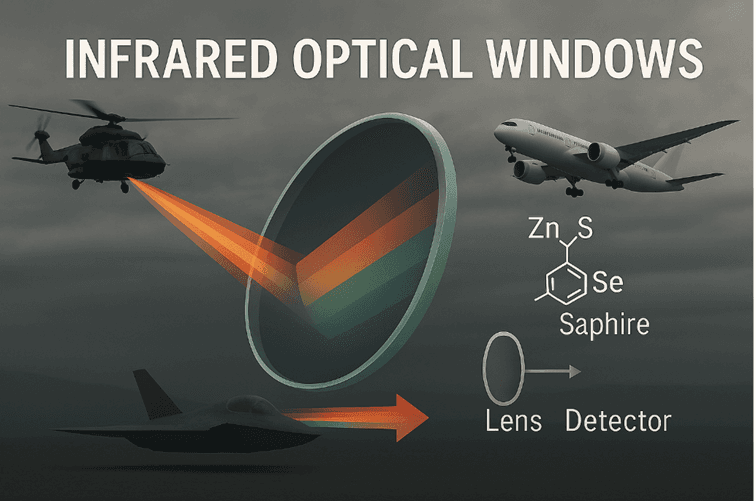
Yapay zeka ile oluşturulmuştur.
The primary function of an optical window is to transmit radiation at the wavelength range of the sensor with minimal loss while providing protection against potential damage from external environmental conditions. In this context, it is not sufficient for the window material to have high transmittance alone; mechanical robustness, resistance to scratching and impact, and a low coefficient of thermal expansion must also be considered. When examining the window materials commonly preferred in modern infrared systems, the most popular include Germanium, Zinc Selenide (ZnSe), Zinc Sulfide (ZnS), Sapphire, and Chalcogenide glasses.
Germanium stands out due to its broad infrared spectrum coverage and high transmittance, offering exceptionally effective transmission in the 2–14 micrometer range. This property makes it indispensable for thermal cameras and military targeting systems. However, its high density (5.3 g/cm3) and high refractive index introduce surface reflection issues that must be carefully managed. These issues can be mitigated through anti-reflective coatings and optimizations applied to other components of the optical system.
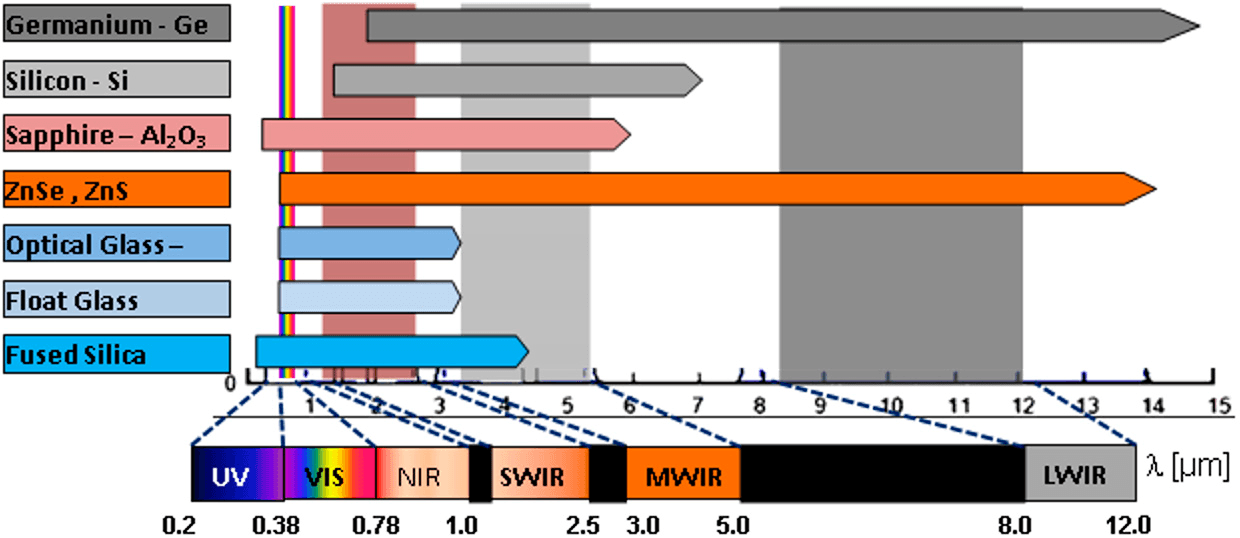
Optik Malzemelere Ait IR Spectrum (Optical Protective Window Design and Material Selection Issues in the Multi-Sensor Electro-Optical Surveillance Systems)
Zinc Selenide is a material particularly favored in laser optical systems and medical IR devices. This crystal offers high transmittance across a broad band from 0.6 to 16 micrometers and is known for its high optical homogeneity. However, it requires careful handling due to its structural brittleness and potentially toxic production dust. Zinc Sulfide is another important material, especially preferred in applications requiring environmental resilience and mechanical strength. While its environmental resistance exceeds that of Zinc Selenide, its transmittance is not as advantageous. Nevertheless, this drawback is partially compensated by its improved version known as “Cleartran”.
When hardness is concerned, Sapphire is the first option that comes to mind. With a Mohs hardness rating of 9, it exhibits considerable resistance to scratching and abrasion. However, its transmittance in the longwave infrared (LWIR) region is limited, and it is difficult to machine. Despite this, it is widely used as an external window in aircraft and missile applications. On the other hand, chalcogenide glasses are preferred in civilian IR applications and the automotive industry due to their low cost and moldability. However, they are limited in hardness and are susceptible to scratching, requiring careful handling.

Locheed Martin (
To minimize surface reflections across all these materials, various coating technologies are employed. In materials with high refractive indices such as Germanium, surface reflection is particularly pronounced, so anti-reflective (AR) coatings are used to reduce light losses. Single-layer and multi-layer AR coatings are optimized for specific wavelength ranges, while DLC (diamond-like carbon) coatings offer significant advantages in terms of environmental durability. DLC coatings provide high resistance to abrasion and chemical exposure while being formulated to avoid negatively impacting optical transmittance.
In optical window design, thermal effects must not be overlooked. In infrared systems, the refractive index of the window material can vary with temperature, leading to phase shifts, reduced contrast, and degradation of image sharpness. To mitigate such issues, specific design techniques are applied during mounting. Flexible O-ring mountings help minimize stress caused by thermal expansion. Additionally, parameters such as window thickness, mounting angle, and distance from the lens system must be carefully calculated.
The performance of infrared windows is not limited to optical transmittance alone. Surface quality issues such as scratches and polishing marks can cause light scattering, thereby reducing image contrast. In military applications, compliance with standards such as MIL-PRF-13830B for surface quality is critical to system success. Furthermore, in high-speed aerial platforms, windows must be structurally reinforced through additional analysis to withstand aerodynamic loads.
In terms of application areas, infrared windows are used across a wide spectrum—from military missile systems to autonomous vehicles, from space telescopes to agricultural multispectral imaging systems. For each application, the selection of window material depends on numerous engineering criteria, including not only transmittance but also durability, machinability, resistance to environmental factors, and optical compatibility with the system. In particular, in multi-sensor systems, the window material must support multiple spectral bands simultaneously.
Infrared windows are not merely passive protective elements; they are active optical components that significantly determine system sensitivity and image quality. Material selection, coating technologies, mounting design, and thermal analysis—all these engineering disciplines collectively determine the effectiveness of these systems. As application fields evolve and technological expectations rise, the demand for higher-performance, lighter, and longer-lasting infrared window materials will become increasingly critical in the coming years.
Anadolu Ajansı. "F-35 Lightning II Savaş Uçağı Basına Tanıtıldı." Anadolu Ajansı, Ankara (TR). Accessed May 5, 2025.https://www.aa.com.tr/tr/pg/foto-galeri/f-35-lightning-ii-savas-ucagi-basina-tanitildi
Crystran Ltd. "Zinc Selenide (ZnSe) Windows." Crystran Ltd., Poole (UK). Accessed May 5, 2025.https://www.crystran.com/windows/zinc-selenide-windows
Edmund Optics. "Understanding Optical Windows." Edmund Optics Inc., Barrington (NJ). Accessed May 5, 2025.https://www.edmundoptics.com/knowledge-center/application-notes/optics/understanding-optical-windows/
Harris, D. C. Materials for Infrared Windows and Domes: Properties and Performance. Bellingham, WA: SPIE Press, 1999. (SPIE Press Monograph Vol. PM99).
Vujić, S., D. Perić, B. Livada, M. Radisavljević, and D. Domazet. "Optical Protective Window Design and Material Selection Issues in the Multi-Sensor Electro-Optical Surveillance Systems." Sensors 23, no. 5 (2023): 2784.

No Discussion Added Yet
Start discussion for "Infrared (IR) Optical Window" article