


This article was automatically translated from the original Turkish version.
+1 More
İstiklal Yolu is a vital supply route that extended from the Turk War of Independence from the Black Sea Region to the front lines. Beginning at İnebolu Port, this route passed through Kastamonu, Ilgaz, and Çankırı before reaching Ankara. During the most critical phases of the war, it played a vital role in transporting weapons, ammunition, food, medicine, and other logistical supplies to the front. Beyond its military function, this route became a symbol of the entire Anatolian population’s unified struggle for independence and an emblem of patriotism and resistance.
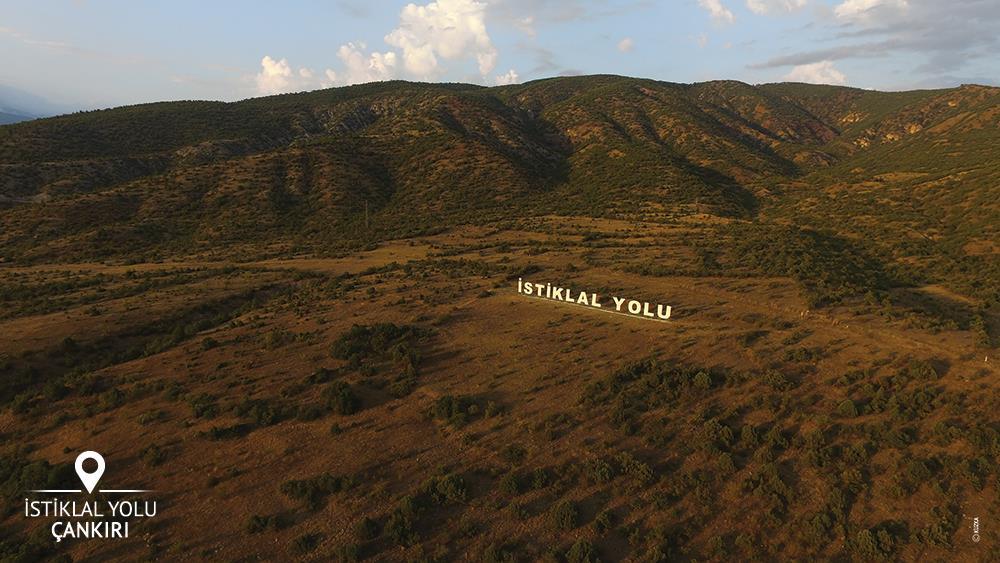
Drone Image of İstiklal Yolu (Çankırı KTB)
Following the signing of the Armistice of Mudros on 30 October 1918, the Ottoman State effectively ceased to exist, and Anatolia, particularly the western and southern regions, came under occupation. Although Istanbul was under the control of occupying forces, nationalist elements there secretly transported weapons and ammunition to Anatolia. Secret organizations in Istanbul, such as the Mim Mim Group and the Karakol Society, covertly sent arms to İnebolu, from where they were transported via Kastamonu to Ankara. İnebolu Port’s geopolitical importance stemmed from its connection to Istanbul via one of the shortest routes across the Black Sea. These transport operations, conducted under British naval surveillance, carried great risk, yet through the mobilization and sacrifice of the people, this line became operational. Ammunition dispatched from here was carried on carts over arduous journeys to the front.
During this period, the local population, especially women and the elderly, actively participated in safeguarding the route and sustaining logistical operations. Local Turkish Hearth organizations, Defense of Rights Societies, and civilian groups provided both weapons and manpower support through this corridor. For this reason, İstiklal Yolu is regarded not merely as a logistical line but as one of the starting points of popular resistance in Anatolia.
İstiklal Yolu served as the primary supply route from 1919 to 1922, supporting the Kuvâ-yi Milliye movement and the establishment of the regular army.
One of the most significant features of İstiklal Yolu is that it was not merely a military supply line but a route on which the civilian population actively participated and demonstrated immense sacrifice in the war.
İstiklal Yolu is approximately 340 kilometers long. Beginning at İnebolu, it passes through the Küre Mountains, then via Seydiler, Kastamonu, Ilgaz, Çankırı, and Kalecik to reach Ankara. Certain sections of the route, particularly the high-altitude areas such as the Ilgaz Mountains, were traversed despite severe winter conditions and extreme transportation challenges.
Along this route:
This route is not merely a path but a cultural corridor that witnessed the resurgence of a nation throughout history.
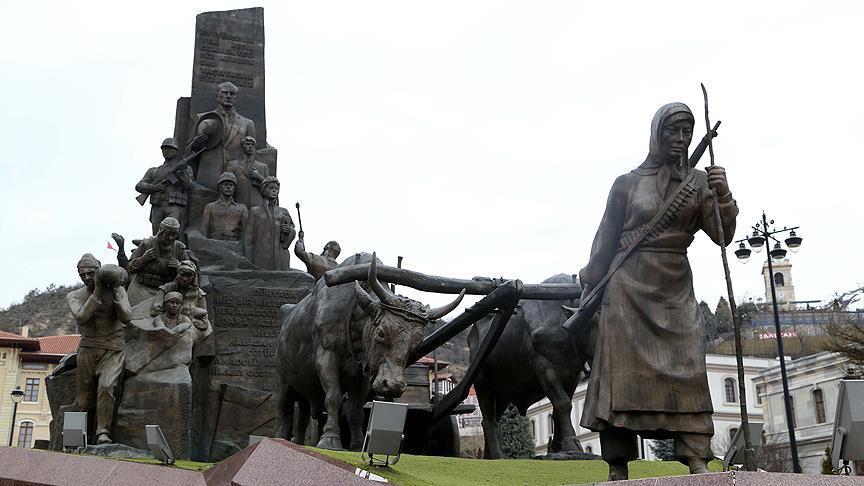
Statue Related to İstiklal Yolu (AA - Özgür Alantor)
Şerife Bacı is the most renowned symbol of İstiklal Yolu and one of the strongest examples of female heroism during the War of Independence. Şerife Bacı, who carried ammunition from Kastamonu to the front, died of exposure in December 1921 in the winter conditions of the Ilgaz Mountains. While attempting to push her cart forward with her child in her arms, she struggled to survive in snow and frozen ground, but despite her sacrifice, she did not survive. Her heroic struggle came to symbolize the Turkish nation’s sacrifice and resistance for independence and freedom. Her struggle stands as the most powerful testament to the entire people’s unified spirit of resistance.
In addition, many unnamed heroines, elderly individuals, and children carried ammunition along İstiklal Yolu with great devotion and became part of this great struggle. During days-long arduous journeys by cart, these heroes did their utmost to fulfill their duty to the homeland without expecting any reward. Most sought only to contribute to their nation’s fight for independence, not honors or recognition. Their heroism reveals how the people, united in solidarity, demonstrated immense resistance, fighting with unwavering determination and faith to overcome hardship.
İstiklal Yolu was indispensable to the sustainability of the national struggle. A large portion of the ammunition used in the battles of Sakarya and Dumlupınar was delivered to the front via this route. The inability of enemy forces to control this route constituted a major disadvantage for them, allowing the Turkish army to gain strategic superiority. İstiklal Yolu also functioned as a communication network that enabled the nation to act in unity. The spirit of resistance spreading from village to town became a shared consciousness through this route.
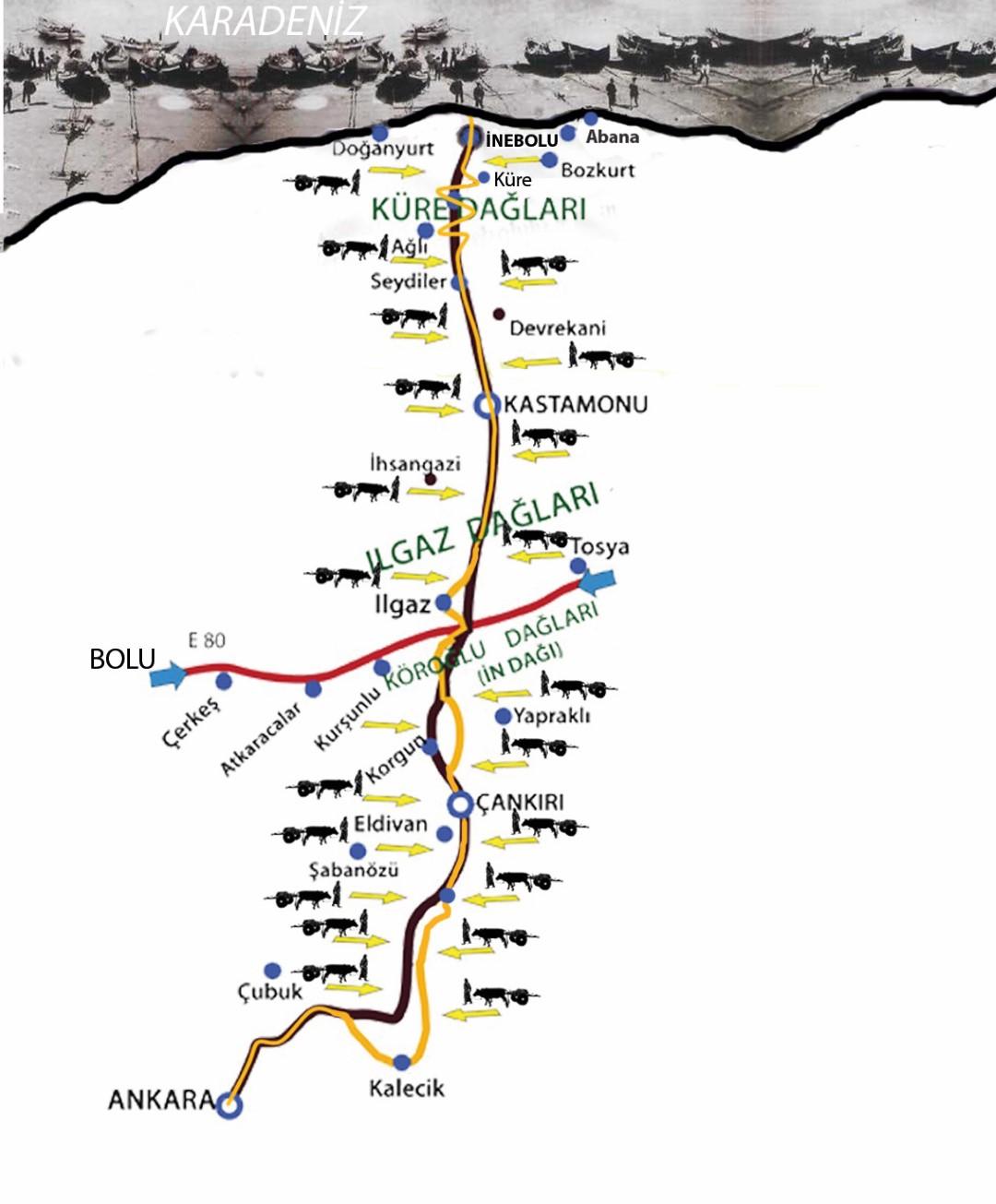
İstiklal Yolu (İYEKTVGD)
In 2008, in cooperation between the Ministry of Culture and Tourism and the Kastamonu Governorship, efforts began to preserve the historical value of İstiklal Yolu. The route has been transformed into a cultural route, enriched with monuments, museums, and informational signs. Under the name İstiklal Yolu Cultural Route, annual walks, symposiums, and commemorative events are held to ensure public ownership of this heritage and to keep historical awareness alive.
Along the route, numerous statues and monuments have been erected in memory of Şerife Bacı and other heroes. Additionally, comprehensive information about this period is presented in museums located at İnebolu Port and in the city center of Kastamonu.
"Atatürk ve İstiklal Yolu." İnebolu Belediyesi. Accessed March 26, 2025.https://www.inebolu.bel.tr/inebolu.asp?Id=64&inebolu=ataturk-ve-istiklal-yolu.
"İstiklal Yolu Tarihi Milli Park İlan Edildi." İstiklal Yolu Resmî Web Sitesi. Accessed March 26, 2025.http://istiklalyolu.com/HaberDetay/-Istiklal-Yolu-Tarihi-Milli-Park-ilan-edildi.html
"İstiklal Yolu." Culture Routes in Turkey. Accessed March 26, 2025.https://cultureroutesinturkey.com/tr/istiklal-yolu/
Karamustafa, Müslüm. "Milli Mücadelede İnebolu’nun Stratejik Önemi." *Avrasya Uluslararası Araştırmalar Dergisi*, no. 14 (2018): 355–371. Accessed March 26, 2025.https://dergipark.org.tr/tr/download/article-file/847098
Yıldız, Emine. "Kurtuluş Savaşı’nda İnebolu’dan Ankara’ya Uzanan İstiklal Yolu ve Şerife Bacı." *Karabük Üniversitesi Sosyal Bilimler Enstitüsü Dergisi*, 10(1), 2020: 206–222. Accessed March 26, 2025.https://dergipark.org.tr/en/download/article-file/1173388
Çankırı İl Directorate of Culture and Tourism. "Tarihi İstiklal Yolu." Ministry of Culture and Tourism of the Republic of Turkey. Accessed March 26, 2025.https://cankiri.ktb.gov.tr/TR-242668/tarihi-istiklal-yolu.html
Çavdar, Döndü. 2020. "Milli Mücadelede Kahraman Türk Kadınları." Accessed March 26, 2025.https://d1wqtxts1xzle7.cloudfront.net/108505244/Dondu_Cavdar_Milli_Mucadelede_kahraman_Turk
Çavdar, Döndü. 2020. "Milli Mücadelede Kahraman Türk Kadınları." Accessed March 26, 2025.https://d1wqtxts1xzle7.cloudfront.net/108505244/Dondu_Cavdar_Milli_Mucadelede_kahraman_Turk_kad%C4%B1nlar%C4%B1-libre.pdf?1701952078=&response-content-disposition=inline%3B+filename%3DMilli_Mucadelede_kahraman_Turk_kadinlari.pdf&Expires=1744731651&Signature=FQNk8e2lYM9B7hkv~~sbCh~4KNu5AbqoVeIibVvy8vU9KSv~etOosmnHAKQSKdvymLq5tbcXzTbiEyXzLxFRE7e9nw9Z~5CQF4UpldmlqCqP-xc6IwuRobVNy94ZbTORbPd-YHBdb5xMjIp3dUDByY7peRjWfCC021DbU5R6PiOTWOYraLRBaQlkBDUspy7YdJb1f2XZdWY-kSwixomm7Aql8D492-8vZACQ-5aEdduKtLUh9pLwF9al6whpH2tph0q69cxO-RL1OcPgLd0RsMflabvqI7nWCubTo55TDuEYpt9fQ6Z~rYsi15BKYvbYI08-~di-HmDhNCUVCR6Hzw__&Key-Pair-Id=APKAJLOHF5GGSLRBV4ZA

Historical Background
Periods of Use and Objectives of İstiklal Yolu
Route and Structural Features
Şerife Bacı: The Heroine and Symbol of İstiklal Yolu
Role of İstiklal Yolu in the National Struggle
İstiklal Yolu Today