This article was automatically translated from the original Turkish version.
+1 More
Location | Konya Türkiye | ||||||||
|---|---|---|---|---|---|---|---|---|---|
Foundation | 1264 (Medrese), 1956 (Museum) | ||||||||
Founder(s) | Vezir Sâhib Atâ Fahreddin Ali | ||||||||
Architect(s) | Keluk bin Abdullah | ||||||||
Architecture(s) | Covered Courtyard Single Story Single Iwan | ||||||||
Ince Minareli Stone and Wood Artifacts Museum is located in the Beyhekim neighborhood of the Selçuklu district in Konya. The museum operates within the Ince Minareli Medrese, one of the most significant structures of Anatolian Seljuk architecture. Built during the reign of Seljuk Sultan II. Izzeddin Keykavus by Grand Vizier Sâhib Ata Fahreddin Ali, the structure originally served as a Darülhadis Medrese and since 1956 has functioned as a museum housing a collection of stone and wooden artifacts from the Seljuk, Beylik, and Ottoman periods.
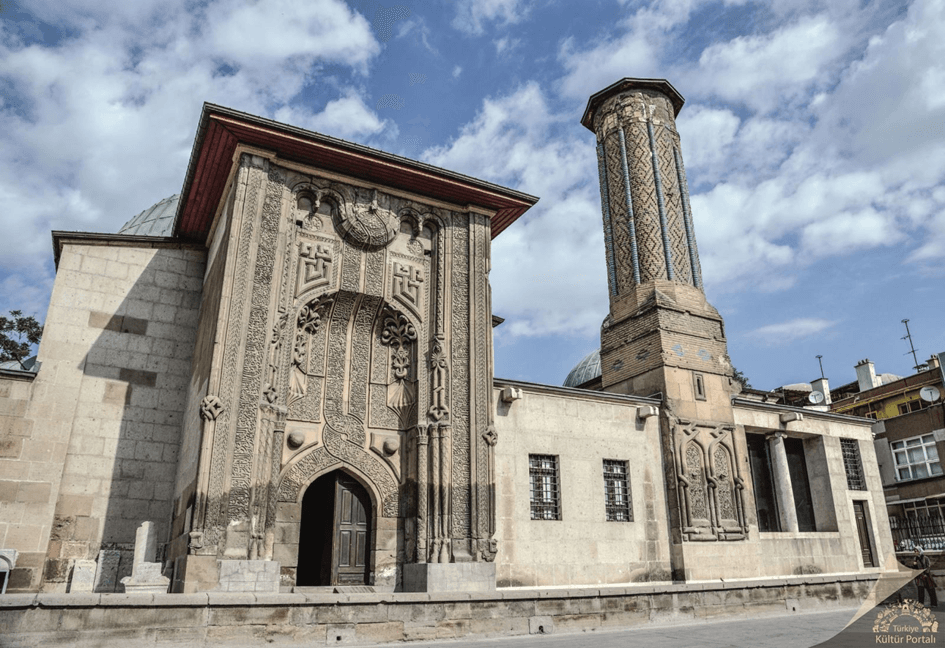
Ince Minareli Stone and Wood Artifacts Museum (Türkiye Culture Portal)
The medrese was constructed between 1260 and 1265 by Seljuk Grand Vizier Sâhib Ata Fahreddin Ali for the teaching of Hadith studies. The architect of the building was Kelûk bin Abdullah. Damaged by an earthquake in Konya in the early eighteenth century, the medrese underwent various repairs in 1714 and subsequently in 1811, 1876, and 1899.
In 1901, a lightning strike caused the dome and minaret of the mosque adjacent to the medrese, located in the northeast corner of the structure, to collapse up to the first balcony. During the Republican era, the building underwent restoration work between 1930 and 1945 and was opened to the public in 1956 as the Seljuk Period Stone and Wood Artifacts Section of the Konya Museum. Later, between 2000 and 2002, reconstruction was carried out on the section between the portal and the minaret as well as on the mosque.
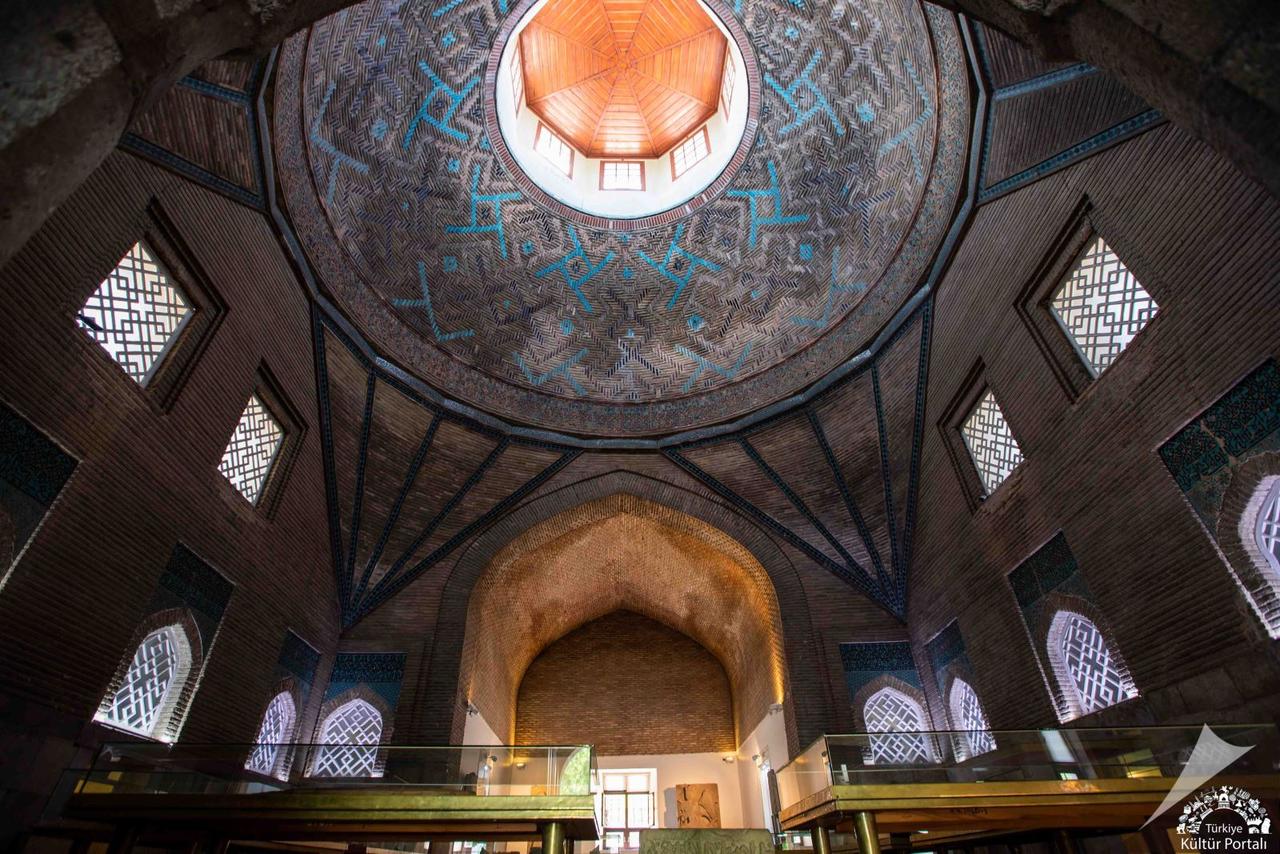
The Ince Minareli Medrese belongs to the group of enclosed courtyard medreses of the Seljuk period. It was built as a single-story, single-iwan structure. The square courtyard is covered by a dome supported by pendentives. A pool is situated at the center of the courtyard. The interior spaces consist of the courtyard, iwan, lecture hall, professor’s room, and student cells.
The monumental portal on the eastern façade is one of the finest examples of Seljuk stone carving. It is adorned with relief decorations featuring geometric and vegetal motifs, with calligraphy as the dominant element. The Yasin and Fatih surahs, written in thuluth script, are arranged in a knotted composition that converges along the central axis of the portal and descends symmetrically on both sides. The names of the architect, Kelûk bin Abdullah, are inscribed on rosettes within the niche arch of the portal. Inside the building, a Kufic inscription reading “el-Mülkü lillâh” encircles the base of the dome.
The minaret, which gives the structure its name, belongs to the mosque adjacent to the medrese. It features a brick shaft rising from a cut-stone base. The shaft is segmented and decorated with turquoise-glazed bricks and tiles. The upper section of the double-balconied minaret was destroyed in the 1901 lightning strike.
%2520(8).jpg&w=1280&q=75)
Ince Minareli Stone and Wood Artifacts Museum (Türkiye Culture Portal)
The Ince Minareli Medrese was converted into a museum in 1956. In the courtyard, gravestones, sarcophagus fragments, and stone inscriptions from the Seljuk, Beylik, and Ottoman periods are displayed. Inside the building, stone reliefs and inscriptions dating to the thirteenth century, along with a limited number of wooden artifacts, are exhibited. The stone pieces depict human, animal, angelic, and mythological figures.
Following renovations in 2002, wooden artifacts began to be exhibited in the space created between the portal and the minaret. The collection includes door and window panels, ceiling rosettes, and various examples of wooden ornamentation. Among the most notable pieces in the collection are large-scale representations of the Seljuk symbol—the double-headed eagle—and winged angels.
%2520(6).jpg&w=1280&q=75)
Ince Minareli Stone and Wood Artifacts Museum (Türkiye Culture Portal)
Although the medrese underwent various repairs during the Republican era, the most comprehensive restoration took place between 2000 and 2002. In subsequent years, the General Directorate of Foundations carried out further restoration activities to address structural issues and repair damage to the portal and minaret.
The Ince Minareli Stone and Wood Artifacts Museum today serves as an important museum displaying stone and wooden artifacts from the Seljuk, Beylik, and Ottoman periods. It is open to visitors throughout the week except on Mondays.
Anadolu Ajansı. “Anadolu Selçuklu Devletinin önemli eserlerinden İnce Minareli Medrese eski ihtişamına kavuşacak.” Accessed August 16, 2025. https://www.aa.com.tr/tr/kultur/anadolu-selcuklu-devletinin-onemli-eserlerinden-ince-minareli-medrese-eski-ihtisamina-kavusacak/3362333
Ministry of Culture and Tourism of the Republic of Türkiye. “İnceminare Taş ve Ahşap Eserleri Müzesi.” *Kültür Portalı.* Accessed August 16, 2025. https://www.kulturportali.gov.tr/turkiye/konya/gezilecekyer/nceminare-tas-ve-ahsap-eserleri-muzesi
T.C. Konya Valiliği. "Konya İnce Minare Müzesi." T.C. Konya Valiliği. Accessed August 16, 2025. http://www.konya.gov.tr/konya-ince-minare-muzesi
T.C. Kültür ve Turizm Bakanlığı. “Konya Taş ve Ahşap Eserleri Müzesi – İnce Minare.” Accessed August 16, 2025. https://kvmgm.ktb.gov.tr/Eklenti/91054,konya-tas-ve-ahsap-eserleri-muzesi-ince-minarepdf.pdf?0
T.C. Selçuklu District Governorship. “İnce Minareli Medrese.” Accessed August 16, 2025. http://www.selcuklu.gov.tr/ince-minareli-medrese

Location | Konya Türkiye | ||||||||
|---|---|---|---|---|---|---|---|---|---|
Foundation | 1264 (Medrese), 1956 (Museum) | ||||||||
Founder(s) | Vezir Sâhib Atâ Fahreddin Ali | ||||||||
Architect(s) | Keluk bin Abdullah | ||||||||
Architecture(s) | Covered Courtyard Single Story Single Iwan | ||||||||
No Discussion Added Yet
Start discussion for "Ince Minare Stone and Wood Artifacts Museum" article
History
Architectural Features
Museum and Collection
Restoration Works
Current Status