



Idiom
What Is an Idiom?
An idiom is a fixed expression that conveys a thought in a brief, effective, and often metaphorical way. Idioms are frequently used in daily life and express events or emotions with vivid language. They typically carry a meaning different from their literal interpretation.
For example, the phrase “ağzı kulaklarına varmak” does not mean the mouth actually reaching the ears, but rather to be extremely happy.
The Origin of Idioms: Language from Oral Culture and Everyday Life
Idioms originated in oral folk culture. People’s observations, experiences, and emotions gradually became embedded in language, and over time these expressions solidified into idioms. They are commonly found in folktales, folk stories, meddah narratives, and poetry.
For instance:
The idiom “kulağını tersten göstermek” describes doing something in a roundabout way and emerged from popular observation.
Characteristics of Idioms
- Fixed Form: The words cannot be altered (e.g., “göze girmek” cannot be changed to “göze ulaşmak”).
- Metaphorical: They use indirect expression beyond their literal meaning.
- Brief and Concise: They usually consist of only a few words.
- Enrich Expression: They convey emotions and ideas more powerfully.
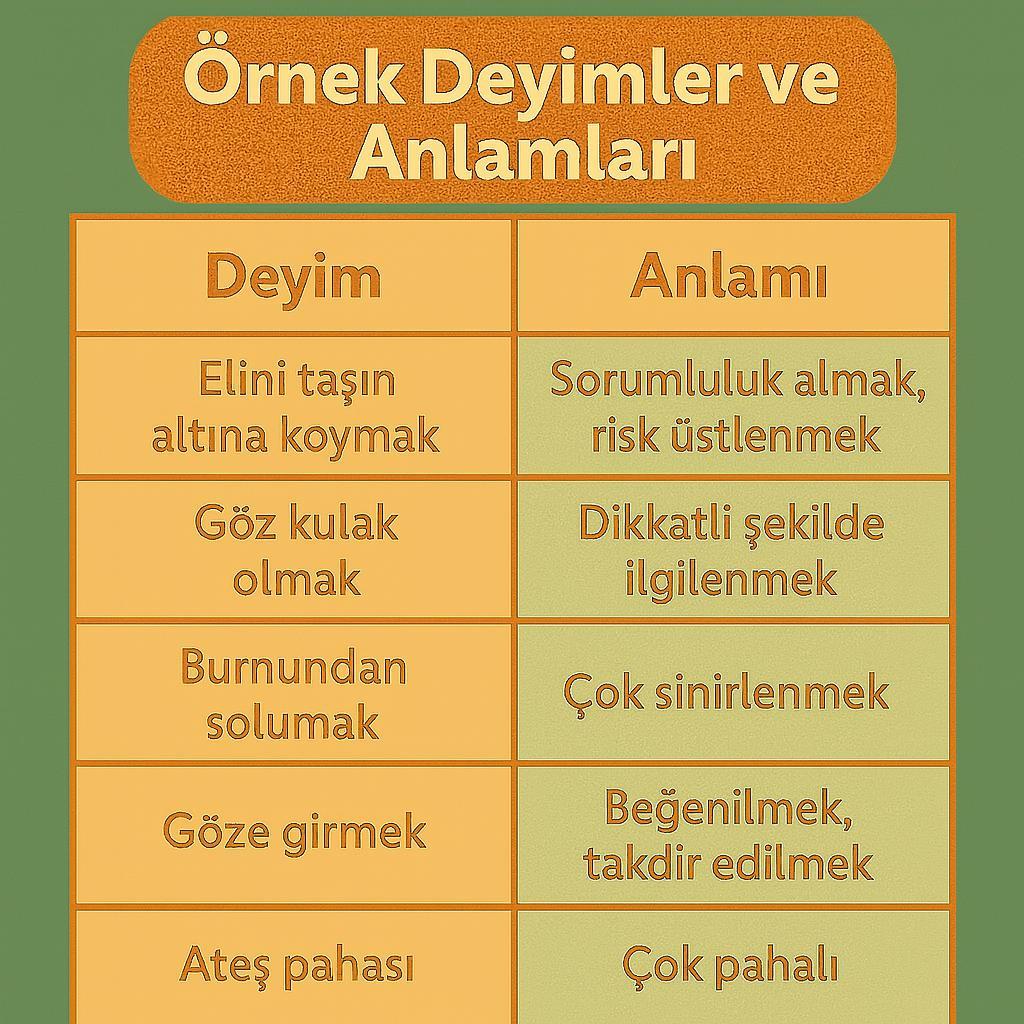
(Generated by artificial intelligence.)
What Do Idioms Offer Children?
- Develop imagination and abstract thinking skills.
- Enhance linguistic awareness and expressive ability.
- Foster cultural identity and shared memory.
- Encourage critical thinking.
- Enable learning through play (e.g., through idiom cards, puzzles, and story-completion games).
Common Misconception: Idiom or Proverb?
Some expressions are easily confused. Let us examine the following examples:
- ✅ “Burnundan solumak” → Idiom (Expresses being angry).
- ✅ “Sakla samanı, gelir zamanı.” → Proverb (Offers advice).
- ❌ Interpreting the idiom “başını derde sokmak” literally as “to have an accident” → Misconception!
References:
- Siirt Provincial Directorate of National Education. “Proverbs and Idioms Working File (Grade 3)”, meb.gov.tr, https://siirt.meb.gov.tr/meb_iys_dosyalar/2021_01/11133732_3.pdf
- Turkish Language Association. “Dictionary of Idioms” (PDF), tdk.gov.tr, https://tdk.gov.tr/wp-content/uploads/2016/06/20160622.pdf
- TRT Çocuk. “Expressing Through Idioms – Video Content”, https://www.youtube.com/watch?v=DJCepbz34Bw
- Culture and Life. “10 Proverbs and Idioms Interpreted Through a Child’s Perspective”, https://kulturveyasam.com/cocuk-bakisiyla-yorumlanan-10-atasozu-deyim/
- TÜBİTAK Science for Youth. “Learning Proverbs and Idioms Through Games”, https://bilimgenc.tubitak.gov.tr/proje/oyunlarla-atasozu-ve-deyimleri-ogrenme
- TÜBİTAK Science and Technology. “Idioms Illustrated Through Cartoons”, https://bilimteknik.tubitak.gov.tr/node/49004





