


This article was automatically translated from the original Turkish version.
+2 More
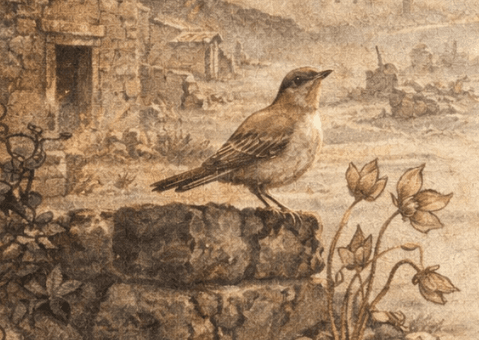
(Generated by Artificial Intelligence)
I said that he had driven his foot from his homeland
Subject(s) | Urban destruction social and personal grief abandonment | ||||||||
|---|---|---|---|---|---|---|---|---|---|
Place in Folk Literature | One of the known examples of city elegies in Turkish folk poetry | ||||||||
Historical Background | The destruction suffered by Bayburt after the 1828 Ottoman–Russian War | ||||||||
Type Characteristic | City elegy | ||||||||
Poetic Form | Koşma | ||||||||
Poet | Bayburtlu Zihni | ||||||||
I came and found my homeland abandoned, its feet fled, a poem by the nineteenth-century poet Bayburtlu Zihnî. The work preserves the formal characteristics of folk poetry tradition and possesses the qualities of a city elegy in content. Centered on the destruction Bayburt suffered after war and occupation, this poem conveys a social catastrophe through an individual narrative and thus belongs to the body of folk literature texts that unite aesthetic expression with historical testimony.
The poem’s emergence is linked to the occupation and devastation Bayburt endured after the 1828 Ottoman–Russian War. Upon returning to his homeland after a long absence, Bayburtlu Zihnî depicted the ruined cityscape in this koşma. However, neither the place nor the time is explicitly identified in the poem. Consequently, the work does not function as a direct historical document; rather, the destruction is conveyed as a generalized sense of catastrophe. Physical damage to the city is mirrored not only as spatial ruin but also as the disintegration of social life.
The poem is composed in the koşma, one of the most common metrical forms in Turkish folk poetry. The text consists of four quatrains structured in an 11-syllable meter, typically with caesuras of 6+5. The use of rhyme and refrain adheres to the conventions of folk poetry. The choice of rhyme patterns and sonic harmony also reflects the poet’s connection to classical literary traditions. These elements of musicality enhance the poem’s suitability for oral performance, reinforcing its place within the folk poetry tradition.
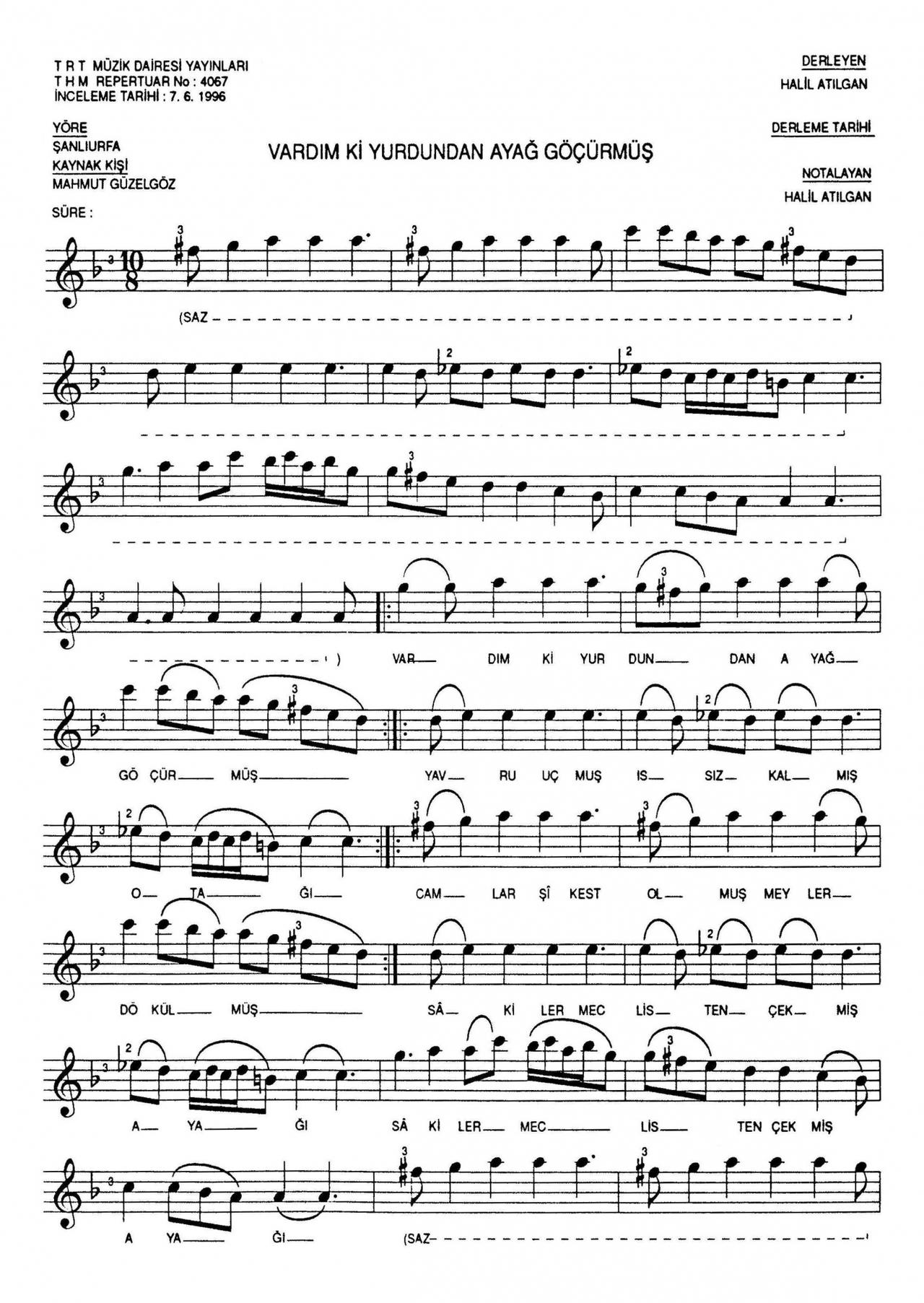
Musical Notation of the Poem’s Melody (Repertükül)
The central theme of the poem is the melancholy arising from an abandoned homeland. Images such as empty homes, dissolved gatherings, and mass emigration convey the devastation suffered by Bayburt. The poem carries the mournful tone characteristic of the elegy genre. Yet this elegy does not lament an individual loss but rather the disappearance of an entire city and its social order. City elegies are rare in Turkish folk literature.
Ontological analyses of the poem identify multiple layers of meaning. These layers are as follows:【1】
This approach allows the poem to be interpreted not merely as an elegy but as a text that examines the human condition in the face of existence. Thus, the poem can be read beyond a specific historical event, within a broader existential framework.
Bayburtlu Zihnî’s koşma is among the texts in Turkish folk literature that transmit historical events through poetry. Evaluated according to its formal features and content, it firmly belongs to the folk poetry tradition. At the same time, as a city-centered elegy, it constitutes a unique example within folk literature. The work is also cited among poems associated with collective memory.
Listening to the Poem (Fatih Ergin)
I came and found my homeland abandoned, its feet fled,
The young ones left, the hearths now empty and still,
The mosques lie shattered, the gardens stripped bare,
The cupbearers have withdrawn from the gathering.
If I find that deer on the mountain’s height,
If I see that wounded eye upon the ground,
It fled from hunters, like a gazelle,
It has migrated from mountain to mountain, with no resting place.
The lilies, hyacinths, and roses have been stolen,
The lovers of joy and pleasure have been seized by sighs and sorrow,
Suleiman’s throne seems to have been carried off,
The age of fellowship has turned to discord.
Zihnî weeps always from the hand of time,
I asked: who weeps for the garden? The gardener weeps,
The hyacinths are shattered, the roses bleed,
The lover-bird has abandoned this garden.【2】
Ergin, Fatih. "Cengiz Özkan - Vardım ki yurdundan ayağ göçürmüş." YouTube. Accessed April 8, 2026. https://youtu.be/R2cuQ5w0lj8.
Karabey, Turgut. "Bayburtlu Zihnî'nin Meşhur Bir Koşmasına Tahlilî Bir Bakış." *Millî Folklor* 19, no. 76 (2007): 65–69. Accessed April 8, 2026. https://turkoloji.cu.edu.tr/HALK%20EDEBIYATI/turgut_karabey_bayburtlu_zihni_meshur_bir_kosmasi.pdf
Köktürk, Şahin. "Bayburtlu Zihnî’nin Bir Koşmasının Ontolojik Analiz Metoduyla İncelenmesi." *Millî Folklor* 15, no. 60 (2003): 170–78. Accessed April 8, 2026. https://www.millifolklordergisi.com/PdfViewer.aspx?Sayi=60&Sayfa=166
Repertükül. "Vardım ki Yurdundan Ayağ Göçürmüş." Accessed March 18, 2026. https://www.repertukul.com/VARDIM-KI-YURDUNDAN-AYAG-GOCURMUS-4067.
[1]
Şahin Köktürk, “Bayburtlu Zihnî’nin Bir Koşmasının Ontolojik Analiz Metoduyla İncelenmesi,” Millî Folklor 15, sy. 60 (2003): 172. accessed April 8, 2026, https://www.millifolklordergisi.com/PdfViewer.aspx?Sayi=60&Sayfa=166.
[2]
Repertükül. "Vardım ki Yurdundan Ayağ Göçürmüş." accessed April 8, 2026. https://www.repertukul.com/VARDIM-KI-YURDUNDAN-AYAG-GOCURMUS-4067.

(Generated by Artificial Intelligence)
I said that he had driven his foot from his homeland
Subject(s) | Urban destruction social and personal grief abandonment | ||||||||
|---|---|---|---|---|---|---|---|---|---|
Place in Folk Literature | One of the known examples of city elegies in Turkish folk poetry | ||||||||
Historical Background | The destruction suffered by Bayburt after the 1828 Ottoman–Russian War | ||||||||
Type Characteristic | City elegy | ||||||||
Poetic Form | Koşma | ||||||||
Poet | Bayburtlu Zihni | ||||||||
No Discussion Added Yet
Start discussion for "I Gave My Foot That Had Traveled from My Homeland (Poem)" article
Historical Context
Poetic Form and Structural Features
Content and the Nature of a City Elegy
Ontological Analysis and Layers of Meaning
Place in Folk Literature
Text of the Poem