This article was automatically translated from the original Turkish version.
The story of a building is a multilayered process of reading that deciphers more than its physical form—it unfolds through historical references, urban morphology, perceptual relationships with the human body, and structural heritage. Like a literary work, architectural production transforms into a readable system shaped over time by environmental factors and preceding structures. Various theoretical approaches and analytical methods are employed to read a building’s urban, bodily, and historical narrative.
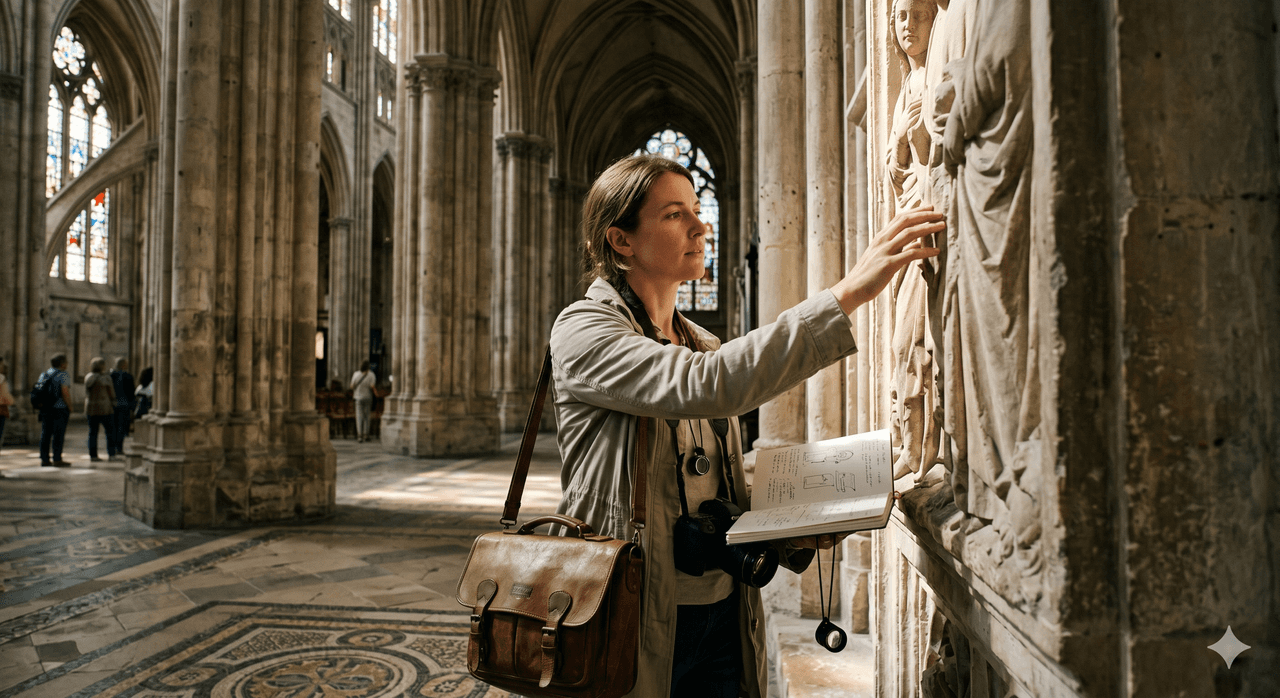
How to Read a Building’s Story? (Generated by Artificial Intelligence.)
Architectural production is intertextual; the meaning of buildings is deciphered through networks of formal and semantic relationships established between antecedent and subsequent structures. Quotation refers to the explicit use of a structural element—such as a form or material—from a different era or architect in a new building. Implicit quotation, by contrast, suggests interaction between antecedent and subsequent structures not directly but through subtle cues. Parody describes the repetition of formal characteristics of architectural elements while altering their functions and purposes. Palimpsest, rooted in the parchment practice of scraping off old text to write anew, in architecture denotes structures renewed over earlier ones or layered layers of occupation.
Typomorphology investigates the organizational logic of urban space by classifying city forms into types defined by buildings and open areas. This approach developed within the Italian tradition under the leadership of Saverio Muratori and Gianfranco Caniggia, asserting that a city’s structure can be understood within its historical context and that building typology forms the foundation of urban research. It examines the built environment in four categories: building, building groups, city, and region. The English tradition, established by M.R.G. Conzen, conducts its analyses through ground plans, building fabric, and land pattern. Central to this reading are the concepts of the “parcel cycle,” which describes changes in the number of buildings on a parcel, and the “urban fringe,” which captures irregular growth along edges. The French tradition—the Versailles School—represents an interdisciplinary approach where architects, sociologists, and geographers collaborate, grouping their investigations under themes such as element typology, urban growth, urban legibility, and the articulation of space.
Space is more than a physical framework of form and function; it is a social and existential medium that interacts with the human body. Perception of the environment is not limited to vision alone; space is experienced as an empirical phenomenon through the integration of touch, hearing, and smell. Perception is the process of recognizing the world, while meaning arises from how individual experiences shape this process.

Villa Malaparte (flickr)
Villa Malaparte offers an experiential narrative through its dramatic relationship with nature and the contrasts it embodies. The monumental staircase leading to the rooftop terrace evokes an iconic reference to the steps of the Annunziata Church on Lipari, where Curzio Malaparte spent his years in exile. The thick-framed windows, seemingly irregularly positioned on the façade, frame the infinite external landscape, transforming it into living paintings within the interior space.
Reading architectural theories requires more than rote memorization of information; it demands critical evaluation through individual standards of judgment. The mental structuring of texts occurs in three fundamental stages: perception, memory retention, and reinterpretation of signs. Concept maps facilitate knowledge construction and critical thinking by graphically linking key terms and their relationships.
Reading and restoring the structural history of historic buildings requires a multidisciplinary approach. The analytical process advances through precise steps analogous to medical diagnosis: anamnesis (information gathering), diagnosis, treatment, and monitoring. Interventions must target root causes rather than symptoms and cause minimal damage to the building’s original characteristics. Restoration methods and materials should, whenever possible, be reversible and enable the building’s continued life without harming its historical traces.
Birer, Emel. "Critical Reading in Architectural Education." *Journal of Design Studio* 4, no. 1 (July 2022): 21–37. Accessed April 20, 2026. https://dergipark.org.tr/en/download/article-file/2203357
Büyükçam, Serap Faiz, and Tülay Zorlu. "Metinlerarasılık ve Mimarlık." *ART-SANAT*, no. 9 (2018): 479-493. Accessed April 20, 2026. https://dergipark.org.tr/tr/download/article-file/783717
Gürer, Tan Kamil. "Tipomorfoloji: Kentsel Mekânın Yapısını Anlamak." *idealkent* 7, no. 18 (January 2016): 8–21. Accessed April 20, 2026. https://dergipark.org.tr/tr/download/article-file/464505
Munson, Sean. "Casa Malaparte." Flickr. Accessed May 6, 2026. https://flic.kr/p/7EoAXR
Şahin, Pınar. "Algı ve Anlam İlişkileri Üzerinden Mimari Mekânı Okumak: Villa Malaparte." *Sanat Yazıları*, no. 50 (May 2024): 304–321. Accessed April 20, 2026. https://dergipark.org.tr/tr/download/article-file/3652124
Intertextuality in Architectural Production
Urban Reading Through Typomorphological Analysis
Bodily Perception and Spatial Meaning
The Case of Villa Malaparte
Critical Reading and Conceptual Mapping
Analysis and Preservation of Architectural Heritage