This article was automatically translated from the original Turkish version.
Length(s) | 14–16 cm | ||||||||
|---|---|---|---|---|---|---|---|---|---|
Weight(s) | 24–32 g | ||||||||
Conservation Status | Least Concern (LC) | ||||||||
Clutch Size | 3–8 individuals | ||||||||
Incubation Period | 11–14 days | ||||||||
Family | Passeridae | ||||||||
Wingspan | 20–25 cm | ||||||||
Class | Aves | ||||||||
Realm | Animalia | ||||||||
Order | Chordata | ||||||||
House Sparrow (Passer domesticus) is a bird species belonging to the family Passeridae within the order Passeriformes, known for its close association with human settlements. One of the most widespread bird species in the world, the sparrow, although native to Eurasia and North Africa, has been dispersed by human activity to regions across North and South America, Australia, and various parts of Africa. It is a resident species found throughout Türkiye year-round. It typically lives in colonies in both rural and urban areas, especially where human activity is intense.
The house sparrow (Passer domesticus) is a bird species in the family Passeridae of the order Passeriformes. The species was first described in 1758 by the Swedish naturalist Carl Linnaeus. Due to its close association with human settlements, wide distribution, and high adaptability, it has become one of the most common bird species worldwide. Although the scientific name Passer domesticus encompasses various subspecies across different geographic regions, the species largely retains its fundamental morphological and behavioral traits.
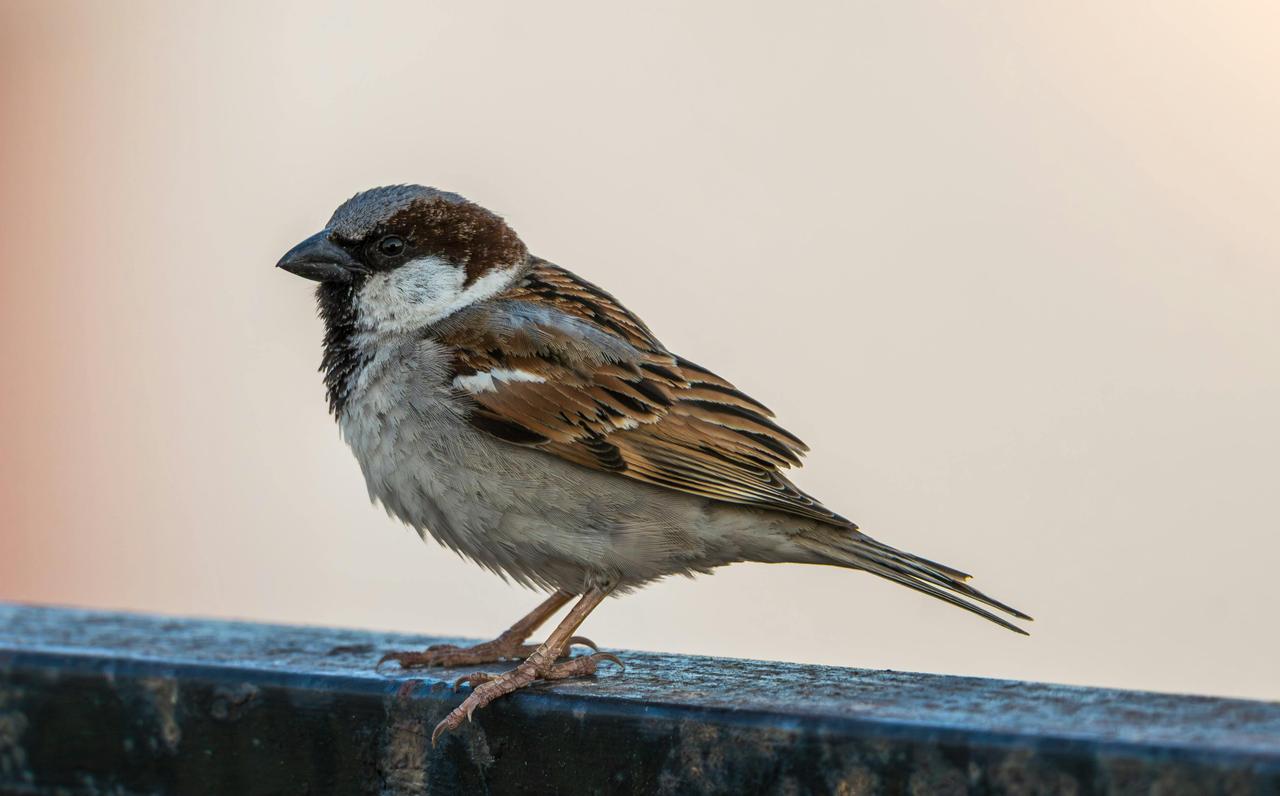
The house sparrow (Passer domesticus) is a small, compactly built bird. It measures on average 14–16 cm in length and has a wingspan of 20–25 cm. The species exhibits marked sexual dimorphism; males and females can be easily distinguished by plumage coloration. The male’s crown is gray, the nape and area around the eyes are chestnut brown, and there is a distinctive black patch on the throat, the size of which may vary with age. The cheeks are dull white and the underparts are light gray. The wings are brown with black streaks and pale wing bars.
Females and juveniles have more subdued coloration. Their upperparts are brown and streaked, while their underparts are light brown or dull white. The black throat patch found in males is absent in females. The bill is short, thick, and conical. The legs vary in color between pink and brown.
House Sparrow is native to Eurasia and North Africa but has been widely dispersed by human activity across much of the globe. It occurs naturally throughout Europe, large parts of Asia, and North Africa. Through human introduction, it has established permanent populations in North America, parts of South America, Australia, and numerous island regions.
The house sparrow is a species that has adapted strongly to human settlements. Villages, cities, suburbs, and agricultural areas are its most common habitats. It typically nests in sheltered locations such as crevices and holes in buildings, roof spaces, wall cavities, tree hollows, and nest boxes. Due to abundant food sources, it can form dense populations in agricultural zones where cereals are grown or livestock is raised. In natural or human-disturbed areas far from settlements, its numbers are significantly lower.
The house sparrow is an extremely social and noisy bird. It generally lives in colonies throughout the year and exhibits strong social structures during feeding, roosting, and breeding periods. A clear hierarchy exists among individuals, and competition or dominance behaviors may occur over food resources or suitable resting areas. In response to threats, individuals may display behaviors such as wing flapping, head extension, and short chases.
In daily life, the house sparrow is highly active. It begins foraging early in the morning and throughout the day alternates between feeding, resting, and preening. In the evening, it gathers in communal roosting sites. Seasonally, especially during winter months, it forms larger flocks and social interactions increase during this period.
The house sparrow (Passer domesticus) has an omnivorous diet and a flexible feeding strategy that allows it to adapt easily to changing food sources throughout the year. Its primary food consists of seeds and grains, particularly the seeds of cultivated plants such as wheat, barley, and oats, as well as wild grass seeds.
During the breeding season, its diet shifts to meet increased protein demands, with insects, larvae, spiders, and other small invertebrates becoming more prominent. This dietary shift is crucial for the healthy development of nestlings.
Due to its adaptation to human settlements, its feeding habitats are highly varied. In agricultural areas, it feeds on spilled grains; in urban environments, it exploits bread crumbs and other human-generated food waste. This high dietary flexibility is one of the most important ecological traits enabling the species to thrive in diverse habitats.
The house sparrow (Passer domesticus) is a monogamous species that breeds multiple times per year (not polygamous, but polyovulatory and multi-brooded). The breeding season typically begins in early spring and can extend into late summer under favorable conditions. Pairs usually remain together for the duration of a single breeding season, and in some cases, pair bonds may persist across multiple years.
Females lay an average of 3–8 eggs per clutch, with an incubation period of approximately 11–14 days. Incubation is primarily carried out by the female, though the male occasionally participates. Nestlings fledge and become capable of flight about 14–16 days after hatching.
Both parents share the responsibility of feeding the young. Protein-rich foods such as insects and larvae are preferred during this stage. Under favorable environmental conditions and sufficient food availability, a pair can raise more than one brood per breeding season—typically two to four. This high reproductive capacity plays a vital role in maintaining the species’ population.
The house sparrow (Passer domesticus) is classified as “Least Concern (LC)” on the IUCN Red List.
Balouria, Rajesh S. “Close-up of a House Sparrow on Rail.” Pexels. Accessed May 8, 2026. https://www.pexels.com/photo/close-up-of-a-house-sparrow-on-rail-31235610/.
International Union for Conservation of Nature (IUCN). “Passer domesticus (House Sparrow).” *The IUCN Red List of Threatened Species.* Accessed May 8, 2026. https://www.iucnredlist.org/species/103818789/155522130.
Lowther, Peter E., and Calvin L. Cink. “House Sparrow (Passer domesticus) – Introduction.” *Birds of the World*, Cornell Lab of Ornithology. Accessed May 8, 2026. https://birdsoftheworld.org/bow/species/houspa/cur/introduction
Ornito. "Serçe." *Ornito Kuş Atlası.* Accessed May 8, 2026. https://ornito.org/Bird/Detail/417.
TRAKUS. "Serçe (Passer domesticus)." *TRAKUS Kuş Veritabanı.* Accessed May 8, 2026. https://www.trakus.org/kods_bird/uye/?fsx=2fsdl17@d&tur=Serçe.

Length(s) | 14–16 cm | ||||||||
|---|---|---|---|---|---|---|---|---|---|
Weight(s) | 24–32 g | ||||||||
Conservation Status | Least Concern (LC) | ||||||||
Clutch Size | 3–8 individuals | ||||||||
Incubation Period | 11–14 days | ||||||||
Family | Passeridae | ||||||||
Wingspan | 20–25 cm | ||||||||
Class | Aves | ||||||||
Realm | Animalia | ||||||||
Order | Chordata | ||||||||
No Discussion Added Yet
Start discussion for "House Sparrow (Passer domesticus)" article
Taxonomy
Morphological Characteristics
Distribution and Habitat
Behavior and Ecology
Diet
Breeding
Conservation Status