


This article was automatically translated from the original Turkish version.
+1 More
Horon
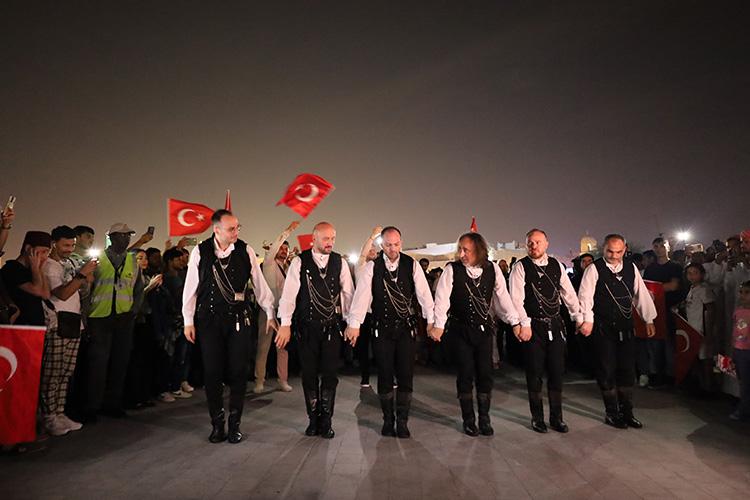
Playing Style | The rhythmic and rapid steps, which complement each other, are characteristic of the game. Players hold onto each other's shoulders or hands. Horon is generally played in a group, forming a circle. | ||||||||
|---|---|---|---|---|---|---|---|---|---|
Horon is a traditional folk dance widely performed in Türkiye’s Black Sea Region, particularly in Eastern Black Sea provinces such as Rize, Trabzon, Artvin, and Giresun. Horon is performed in various social contexts including weddings, engagement ceremonies, highland festivals, military send-offs, and holidays. It can be danced by men and women together or separately.
Horon is a folk dance characterized by its rhythmic structure, rapid movements, and group performance. It is typically performed in a circle with dancers holding hands, shoulders, or arms. Movements include knee bends, foot stomping, and shoulder and arm gestures. The tempo of the dance often increases over time, accelerating in its final sections. Horon is usually accompanied by instruments such as the kemençe, tulum, davul-zurna, and kaval. Horon can be performed with vocal elements or solely with instrumental accompaniment.
There are various theories regarding the origin of the word “horon.” Some sources suggest that it derives from the Yakut Turkish words “hor,” “kor,” and “hori,” meaning “to repeat” and “to strike in sequence,” which over time evolved into the form “horon.” In the Compilation Dictionary, the terms “horum” and “horom” refer to piles of corn stalks or grass in Eastern Black Sea regions; this has led to the association that their arrangement resembles the circular formation of the horon dance.
Horon is performed in diverse settings such as weddings, highland migrations, highland nights, and fishing boats. In the past, horon dances were performed for extended periods during multi-day weddings; today, they are mostly performed during specific segments of weddings held in urban centers.
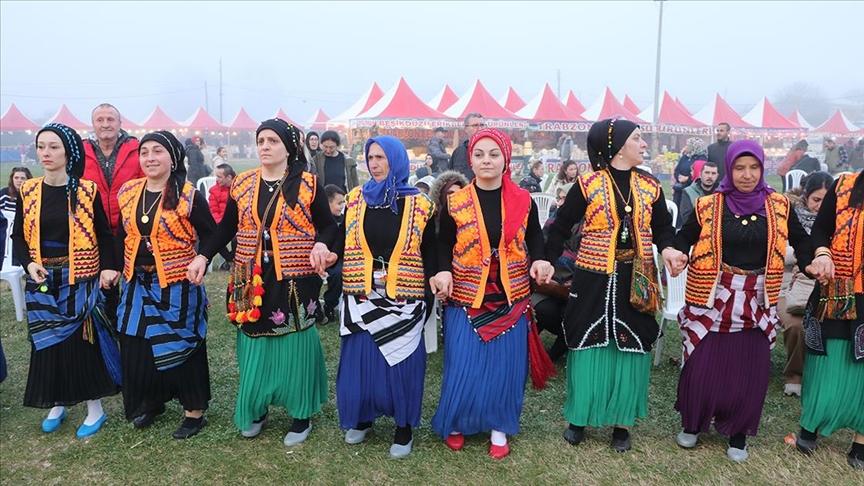
Horon dances can be performed by women, men, and different age groups. In women’s horon dances, the tempo is slower and movements such as bending to the ground are less frequent. Women’s horons often include vocal repetitions known as “nanay,” while mixed dances feature vocal sections in the form of “atma türkü.” In Hemşin horons, vocal sections called “fora” are performed with tulum accompaniment.
Horon (Anadolu Ajansı)
Horon is performed in a circular formation with a rhythmic structure. Dancers align themselves by holding hands, shoulders, or fingertips. The direction of the dance is typically clockwise. Key movements include raising and lowering the arms, forcefully stomping the feet, knee bends, jumps, and body sways. The dancers’ bodily motions are inspired by everyday life; for example, rowing, casting nets, walking on narrow paths, and hurried movements can be observed in horon figures.
During horon performances, the person directing the dance is commonly called the “horon başı.” Commands such as “Yüksek oyna” (Play high), “al oyna yüksel” (Raise and play), “kalk yürü” (Stand and walk), and “al da yüksel” (Raise again) guide the dancers. These commands coordinate foot, arm, and body movements.
There are many variants of horon in the Black Sea Region. Although some sources mention nearly fifty types, variations in naming and minor stylistic differences cause this number to fluctuate. Some horon types from the Rize region are listed below:
Horon is typically accompanied by kemençe, tulum, davul-zurna, and kaval. Regional preferences in instrumentation influence both the rhythm and tempo of the dance. In the Hemşin region, the tulum is preferred, while the kemençe is more common along the coast. The majority of horon songs are anonymous and composed in the mani form. Melodies are predominantly in irregular meters such as 5/8, 7/16, and 9/16, and some tunes combine multiple meters. Vocal sections often include expressions such as “yar,” “nazlı yar,” and “sevdiğim.”
The mountainous terrain of the region has helped preserve the traditional structure of horon by limiting external influences. The dance has retained its folk character in this context. In some areas, folk dance ensembles contribute to its promotion by performing horon at various festivals.
How is Horon performed? (Youtube/Folklor Kültür ve Sanat)
Karadeniz Valiliği. “Halk Oyunları.” Karadeniz Bölgesi Resmî İnternet Sitesi. Accessed May 16, 2025.https://karadeniz.gov.tr/halk-oyunlari-2/
Sürmeli, Metin. “Rize Halk Oyunlarında Müziğin Oynanış Üzerine Etkileri.” *Uludağ Üniversitesi Eğitim Fakültesi Dergisi* 20, no. 2 (2007): 407–426. Accessed May 16, 2025.https://dergipark.org.tr/en/download/article-file/28782.
YouTube. "Horon Gösterisi - Trabzon." YouTube video, 2:57. Published by T.C. Kültür ve Turizm Bakanlığı, 2022. Accessed May 16, 2025.
“Artvin / Deli Horon.” Kültür Portalı. Accessed May 16, 2025.
“Horon.” T.C. Kültür ve Turizm Bakanlığı Kültür Portalı. Accessed May 16, 2025.
“Horon.” T.C. Kültür ve Turizm Bakanlığı Trabzon İl Kültür ve Turizm Müdürlüğü. Accessed May 16, 2025.

Horon
Playing Style | The rhythmic and rapid steps, which complement each other, are characteristic of the game. Players hold onto each other's shoulders or hands. Horon is generally played in a group, forming a circle. | ||||||||
|---|---|---|---|---|---|---|---|---|---|
Definition and General Characteristics
Origin
Place in Social Life
Structural Features of Horon
Commands
Variants
Musical and Melodic Features
Geographical and Cultural Context