This article was automatically translated from the original Turkish version.
Registration Number | 697 | ||||||||
|---|---|---|---|---|---|---|---|---|---|
Registration Date | 22.03.2021 | ||||||||
Application Number | C2019/095 | ||||||||
Application Date | 01.08.2019 | ||||||||
Name of the Geographical Indication | Honaz Cherry | ||||||||
Product / Product Group(s) | Cherry / Processed and unprocessed vegetables and mushrooms | ||||||||
Type of Geographical Indication | Place of origin | ||||||||
Applicant/Registrant(s) | Honaz Chamber of Agriculture | ||||||||
Address of the Registrant | Cumhuriyet Mah. Yıldırım Sok. No:6 Honaz / DENİZLİ | ||||||||
Geographical Boundary | Honaz district Denizli province | ||||||||
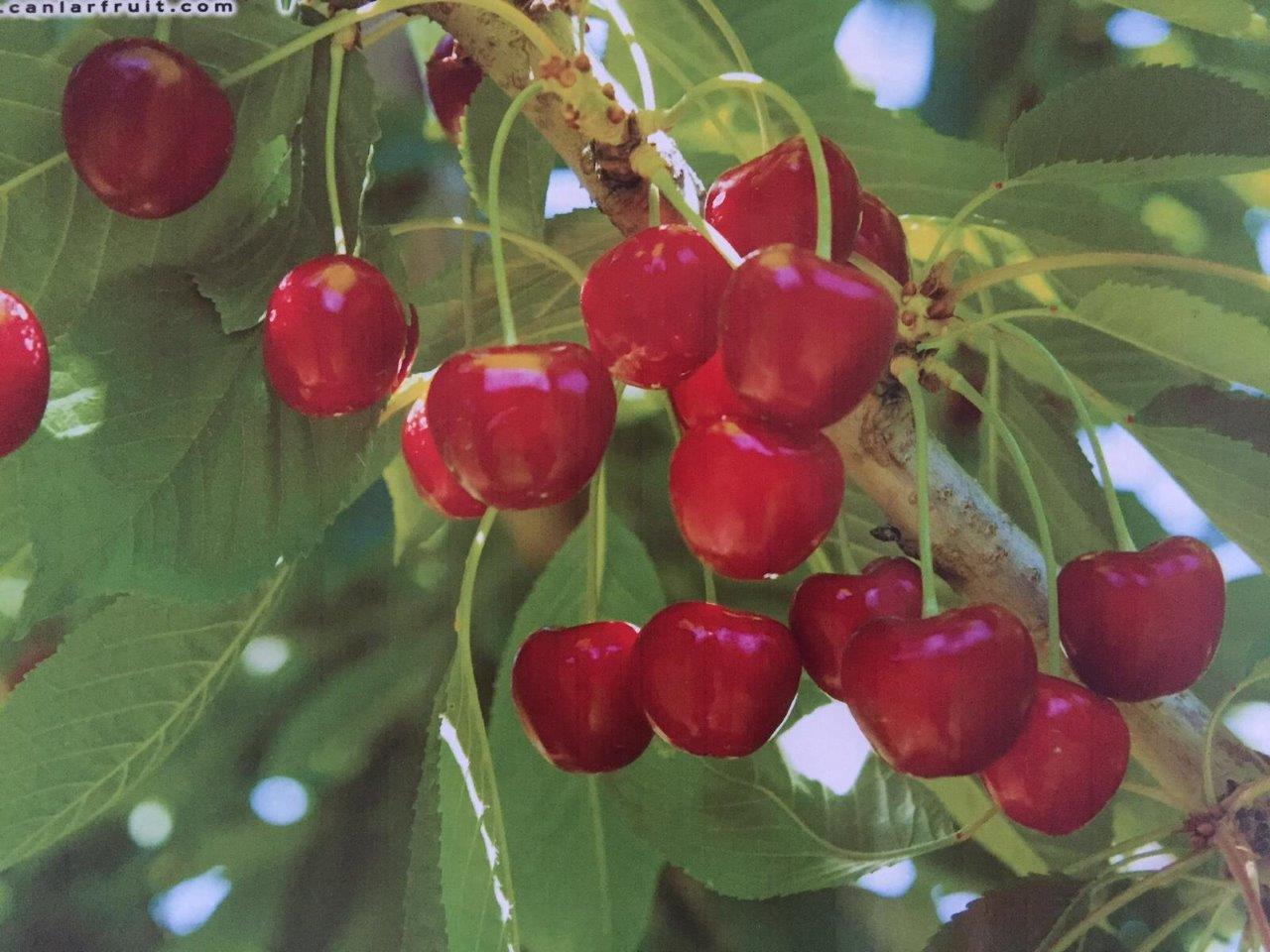
Honaz cherry is a local cherry variety cultivated in the Honaz district of Denizli Province since the 1900s, known for its large, firm fruit. It is produced by grafting the 0900 Ziraat variety onto resilient rootstocks such as Bird cherry (Prunus avium) and İdris (Prunus mahaleb). It features a long stalk, resistance to cracking, and sweet flesh.
Honaz cherry is an agricultural product grown exclusively in the Honaz district of Denizli Province, where it has served as a vital source of livelihood for the local population since the early 1900s. It is protected as a geographical indication under the “place of origin” designation. Production is confined to the Honaz district located on the northern slopes of Honaz Mountain. Due to the unique microclimate, local cultivation techniques, soil composition, and climatic conditions of this specific geography, Honaz cherry has developed distinct physical and chemical characteristics.
In Honaz cherry production, the 0900 Ziraat variety is used, grafted onto rootstocks including Bird cherry (Prunus avium), İdris (Prunus mahaleb), and clonal rootstocks such as Mazzart f 12/1, SL-64 (St. Lucie 64), Gixela-5, Ma x Ma 14, and Tabel/Edabriz. Producers in Honaz do not accept nursery-grown grafted saplings from outside the region; production and propagation are based entirely on local sources.
The fruit of the Honaz cherry is large and firm, with sweet, juicy flesh. Its resistance to cracking, long stalk, and green stalk color are distinguishing features. Under proper storage conditions, it can be preserved for extended periods. Physically, the number of fruits per kilogram ranges from 71 to 125, with individual fruit weight measuring 8–14 grams, length 21–26 mm, and width 22–26 mm. The flesh-to-pit ratio is 9.9–12.7, soluble dry matter content (SDMC) is 15.6–19%, sugar content is 13–16%, and fruit firmness ranges from 43 to 53 g.
The production area of Honaz cherry lies in a valley bordered by the Aksu Stream to the north and Honaz Mountain to the south. The microclimate created by Honaz Mountain, which rises to 2571 meters, and its surrounding forest cover regulates temperature fluctuations, particularly during fruit ripening. This microclimate reduces water loss in cherries, prevents premature ripening, and keeps cracking rates below 2%. The placement of cherry orchards on sloping terrain minimizes radiation frosts and late spring frosts. Sufficient sunlight exposure further supports the ripening process.
The soil structure is non-saline and highly calcareous. Irrigation water is of drinking quality and is also used for human consumption. These properties positively influence the fruit’s flavor, aroma, firmness, and contribute to its distinctive color. Enrichment of soils with livestock manure increases porosity and supports plant development.
Grafted saplings are planted in autumn or spring. Prior to planting, root pruning is performed, and saplings are planted at the same depth from which they were removed. Pruning follows the “central leader” system. In this system, the top of the sapling is cut at a height of 75–85 cm above ground, and controlled shoot development is guided to shape the canopy. Widening branch angles enhances early bearing and fruit yield. The target is to develop 4–5 tiers and 17–21 lateral branches.
Soil tillage is kept shallow, with aeration and weed control carried out in spring and autumn. Drip irrigation is the most ideal system; in sprinkler-irrigated areas, care is taken to prevent water from directly contacting the tree trunk. Irrigation is avoided immediately before harvest as it negatively affects fruit quality. Post-harvest irrigation is applied to support the development of new flower buds.
Fertilization practices are based on soil and leaf analyses. Due to the high calcium content in the soil, sulfur applications are made to maintain soil balance. It is recommended to apply 2–3 tons of composted barn manure per hectare every two years. Phosphorus and potassium fertilizers are applied in autumn, while nitrogen fertilizers are applied in three stages: in spring, after petal fall, and during harvest. Foliar fertilizers are applied 2–3 times depending on nutrient deficiencies in the plant.
Honaz cherries are hand-harvested with their stalks intact during early morning hours in May and June. Care is taken during harvest to avoid damaging the fruit buds for the following year. Harvested fruits are stored in shaded, cool conditions.
The production, labeling, and packaging processes of Honaz cherry are inspected three times annually by a four-member monitoring board coordinated by the Honaz Chamber of Agriculture. At least two of these inspections occur during the harvest period (May–June), and one takes place before harvest. Additional inspections may be conducted as needed or upon complaint. During inspections, the product’s origin, physical characteristics, production method, and proper use of the geographical indication emblem are verified. Required analyses are carried out by laboratories under the Ministry of Agriculture and Forestry or accredited private laboratories. The registering organization is responsible for managing all legal protection procedures related to the product.
Turk Patent and Trademark Office. "Honaz Kirazı Teknik Şartnamesi (PDF)." Accessed July 20, 2025. https://ci.turkpatent.gov.tr/Files/GeographicalSigns/c2c5ab60-deef-496a-9be4-a6741139bb43.pdf.
Türk Patent ve Marka Kurumu. "Coğrafi İşaretler: Honaz Kirazı." Accessed July 20, 2025. https://ci.turkpatent.gov.tr/cografi-isaretler/detay/783.

Registration Number | 697 | ||||||||
|---|---|---|---|---|---|---|---|---|---|
Registration Date | 22.03.2021 | ||||||||
Application Number | C2019/095 | ||||||||
Application Date | 01.08.2019 | ||||||||
Name of the Geographical Indication | Honaz Cherry | ||||||||
Product / Product Group(s) | Cherry / Processed and unprocessed vegetables and mushrooms | ||||||||
Type of Geographical Indication | Place of origin | ||||||||
Applicant/Registrant(s) | Honaz Chamber of Agriculture | ||||||||
Address of the Registrant | Cumhuriyet Mah. Yıldırım Sok. No:6 Honaz / DENİZLİ | ||||||||
Geographical Boundary | Honaz district Denizli province | ||||||||
Geographical Distribution
Botanical Characteristics and Rootstocks
Fruit Characteristics
Ecological Factors
Cultivation and Production Method
Fertilization
Harvest
Monitoring and Protection