


This article was automatically translated from the original Turkish version.
+1 More
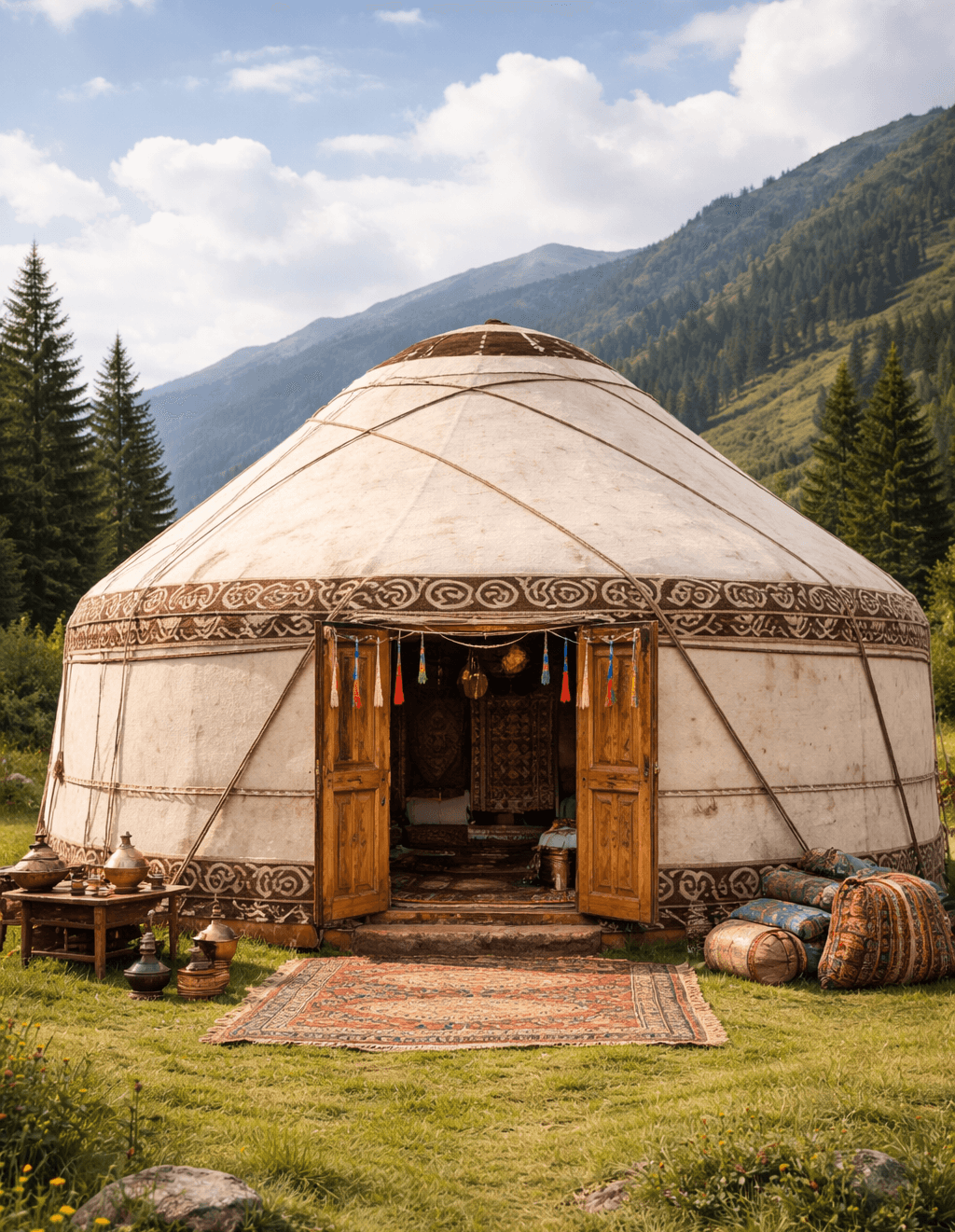
Dormitory
(Generated by artificial intelligence)
International Registration | UNESCO Representative List of the Intangible Cultural Heritage | ||||||||
|---|---|---|---|---|---|---|---|---|---|
Countries of Registration | 2025 - Kazakhstan, Kyrgyzstan and the Karakalpak Autonomous Republic (Uzbekistan) 2014 - Kazakhstan and Kyrgyzstan | ||||||||
Registration Name | 2025 - Traditional knowledge and skills in making Kyrgyz Kazakh and Karakalpak yurts (Turkic nomadic dwellings) - [Kırgız Kazak ve Karakalpak yurtlarının (Türk göçebe konutları) yapımında kullanılan geleneksel bilgi ve beceriler] | ||||||||
Yurt is a portable dwelling type considered sacred and indispensable to the family (household) life of Turkish nomadic communities. Once a settlement area is selected, a yurt can be quickly assembled to meet immediate needs. Families may own more than one yurt depending on their means. The yurt was not used solely for shelter; it also served as the central space for rituals such as birth, marriage, and funeral ceremonies, as well as daily life activities. In this sense, it is a structure that embodies family organization and community identity. In 2014, within the context of Kazakhstan and Kyrgyzstan, and in 2025, extending to include the Kazakh, Kyrgyz, and Karakalpak communities, the yurt was inscribed on UNESCO’s Representative List of the Intangible Cultural Heritage.
Traditional Knowledge Used in the Construction of Kyrgyz, Kazakh, and Karakalpak Yurts (UNESCO)
The yurt, the most common type of tent among Turks, is defined as a dwelling with a circular base and a low dome-shaped roof, constructed from felt. Due to its shape and the materials used in its construction, it is also known as “kiyiz üy,” meaning “felt house.” In Kâşgarlı Mahmud’s work Dîvânu Lugâti’t-Türk, the term “keregü” is used for yurt and is associated with the meaning of “winter house.” 【1】 These terms are historical designations that reflect both the physical characteristics and functional purposes of the yurt.
The yurt is described as a mobile dwelling consisting of a collapsible wooden circular framework, covered with felt and secured with ropes. Its most essential feature is its ability to be assembled and disassembled rapidly. Yurts are produced using natural and renewable raw materials.
There is a clear division of labor in the yurt-making process. Men and their apprentices craft the wooden framework by hand; during this process, structural details made of leather, bone, and metal are also prepared. Women produce the interior decorations and exterior coverings, which are adorned with organic or geometric patterns. Women typically work in community-based groups under the supervision of experienced masters. Traditional handicraft techniques such as weaving, spinning, knitting, felt-making, embroidery, and sewing are employed together in this process. Yurt construction is not merely an individual production activity; it is presented as a collective process involving the entire community through shared labor and solidarity.

Yurt Construction Today (Anadolu Ajansı)
The interior layout of the yurt has been shaped according to a specific order that reflects the social structure, family relationships, and daily life practices of Turkic nomadic communities. According to Wilhelm Radloff’s observations, the internal arrangements of yurts generally exhibit similar features across regions. At the exact center of the yurt is the “korluk”, a hearth. Above the hearth stands a large tripod, upon which a large cauldron is placed. The hearth is not merely a cooking area; it is regarded as the most sacred point of the yurt. It is noted that great care is taken to ensure the fire burns continuously throughout the day, symbolizing the continuity of the family lineage, an understanding preserved in the modern expression “to let the hearth go out.” 【2】 The absence of smoke from a yurt’s chimney was considered evidence that no one was living inside. When a son marries, he takes fire from his father’s hearth to light his own yurt’s fire, linking the hearth’s sanctity with the continuity of lineage. It is stated that for ancient Turks, fire was considered sacred due to its purifying properties.
Immediately to either side of the hearth are two upright posts known as “sırguk”. These posts support the central crown ring (tüynük) and contribute to the structural stability of the yurt. It is reported that the sırguk posts are associated with the Turkic cosmological belief in a “pillar of the sky” that holds up the heavens. In this context, an expression such as “my house’s pillar has fallen” is understood to signify the collapse of the yurt, reflecting a symbolic link between the structural pillar and the household’s integrity.
Upon entering the yurt, directly opposite the entrance and extending along the wall is a section called “tör”, where chests, saddlebags, bundles, and sacks are arranged. This area is typically reserved for the eldest, most respected, and highest-status male guests. A felt or carpet is laid on the floor in front of the stored items to create a seating area, which is often covered with special carpets called “ocakçı” or embroidered felt coverings known as “koşma.” The area to the left of the entrance is designated for ordinary male guests.
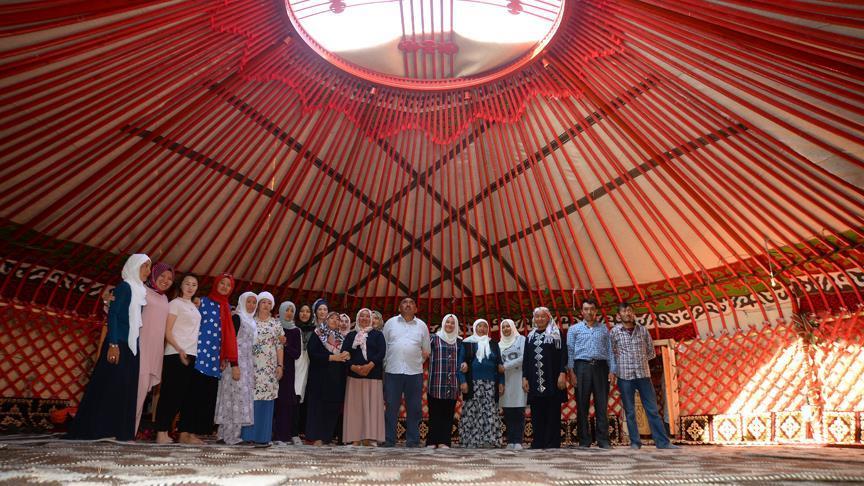
Interior View of a Yurt (Anadolu Ajansı)
The area to the right of the entrance, separated by a woven screen embroidered with patterns, is designated for female guests. Cooking utensils and household items are stored here. Beyond this section, in the rear right portion of the yurt, lies the family’s private living area. Beds are placed here, and a curtain is stretched in front of the bed to ensure privacy. On the right side of the bed is a metal or silver peg for hanging clothing and weapons. On the left side of the bed, along the wall, chests, saddlebags, bundles, and sacks are arranged in two rows, also referred to as “yük.”
On the left side of the yurt’s entrance, saddles and horse tack are hung. The area near the doorway is used by servants. This arrangement reveals the spatial manifestation of social status, gender roles, and concepts of privacy within the yurt. The interior layout of the yurt is functionally unified, reflecting family life, hospitality traditions, and daily usage.
The yurt serves as the fundamental space for family life and community organization among Kazakh, Kyrgyz, and Karakalpak communities. UNESCO decisions highlight that yurt-making and usage support shared human values, cooperation, and production skills. Yurts are preserved within families, passed from parents to children, and safeguarded as sacred family heritage. In this sense, the yurt is a tangible part of family history. It is also regarded as a factor that strengthens social harmony among communities and contributes to the preservation of cultural diversity.
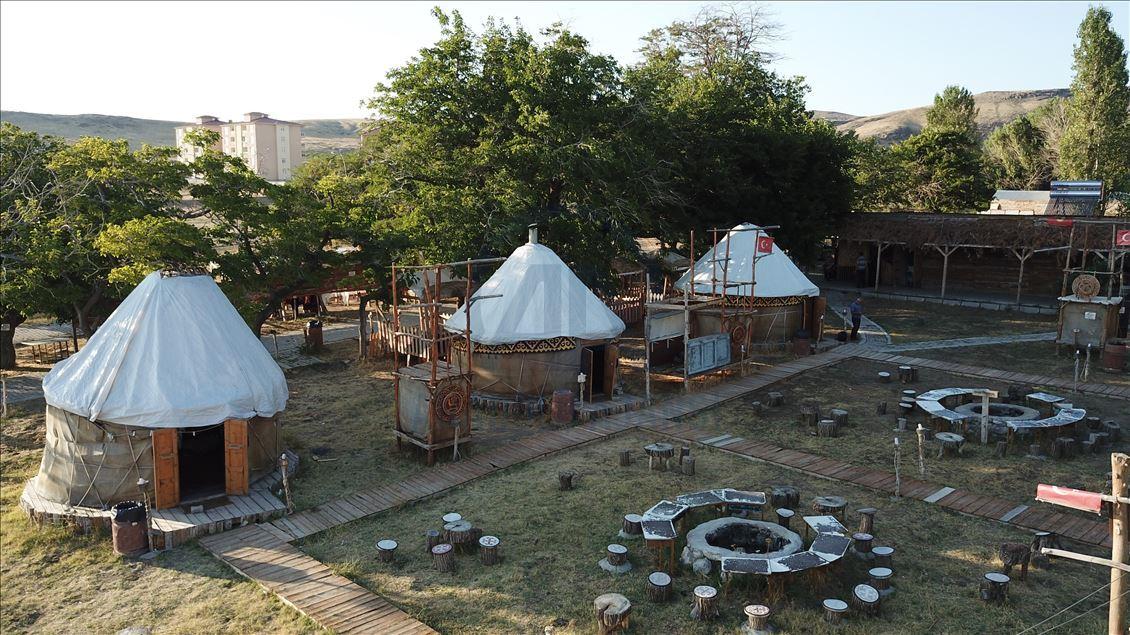
Yurt (Anadolu Ajansı)
Knowledge and skills related to yurt construction are primarily transmitted within families from parents to children. Additionally, the master-apprentice relationship is identified as a fundamental method of transmission. Community elders also play a significant role in this process.

Yurt Construction (Anadolu Ajansı)
According to the 2025 UNESCO decision, this transmission also occurs through exhibitions, festivals, workshops, and media channels. 【4】 Thus, knowledge of yurt construction is sustained not only through traditional means but also through community-based cultural activities.
At the ninth session of the Intergovernmental Committee held in Paris from 24 to 28 November 2014, nomination dossier submitted by Kazakhstan and Kyrgyzstan under the title “Traditional knowledge and skills in making Kyrgyz and Kazakh yurts (Turkic nomadic dwellings)” was accepted by Decision 9.COM 10.24. As a result, the traditional knowledge and skills related to yurt construction were inscribed on UNESCO’s Representative List of the Intangible Cultural Heritage as an element passed from generation to generation and inseparable from daily life and rituals. The decision text explicitly emphasized the importance of yurts in relation to family structure, community identity, and the relationship between humans and nature. It also noted that yurt construction is a cultural practice that fosters cooperation and collective production among community members. 【5】
In 2025, at the twentieth session of the Intergovernmental Committee held in New Delhi, India, from 8 to 12 December, the yurt was inscribed on UNESCO’s Representative List of the Intangible Cultural Heritage with an expanded scope under Decision 20.COM. This inscription, titled “Traditional knowledge and skills in making Kyrgyz, Kazakh and Karakalpak yurts (Turkic nomadic dwellings)”, includes the Karakalpak communities of Uzbekistan in addition to Kazakhstan and Kyrgyzstan. The decision text states that yurts are preserved within families as sacred heritage, transmitted across generations, and thus constitute one of the fundamental elements of identity for these communities. 【6】
Göner, Göksu, and Gülderen, Gönen. "Türklerde Çadır Kültürünün Gelişimi." *GAB Akademi* 2, no. 3 (2022): 11–24. Accessed January 4, 2026.https://dergipark.org.tr/en/pub/gabakademi/issue/74807/1204135
Karaca, Necmettin. “Kırgız Türkleri Çivi Kullanmadan Yaptıkları 'Otağ'ları Yurt Dışına Gönderiyor.” Anadolu Ajansı, September 20, 2020. Accessed January 4, 2026.https://www.aa.com.tr/tr/pg/foto-galeri/kirgiz-turkleri-civi-kullanmadan-yaptiklari-otaglari-yurt-disina-gonderiyor/2
Toktaş, Şener. “Han Otağı ile Malazgirt Ruhu Yaşatılacak.” Anadolu Ajansı, August 23, 2018. Accessed January 4, 2026.https://www.aa.com.tr/tr/turkiye/han-otagi-ile-malazgirt-ruhu-yasatilacak-/1237654
UNESCO. “Decision of the Intergovernmental Committee: 9.COM 10.24.” Accessed January 4, 2026.https://ich.unesco.org/en/decisions/9.COM/10.24
UNESCO. “Ninth Session of the Intergovernmental Committee (9.COM).” Accessed January 4, 2026.https://ich.unesco.org/en/9com
UNESCO. “Traditional Knowledge And Skills in Making Kyrgyz, Kazakh and Karakalpak Yurts.” YouTube, 7:16. Accessed January 4, 2026.https://www.youtube.com/watch?v=tTpyk8DnTY0
UNESCO. “Traditional Knowledge and Skills in Making Kyrgyz, Kazakh and Karakalpak Yurts (Turkic Nomadic Dwellings).” Accessed January 4, 2026.https://ich.unesco.org/en/RL/traditional-knowledge-and-skills-in-making-kyrgyz-kazakh-and-karakalpak-yurts-turkic-nomadic-dwellings-02284
UNESCO. “Vingtième Session du Comité Intergouvernemental de Sauvegarde du Patrimoine Culturel Immatériel.” Accessed January 4, 2026.https://ich.unesco.org/fr/20com
Özpınar, Berna. "Türk Çadır Kapıları Üzerine Bir İnceleme." *Türklük Bilimi Araştırmaları* 51 (2022): 137-162. Accessed December 4, 2025.https://dergipark.org.tr/en/pub/tubar/issue/70261/631277
[1]
Göksu Göner, ve Gülderen Gönen. "Türklerde Çadır Kültürünün Gelişimi." GAB Akademi 2, no. 3 (2022): 15. Erişim 4 Ocak 2026. https://dergipark.org.tr/en/pub/gabakademi/issue/74807/1204135
[2]
Göner ve Gönen. "Türklerde Çadır Kültürünün Gelişimi." (2022): 16-17. Erişim 4 Ocak 2026. https://dergipark.org.tr/en/pub/gabakademi/issue/74807/1204135
[4]
UNESCO. “Traditional Knowledge and Skills in Making Kyrgyz, Kazakh and Karakalpak Yurts (Turkic Nomadic Dwellings).” Erişim 4 Ocak 2026. https://ich.unesco.org/en/RL/traditional-knowledge-and-skills-in-making-kyrgyz-kazakh-and-karakalpak-yurts-turkic-nomadic-dwellings-02284
[5]
UNESCO. “Decision of the Intergovernmental Committee: 9.COM 10.24.” Erişim 4 Ocak 2026. https://ich.unesco.org/en/decisions/9.COM/10.24
[6]
UNESCO. “Traditional Knowledge and Skills in Making Kyrgyz, Kazakh and Karakalpak Yurts (Turkic Nomadic Dwellings).” Erişim 4 Ocak 2026. https://ich.unesco.org/en/RL/traditional-knowledge-and-skills-in-making-kyrgyz-kazakh-and-karakalpak-yurts-turkic-nomadic-dwellings-02284

Dormitory
(Generated by artificial intelligence)
International Registration | UNESCO Representative List of the Intangible Cultural Heritage | ||||||||
|---|---|---|---|---|---|---|---|---|---|
Countries of Registration | 2025 - Kazakhstan, Kyrgyzstan and the Karakalpak Autonomous Republic (Uzbekistan) 2014 - Kazakhstan and Kyrgyzstan | ||||||||
Registration Name | 2025 - Traditional knowledge and skills in making Kyrgyz Kazakh and Karakalpak yurts (Turkic nomadic dwellings) - [Kırgız Kazak ve Karakalpak yurtlarının (Türk göçebe konutları) yapımında kullanılan geleneksel bilgi ve beceriler] | ||||||||
Terminology
Structure, Materials, and Assembly
Interior Layout and Use
Social and Cultural Functions
Transmission of Traditional Knowledge on Yurt Construction
UNESCO Representative List Process
2014 – Paris
2025 – New Delhi