


This article was automatically translated from the original Turkish version.
+2 More
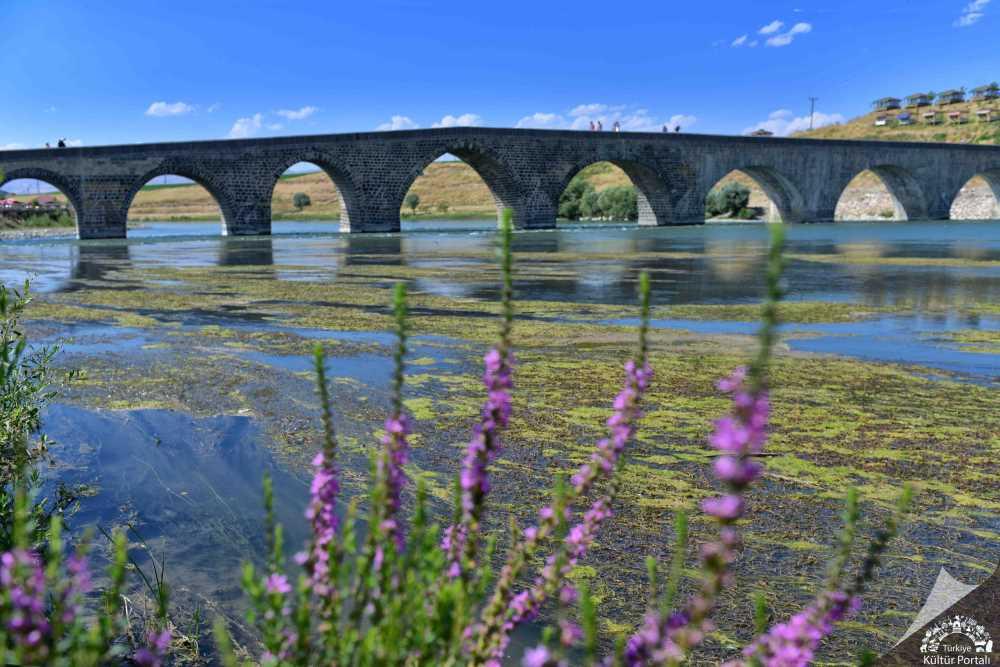
Historical Murat Bridge
Location | Muş / Türkiye | ||||||||
|---|---|---|---|---|---|---|---|---|---|
Construction Period | 13th century (Seljuk period) | ||||||||
Material | Cut stone and rubble stone | ||||||||
Length | 143 metres | ||||||||
Width | 5 metres | ||||||||
Height | 16–18 metres | ||||||||
Protection | It is under local protection within the cultural heritage framework | ||||||||
The Historical Murat Bridge is located on the Murat River within the boundaries of Muş province and is one of Anatolia’s most significant historical bridges. Although its exact construction date is unknown, based on its architectural features and historical records, it is generally accepted that the bridge was built during the Seljuk period in the 13th century. A marble inscription dated 1871 on the bridge indicates that it underwent restoration during the Ottoman period. The bridge, still in use today, attracts attention for its historical and architectural value. Moreover, due to the recreational areas, cafés and local restaurants along the Murat River, it has become an important cultural and tourist hub.
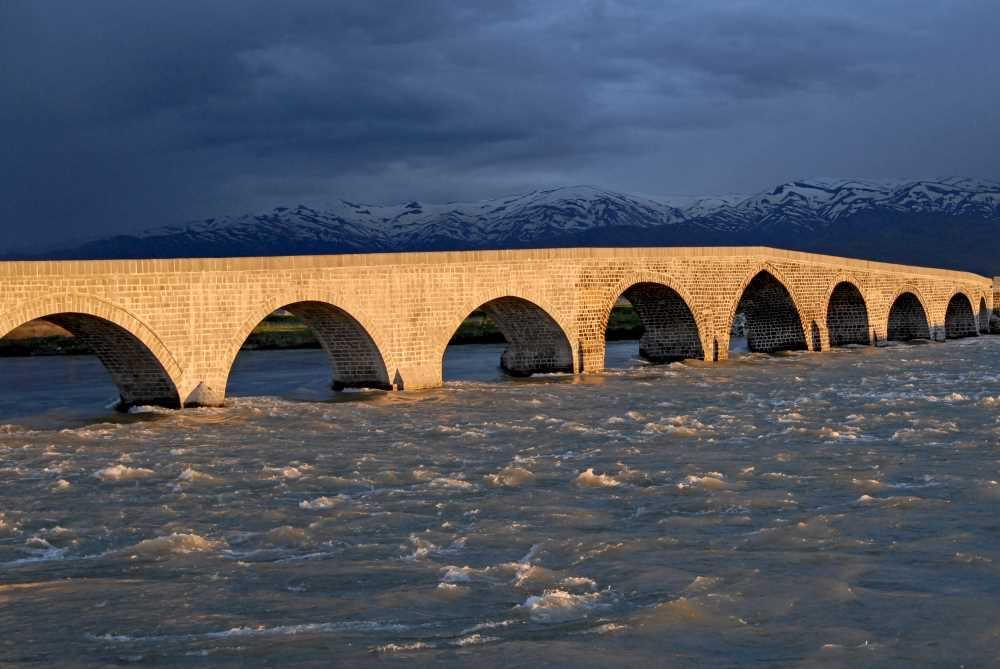
Historical Muş Murat Bridge ( Culture Portal)
Although the exact construction year of the Historical Murat Bridge is unknown, its architectural features and regional historical context lead scholars to conclude that it was built during the Seljuk period in the 13th century. During the time the Seljuks established dominance in Eastern Anatolia, such stone bridges were commonly constructed across the Murat River to facilitate crossings and secure trade routes.
The most concrete evidence regarding the bridge’s historical development comes from the marble inscription on its surface. The date of 1871 inscribed on the plaque indicates that the bridge underwent significant restoration during the Ottoman period. This restoration was most likely carried out by the provincial administration of the time to ensure the bridge’s continued function as a transportation link.
The bridge remained actively used during the Republican era. In 2010, lighting works enhanced its nighttime visibility and aesthetic appeal. Over the years, the structure suffered various damages; according to local legends, it was occasionally targeted by treasure hunters. However, through the implementation of protective measures and restoration efforts aimed at preservation, the bridge has been restored to its functional and cultural significance.
Today, the Historical Murat Bridge serves both as a road crossing and a tourist attraction, continuing to stand as one of the most important symbols of Muş’s historical identity.
The Historical Murat Bridge reflects the typical characteristics of Seljuk-era stone bridge architecture. Spanning 143 meters in length, 5 meters in width and approximately 16–18 meters in height, the bridge features 12 pointed arches that enable passage over the river. The pointed arch form is a distinctive feature of Seljuk architecture. The height and span of the arches are varied to suit the river’s flow regime. The largest arch is positioned at the center, while smaller arches symmetrically decrease in size toward the ends, giving the bridge both structural balance and aesthetic harmony.
The bridge was constructed using locally sourced dressed stone and rubble stone. Triangular-shaped cutwaters were added to the piers facing the current, strengthening the structure against hydrodynamic forces and reducing the erosive impact of water. A uniform load distribution was achieved between the arches and piers, allowing the bridge to withstand pedestrian traffic and light transport loads for centuries. Both ends of the bridge are completed with gently sloping ramps that integrate seamlessly with the natural topography.
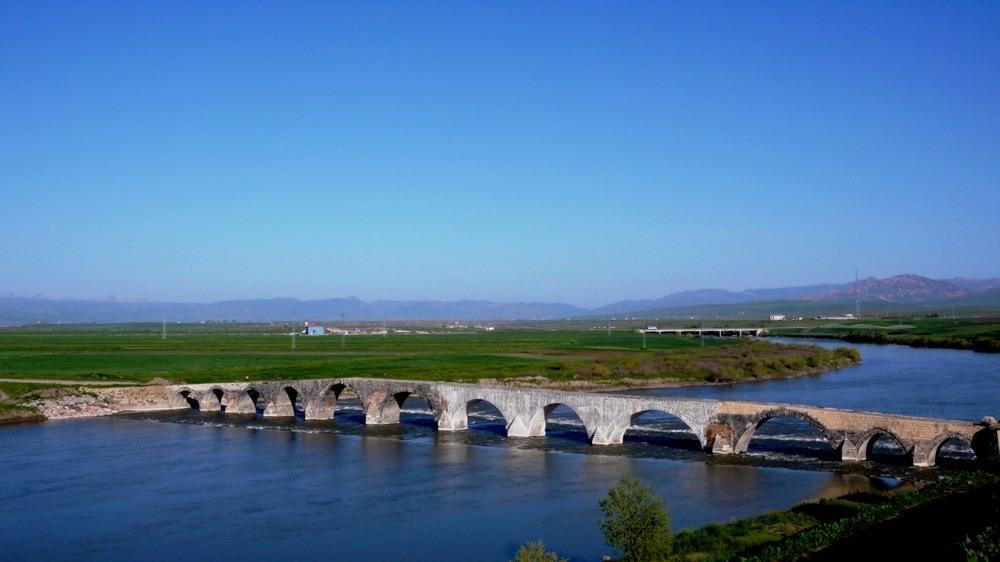
Historical Murat Bridge (Muş Provincial Administration)
The area surrounding the bridge has been enriched with recreational spaces, restaurants and cafés, transforming it into a vibrant living space where both local residents and visitors can relax and enjoy regional cuisine. The 2010 lighting project highlighted the bridge’s nighttime appearance, enhancing its visual impact. The bridge is one of the rare places where nature and historical architecture converge, offering continuous access throughout the day and holding high potential for cultural tourism and regional promotion.
Embraced by the local community, the bridge has also become part of the region’s oral culture through the legends associated with it. In this context, the Murat Bridge is not merely a physical crossing point; it is a cultural entity representing Muş’s historical identity, traditions and social belonging.
Artan, Cüneyt. "Muş İlinde Bulunan Tarihi Köprüler ve Tarihi Murat Köprüsünün Yapısal Değerlendirmesi." Master's thesis, Bilecik Şeyh Edebali Üniversitesi, 2020.https://acikkaynak.bilecik.edu.tr/xmlui/bitstream/handle/11552/2702/10411444.pdf?sequence=1
T.C. Kültür ve Turizm Bakanlığı. "Tarihi Murat Köprüsü." Türkiye Kültür Portalı. Accessed April 15, 2025.https://www.kulturportali.gov.tr/turkiye/mus/gezilecekyer/tarh-murat-koprusu
Türkiye Turizm Ansiklopedisi. "Tarihi Murat Köprüsü." Türkiye Turizm Ansiklopedisi. Accessed April 15, 2025.https://turkiyeturizmansiklopedisi.com/tarihi-murat-koprusu

Historical Murat Bridge
Location | Muş / Türkiye | ||||||||
|---|---|---|---|---|---|---|---|---|---|
Construction Period | 13th century (Seljuk period) | ||||||||
Material | Cut stone and rubble stone | ||||||||
Length | 143 metres | ||||||||
Width | 5 metres | ||||||||
Height | 16–18 metres | ||||||||
Protection | It is under local protection within the cultural heritage framework | ||||||||
No Discussion Added Yet
Start discussion for "Historic Murat Bridge" article
History
Architectural Structure
Cultural and Touristic Significance