


This article was automatically translated from the original Turkish version.
+1 More
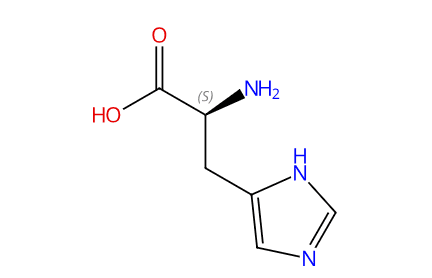
Histidine
IUPAC Name | Histidine | ||||||||
|---|---|---|---|---|---|---|---|---|---|
Systematic IUPAC Name | 2-Amino-3-(1H-imidazol-4-yl)propanoic acid | ||||||||
Melting Point | 287 | ||||||||
Density | 1.412 g/cm³ | ||||||||
Molecular Mass | 155.15 | ||||||||
Histidine (His or H) is one of the standard 20 amino acids that serve as fundamental building blocks of proteins in living organisms. Due to its unique chemical and biological properties, it plays a vital role in structural integrity and functional diversity. In humans, histidine is considered an essential amino acid, meaning it cannot be synthesized in sufficient quantities by the body and must be obtained through the diet. The most distinctive feature of histidine is its imidazole side chain, which has a pKa value close to physiological conditions (approximately 6.0). This property enables histidine to play a critical role in the catalytic mechanisms of many enzymes and in the pH-sensitive functions of proteins.

Esansiyel Amino Asit Histidinin Yapısal Formülü (Leonid_Andronov - Vektör)
Histidine consists of an α-amino group, an α-carboxylic acid group, and an imidazole side chain. The imidazole ring is a five-membered heterocyclic structure containing two nitrogen atoms. One of these nitrogen atoms is protonatable, while the other is typically bound to the protein or exists in a deprotonated form.
The pKa of the imidazole side chain can vary depending on the surrounding microenvironment but is generally around 6.0. This means that at physiological pH (~7.4), histidine residues can exist in both protonated (positively charged) and deprotonated (neutral) forms. This characteristic makes histidine highly effective in acid-base catalysis, proton transfer reactions, and the formation of coordination complexes with metal ions such as zinc, copper, and nickel.
Histidine has diverse functions in living organisms:
Histidine is absorbed from the intestines following the digestion of dietary proteins. In the body, it enters various metabolic pathways:
Disorders in histidine metabolism or imbalances in histidine levels have been associated with various clinical conditions:
Chemical Abstracts Service (CAS). "L-Histidine." CAS Common Chemistry. Accessed May 19, 2025.https://commonchemistry.cas.org/detail?cas_rn=71-00-1
Kessler, Aleeza T. and Avais Raja. "Biochemistry, Histidine." *StatPearls*. Accessed May 19, 2025.https://www.ncbi.nlm.nih.gov/books/NBK538201/.
Leonid_Andronov. "Esansiyel Amino Asit Histidin Yapısal Formülü – Vektör." Depositphotos. Accessed May 19, 2025.https://depositphotos.com/tr/vector/essential-amino-acid-histidine-structural-formula-13279835.html

Histidine
IUPAC Name | Histidine | ||||||||
|---|---|---|---|---|---|---|---|---|---|
Systematic IUPAC Name | 2-Amino-3-(1H-imidazol-4-yl)propanoic acid | ||||||||
Melting Point | 287 | ||||||||
Density | 1.412 g/cm³ | ||||||||
Molecular Mass | 155.15 | ||||||||
No Discussion Added Yet
Start discussion for "Histidine (Amino Acid)" article
Chemical Structure and Properties of Histidine
Biological Functions of Histidine
Histidine Metabolism
Clinical Significance