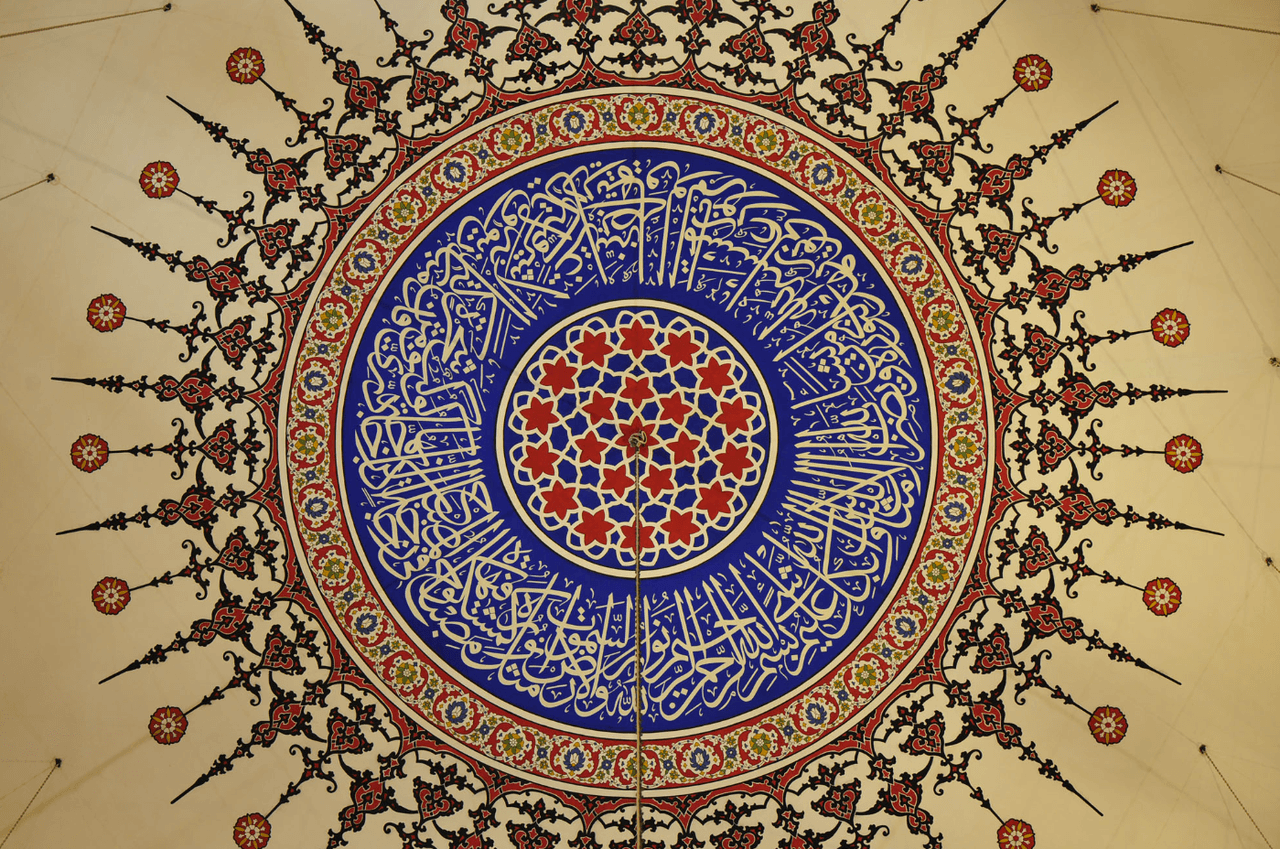
Kalemişi is an ornamental art form in which patterns drawn on semi-transparent tracing paper are pierced with needles and transferred onto the target surface using coal dust, followed by coloring with various pigments and brushes. This art form holds an important place in Ottoman and Türk artistic traditions and has been widely used in the interior and exterior decoration of religious, civil, and military architectural structures.
History and Development of Kalemişi Art
Kalemişi art has its origins in the Central Asian Turkish Uyghur artistic tradition. Wall frescoes used by Turks in Central Asia during the 8th and 9th centuries are considered early examples of this art. With the migrations of the Turks, this technique was carried to Anadolu and developed further under the influence of Islamic art, particularly in its motifs and compositions. During the Great Selçuklu period, kalemişi was employed in religious and civil architectural decoration and reached its peak during the Ottoman era. In the 16th century, during the classical style period, this art experienced its most brilliant phase and underwent significant development within the Ottoman palace nakkaşhaneler.
The Süleymaniye, Rüstem Paşa, and Takkeci İbrahim Ağa mosques are among the important examples of classical Ottoman kalemişi decoration. In the 19th century, Western artistic movements such as Barok, Rokoko, and gibi Ampir were integrated into kalemişi art. Important works from this period include the Aksaray Pertevniyal Valide Camii and the Sacred Relics Chamber of kutsal Topkapı Sarayı. Although modern artistic approaches replaced traditional arts after the Republic, academic research and restoration projects continue to preserve kalemişi art. Today, this art is used in restoration projects and specialized decorative applications.
Techniques Used in Kalemişi Art
Kalemişi art encompasses various techniques applicable to different surfaces:
Plaster Surface Applications
- Contoured (Tahrirli) Applications: In this method, patterns intended for the plastered surface are first drawn on tracing paper, pierced with needles, and transferred onto the surface using a coal dust pad. The designs are then painted according to specific rules, followed by the tahrir process, which outlines the contours. This technique enhances the visibility of fine details.
- Non-contoured (Negative) Applications: In this technique, designs are colored directly without any outlining. Contrast colors are applied to the background and motifs to make them stand out. It is considered a more practical method in terms of craftsmanship.
- Stencil Applications: This method involves applying patterns through stencils, typically cut from acetate or varnished cardboard. Painting is done using sponge pads or puff brushes. It is one of the fastest and most suitable techniques for mass production.
- Fresco Technique: In this method, designs are painted onto wet plaster so that the pigments are absorbed directly into the surface. This technique, used for wall decorations for centuries, is preferred due to its durability.
- Roller Technique: This technique, used in kalemişi decoration, involves transferring patterns onto surfaces using specially prepared roller stamps. It is commonly employed to repeat the same motif across large areas.
Relief Plaster Surface Applications
- Malakari Technique: Known in kalemişi art as a relief plaster application, this technique involves carving patterns into wet plaster to create a three-dimensional effect. It is frequently used in architectural decoration to produce depth.
- Cardboard Cutting Technique: Patterns are cut from cardboard and adhered to the plaster surface to create a relief effect. This method is especially effective in interior decorations for highlighting intricate details.
- Cartonpierre Technique: Commonly used in areas requiring mass production, this technique involves casting plaster designs using molds and mounting them onto surfaces.
Wood Surface Applications
- Edirnekari: Relief patterns are applied to wooden surfaces using a mixture of plaster and adhesive, then decorated with gold leaf. This technique was widely used during the Ottoman period.
- Coloring of Carved Wood: Achieved by carving designs into the wood surface. The finished pieces may be gilded with gold leaf or left in their natural wood tones.
- Fabric Applications: Fabric is applied over wooden surfaces to facilitate the application of patterns. This method is typically used on flexible surfaces.
Applications on Metal, Leather, and Stone
- Kalemişi on Metal Surfaces: Applied to metal surfaces to create decorative finishes resistant to moisture and humidity.
- Applications on Leather: Decorative kalemişi patterns applied to processed animal hides, typically prepared in parchment-like consistency.
- Kalemişi on Stone and Marble: Applied to stone and marble surfaces using a slurry and pigments. Due to its durability and longevity, it is preferred in large-scale structures.
Kalemişi art is currently preserved by a number of master artists who teach the craft through the traditional master-apprentice relationship and pass it on to future generations:
- Sabri İrteş (1923–2010): A prominent master who worked on the restoration of Ottoman-era kalemişi art. He restored decorative elements in numerous historical sites, including Topkapı Sarayı.
- Hamit Üçer (1923–2006): For 52 years, he carried out kalemişi restorations in major monuments such as Topkapı Sarayı and Ayasofya, making significant contributions to the preservation of the art.
- Semih İrteş, Kaya Üçer, and Servet Çaçan: Contemporary artists who continue to sustain kalemişi art and train new masters. They contribute to the sustainability of the art through academic instruction.