


This article was automatically translated from the original Turkish version.
+1 More
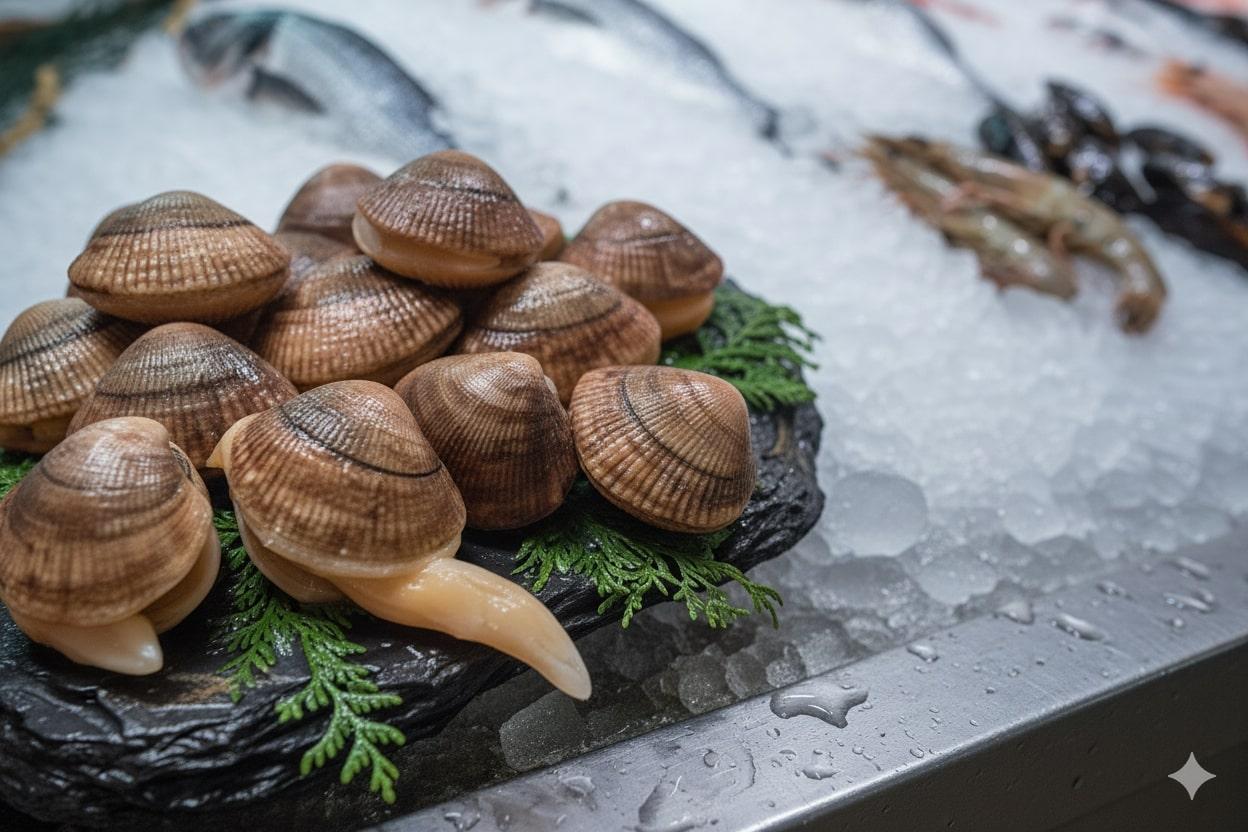
Hirotawansan Ishikagegai (Generated by Artificial Intelligence.)
Geographical Place Name | Hirotawansan Ishikagegai | ||||||||
|---|---|---|---|---|---|---|---|---|---|
Class | Fish and Shellfish | ||||||||
Type(s) | Oyster (Clinocarium californiense) | ||||||||
Applicant | Hirotawan Gyogyo Kyodo Kumiai | ||||||||
Hirotawansan Ishikagegai is a species of oyster (Clinocarium californiense) cultivated in Hirota Bay off the coast of Rikuzentakata City in Iwate Prefecture. Its geographical indication (GI) name is “Hirotawansan Ishikagegai” and it belongs to the category of Fish and Shellfish Products.
This oyster species, scientifically known as Clinocarium californiense, has a dark reddish-brown, rounded shell. The edible part is the cream-colored foot. The flesh has a chewable texture and a sweet flavor. When evaluated for nutritional value, it is noted for its high content of free amino acids.
About Hirotawansan Ishikagegai (Geographical Indication Product Information Website)
The production area is Hirota Bay, located along the southernmost coastline of Iwate Prefecture in Rikuzentakata City. The bay is enriched with abundant nutrients carried by the Kesengawa River from the foothills of Mount Hikami to the north. Mount Hikami (elevation: 874.7 m) is situated in the southeastern section of the Kitakami Mountains, with its foothills extending southward to Hirota Bay and northeastward to Ofunato Bay. Production involves collecting oyster larvae in the production area and rearing them in specialized containers. In 1993, a mariculture technology was developed that utilized the deeply indented and protruding coastline, employing suspended baskets containing wild oyster larvae and sand. In 1996, Japan’s first full-scale mariculture operation of this species was launched. Mussels are harvested when their shell length reaches or exceeds 5 cm. After harvest, dead or broken mussels are removed visually and/or by odor, and the product is shipped in sterilized seawater to preserve freshness.
This product, which began Japan’s first full-scale mariculture in 1996, suffered severe damage during the 2011 Great East Japan Earthquake due to the resulting tsunami. The tsunami caused extensive destruction to fishing vessels, aquaculture facilities, and equipment. However, through the intensive efforts of fishermen and related organizations, production was revived and reached 53 tons by 2018.
Hirotawansan Ishikagegai is a unique oyster species cultivated in Hirota Bay along the coast of Rikuzentakata City in Iwate Prefecture, Japan, and registered under the country’s Geographical Indication (GI) system. This seafood product is listed in Japan’s Geographical Indication Products Information System with registration number 114 and was granted protection on 2022/02/03. It is classified under the category “Fish and Shellfish Products.”
"Geographical Indication Product Information Website." 114 Hirotawansan Ishikagegai. YouTube. Accessed October 25, 2025. https://www.youtube.com/watch?v=-KTyjj5Q6MY
Ministry of Agriculture, Forestry and Fisheries – Japan. “GI Act Register Entry S114 – Hirotawansan Ishikagegai.” Ministry of Agriculture, Forestry and Fisheries – Japan. Accessed October 25, 2025. https://www.maff.go.jp/e/policies/intel/gi_act/register/s114.html
PD – Japan Geographical Indications Center. “Entry 114 – Hirotawansan Ishikagegai.” PD – Japan Geographical Indications Center. Accessed October 25, 2025.

Hirotawansan Ishikagegai (Generated by Artificial Intelligence.)
Geographical Place Name | Hirotawansan Ishikagegai | ||||||||
|---|---|---|---|---|---|---|---|---|---|
Class | Fish and Shellfish | ||||||||
Type(s) | Oyster (Clinocarium californiense) | ||||||||
Applicant | Hirotawan Gyogyo Kyodo Kumiai | ||||||||
No Discussion Added Yet
Start discussion for "Hirotawansan Ishikagegai" article
Product Characteristics
Production Area and Method
History and Earthquake Impact
Registration Information