


This article was automatically translated from the original Turkish version.
Herzberg’s Two-Factor Theory is a theory developed by Frederick Herzberg in 1959 and introduced into the literature to explain employee motivation. The theory distinguishes between two fundamental factors that determine satisfaction and dissatisfaction in the workplace: motivational factors and hygiene factors. This approach has become an important reference point in research on organizational behavior,human resource management, andjob satisfaction.
According to Herzberg, satisfaction and dissatisfaction in the workplace arise from different factors. Therefore, these two states are not opposing poles on the same continuum but independent dimensions. Unlike classical motivationtheories, Herzberg’s theory argues that motivation and demotivation stem from distinct and separate causes.
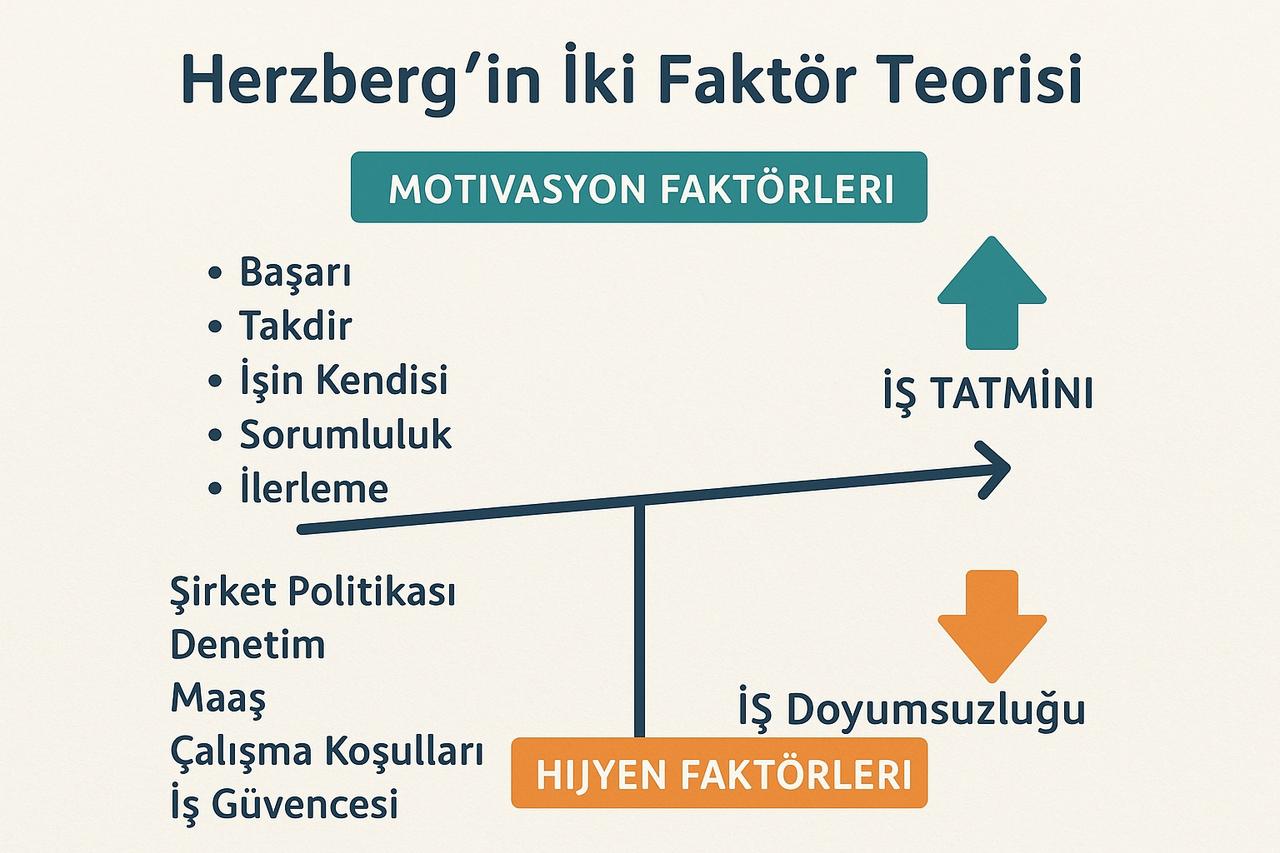
Herzberg’in İki Faktör Teorisi (Yapay Zeka İle Oluşturulmuştur.)
Herzberg’s Two-Factor Theory provides guidance in the development of human resource policies, the design of performance evaluation systems, and the implementation of motivational job design. Through this theory, organizations have come to understand that employees must be motivated not only by financial incentives but also by meaningful and satisfying tasks.
Erdem, Ali Rıza. “İçerik Kuramları ve Eğitim Yönetimine Katkıları.” Pamukkale Üniversitesi Eğitim Fakültesi Dergisi, no. 3 (1997): 69–77. Accessed May 7, 2025.https://dergipark.org.tr/en/download/article-file/114975.
Kurt, Türker. “Herzberg’in Çift Faktörlü Güdüleme Kuramının Öğretmenlerin Motivasyonu Açısından Çözümlenmesi.” Gazi Üniversitesi Gazi Eğitim Fakültesi Dergisi 25, no. 1 (2005): 285–299. Accessed May 7, 2025.https://dergipark.org.tr/en/download/article-file/77285
Kılıç, Recep, and Mehmet Çoban. “Herzberg’in Motivasyon Teorisi ile Liderlik Tipleri Arasındaki İlişki: Bankacılık Sektöründe Bir Uygulama.” *Yönetim ve Ekonomi Araştırmaları Dergisi* 13, no. 1 (2015): 365–378. Accessed May 7, 2025.https://dergipark.org.tr/en/download/article-file/203321

No Discussion Added Yet
Start discussion for "Herzberg's Two-Factor Theory" article
Core Assumptions of the Theory
Application Areas