badge icon

This article was automatically translated from the original Turkish version.

Article

Helioseismology

Quote

Helioseismology is a subdiscipline of astrophysics that analyzes oscillations observed on the Sun’s surface to study its internal structure chemical composition and internal dynamics. The term is derived from the combination of “helios” meaning Sun and “seismology” the study of Earth’s internal structure using seismic waves. Similar to how seismology examines the paths of earthquake-induced waves through Earth’s layers helioseismology provides indirect information about the Sun’s interior by analyzing acoustic waves generated by surface vibrations. This method is regarded as one of the primary techniques for obtaining the most reliable and detailed data about regions of the Sun that cannot be observed directly.
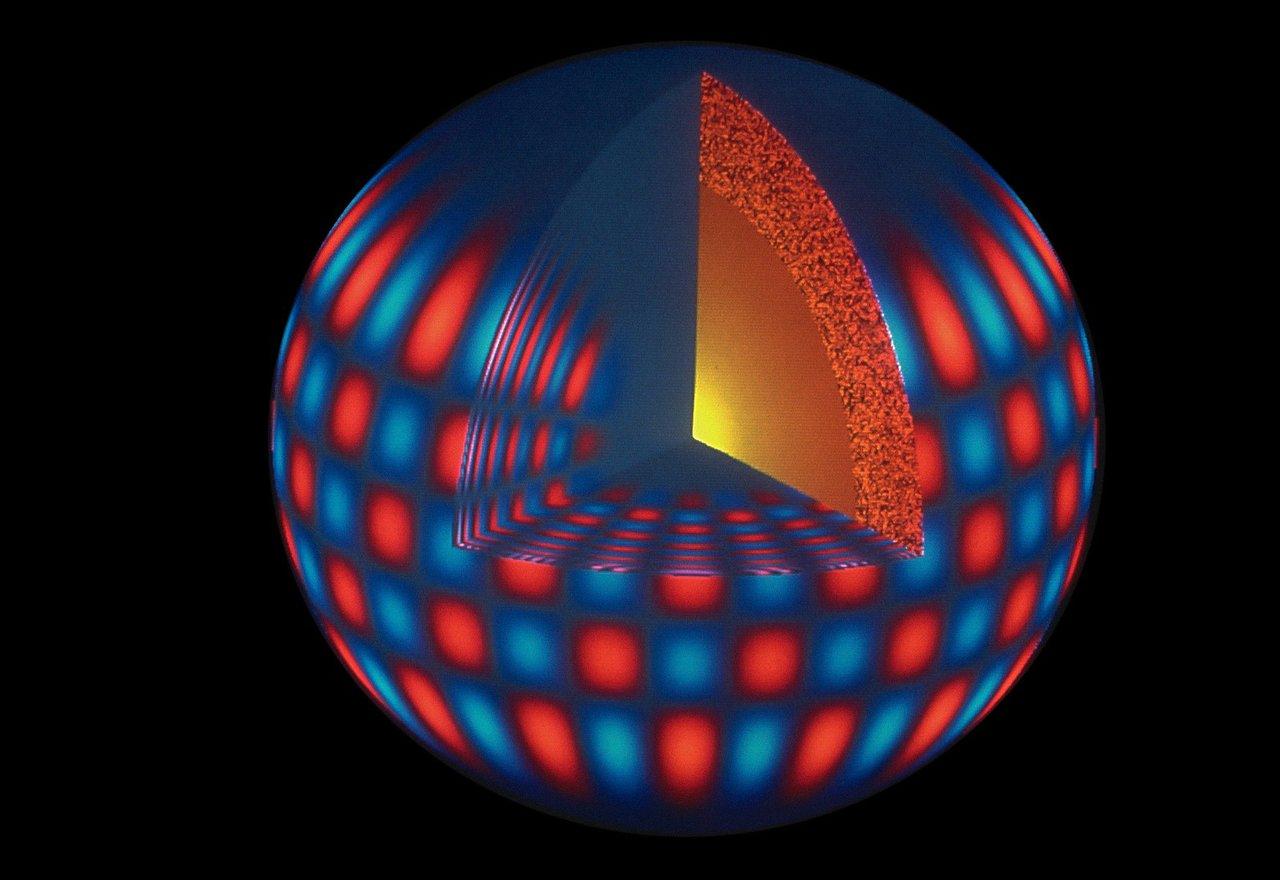

Helioseismology Example Image (ESO Supernova)

Basic Principle and Method

The fundamental principle of helioseismology is based on the analysis of acoustic (sound) waves that are continuously generated and propagated within the Sun’s interior. These waves originate from turbulent plasma motions in the convective zone near the solar surface. Large-scale rising and sinking movements in this region generate low-frequency sound waves that propagate toward the Sun’s inner layers. As these acoustic waves travel inward they refract due to increasing temperature and density and are reflected back toward the surface reaching different points on the solar surface.


Millions of waves that continuously reflect and interact within the Sun’s interior cause the star to behave like a resonant cavity producing oscillations at specific frequencies (modes). These oscillations manifest as periodic vertical motions on the solar surface with amplitudes of several hundred meters per second. Although these motions cannot be observed directly they are detected indirectly through Doppler shifts in the Sun’s spectrum. When a region on the surface moves toward the observer the Fraunhofer lines shift toward the blue and when it moves away they shift toward the red. Thanks to high-precision measurements of these Doppler shifts thousands of oscillation modes on the solar surface can be mapped. The frequencies and other properties of these modes provide detailed information about the physical characteristics of the solar layers through which the waves pass including temperature density and rotation rate.

Solar Oscillation Modes

Two main types of waves are studied in helioseismology: p-modes and g-modes.


  • p-modes (Acoustic Modes): These are standard sound waves for which pressure is the restoring force. They are the easiest to detect on the solar surface and form the foundation of all helioseismological achievements to date. They typically have periods of about five minutes. Since the speed of p-modes depends on the local sound speed they provide extremely precise information about the depth of the convective zone and the internal temperature and density profile of the Sun.


  • g-modes (Gravity Modes): These are waves for which buoyancy is the restoring force and gravity plays a significant role. Unlike p-modes g-modes are largely trapped deep within the Sun’s interior (in the radiative zone and core) and their amplitudes become extremely small by the time they reach the surface. Consequently detecting them is exceedingly difficult. The definitive detection of g-modes is one of the most important goals of helioseismology because these modes have the potential to provide direct information about the rotation rate and structure of the solar core.

Main Results and Contributions of Helioseismology

Since the 1970s helioseismology has significantly advanced scientific understanding of the Sun’s internal structure and dynamics. Its main contributions include:


  • Confirmation of the Sun’s Internal Structure: Helioseismological data have confirmed the predictions of the Standard Solar Model regarding internal temperature density and pressure profiles. It has also determined the location and depth of the boundary between the radiative zone and the convective zone.


  • Mapping of the Internal Rotation Profile: It was known that the Sun’s surface rotates faster at the equator than at the poles (differential rotation). Helioseismology revealed how this rotation profile changes with depth. It was discovered that the entire convective zone rotates differentially like the surface while the underlying radiative zone rotates almost as a rigid body. This sharp shear layer between the two regions is called the tachocline and is believed to be critically important for the dynamo mechanism that generates the Sun’s magnetic field.


  • Imaging the Far Side of the Sun: Using a technique called “helioseismic holography” large active regions sunspot groups on the far side of the Sun invisible from Earth can be detected by analyzing surface waves. This provides crucial early warnings for space weather forecasting.


  • Studying the Solar Cycle: Analysis of large-scale plasma flows beneath the surface such as meridional circulation helps in understanding the solar dynamo mechanism that drives the 11-year sunspot cycle.

Observational Projects and Missions

Advances in helioseismology have been made possible largely by long-term high-precision and uninterrupted data sets provided by ground-based observation networks and space-based missions specifically designed for this discipline.


  • GONG (Global Oscillation Network Group): A ground-based network consisting of six identical telescopes distributed across different locations on Earth. This network provides a continuous stream of data by observing the Sun without interruption for 24 hours a day.


  • SOHO (Solar and Heliospheric Observatory): Launched in 1995 through a collaboration between NASA and ESA, this observatory has provided high-resolution and continuous data in the field of helioseismology through instruments such as MDI and GOLF, making significant contributions to the development of the discipline by offering observations free from the distorting effects of Earth’s atmosphere.


  • SDO (Solar Dynamics Observatory): Launched in 2010 and regarded as the successor to SOHO, this NASA mission observes the Sun’s oscillations and magnetic field with high spatial and temporal resolution using its HMI (Helioseismic and Magnetic Imager) instrument, providing advanced data for helioseismology and solar magnetic field research.

Bibliographies


Christensen-Dalsgaard, J. “Helioseismology.” Accessed July 20, 2025. https://arxiv.org/abs/astro-ph/0207403.

ESO Supernova. "Helioseismology." Accessed July 20, 2025. https://supernova.eso.org/exhibition/images/0406_C_cutaway-CCfinal/.

National Solar Observatory. "GONG Program." Accessed July 20, 2025. https://gong.nso.edu/.

Author Information

Avatar
AuthorErhan ŞencanDecember 2, 2025 at 5:52 AM

Tags

Discussions

No Discussion Added Yet

Start discussion for "Helioseismology" article

View Discussions

Contents

  • Basic Principle and Method

  • Solar Oscillation Modes

  • Main Results and Contributions of Helioseismology

  • Observational Projects and Missions

Ask to Küre