This article was automatically translated from the original Turkish version.
+1 More
Name(s) | HD 108874 b | ||||||||
|---|---|---|---|---|---|---|---|---|---|
Type(s) | Gas giant exoplanet | ||||||||
Constellation | Coma Berenices | ||||||||
Distance | 222 light years | ||||||||
Discovery Year | 2003 | ||||||||
Observation Instrument | Keck I Telescope | ||||||||
Orbital Period | 395.4 ± 2.5 days | ||||||||
Distance from Star | 1.051 AU | ||||||||
Minimum Mass | 1.34 ± 0.04 M♃ | ||||||||
Planet Type | Gas giant | ||||||||
System Structure | Two-planet | ||||||||
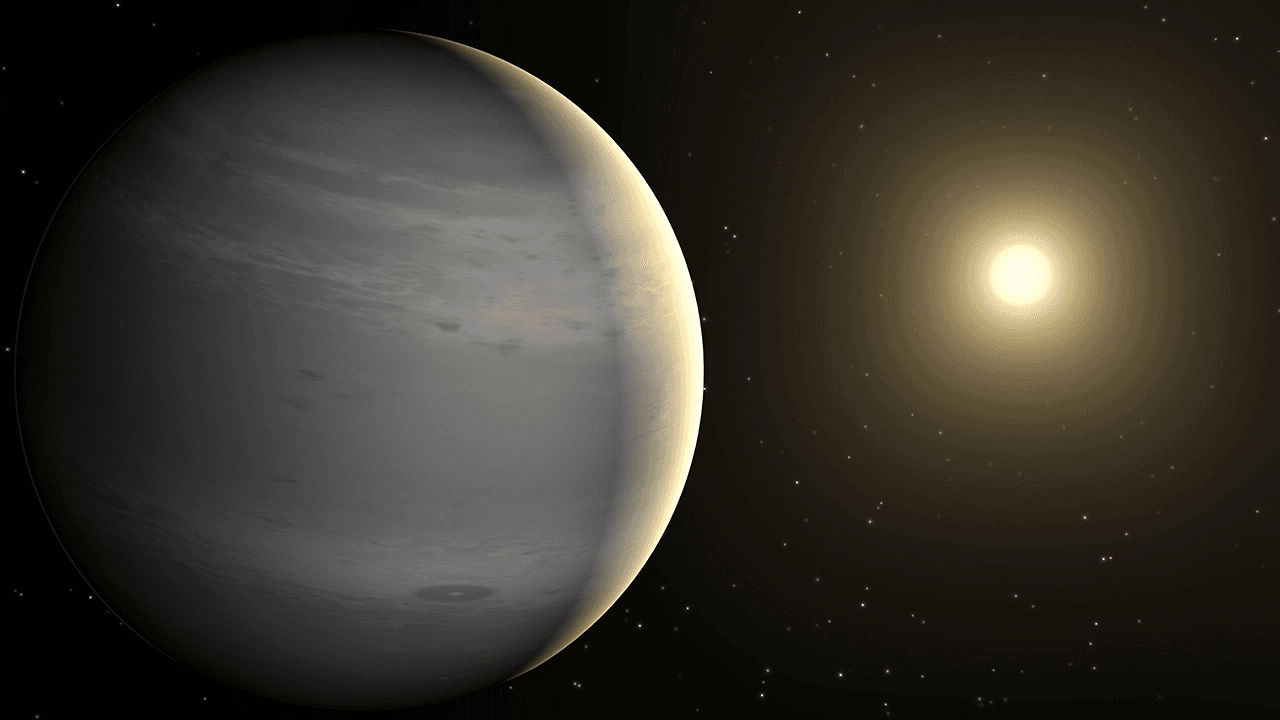
HD 108874 b is a gas giant exoplanet located approximately 222 light years from Earth in the direction of the Coma Berenices constellation. It orbits the Sun-like star HD 108874 and is the closer of the two known planets in the system. Its discovery attracted attention within the astronomical community due to its position just inside the habitable zone of its host star and its dynamic interaction with another giant planet.
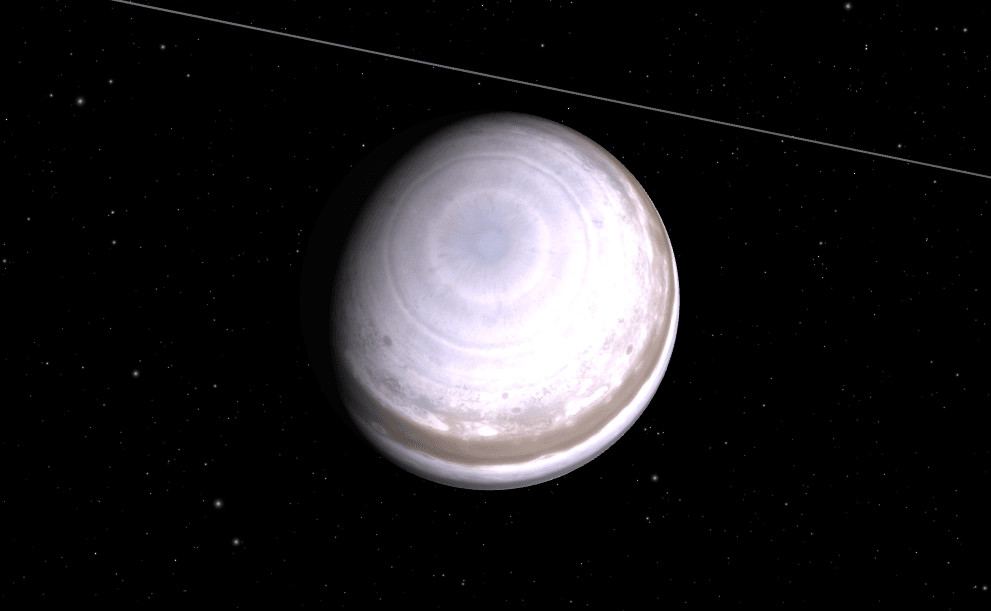
HD 108874 b (NASA)
The existence of HD 108874 b was announced in 2003 by the California and Carnegie Planet Search Team. The team, which included R. Paul Butler, Geoffrey Marcy, Debra Fischer, and Steven Vogt, detected the planet using the radial velocity method. This technique identifies periodic wobbles in the host star caused by the gravitational pull of an orbiting planet, observed as Doppler shifts in the star’s spectral lines.
Observations were made using the High Resolution Echelle Spectrometer (HIRES) mounted on the 10-meter Keck I telescope at the W. M. Keck Observatory in Hawaii. The periodic signal detected in the star’s radial velocity data revealed the presence of a massive planet with an orbital period of approximately 400 days. A second planet in the same system, HD 108874 c, discovered later, further enhanced the system’s scientific interest.
HD 108874 is a yellow dwarf star of spectral type G5V, closely resembling the Sun. Its mass has been measured at approximately 1.02 times that of the Sun (1.02±0.03 M☉), and its radius at about 1.05 times the solar radius (1.05±0.05 R☉). Its surface temperature is approximately 5,740 Kelvin, very close to the Sun’s 5,778 K. The star’s metallicity ([Fe/H]), which measures the abundance of elements heavier than hydrogen and helium, is higher than the Sun’s, at +0.21±0.05 dex. This indicates that HD 108874 contains about 62 percent more heavy elements than the Sun.
High metallicity is positively correlated with the formation of gas giant planets, making the presence of such planets around HD 108874 consistent with theoretical expectations. The star is estimated to be approximately 7.1 billion years old, making it older than the Sun, which is about 4.6 billion years old.
Since HD 108874 b was discovered via the radial velocity method, its only directly measurable physical property is its minimum mass (M sin i), which equals the true mass multiplied by the sine of the inclination angle between the orbital plane and the line of sight. Measurements indicate that HD 108874 b has a minimum mass of about 1.34 times that of Jupiter (1.34±0.04 M♃). Because the orbital inclination is not precisely known, this value represents a lower limit; however, statistically, the planet’s true mass is expected to be close to this figure.
This mass classifies HD 108874 b as a gas giant larger than Jupiter. As a gas giant, it is not expected to have a solid surface.
HD 108874 b completes one orbit around its host star in approximately 395.4 days (395.4 ± 2.5 days), very close to the length of an Earth year. Its average distance from the star, or semi-major axis, is about 1.051 astronomical units (AU), meaning its orbit is nearly identical in size to Earth’s orbit around the Sun. Its orbital eccentricity is very low (e = 0.07 ± 0.02), indicating that its orbit is nearly circular.
The HD 108874 system hosts at least two gas giant planets. The outer planet, HD 108874 c, completes its orbit in approximately 1,605 days. The ratio of the orbital periods of the two planets is about 4.06, suggesting that they may be in or near a 4:1 orbital resonance (mean-motion resonance). Such resonant relationships play a decisive role in the long-term dynamical stability of planetary systems through regular gravitational interactions between the planets.
As a gas giant, HD 108874 b cannot support life as we know it. However, its orbit lies within the habitable zone of its host star. For a Sun-like star such as HD 108874, the habitable zone is estimated to extend from approximately 0.95 to 1.67 AU. With an orbital distance of 1.051 AU, HD 108874 b resides near the inner edge of this zone, very close to Earth’s position relative to the Sun.
This raises the theoretical possibility that large, rocky moons (exomoons) orbiting HD 108874 b could possess conditions suitable for life. If a moon with a mass similar to Mars or Earth exists in this orbit, it might maintain liquid water on its surface due to the stellar radiation it receives and the gravitational protection provided by the gas giant. While current observational technology cannot directly detect such exomoons, gas giants located within the habitable zone—like HD 108874 b—are considered high-priority targets for future exomoon research.
Fischer, Debra A., and Jeff Valenti. “The Planet-Metallicity Correlation.” Accessed July 19, 2025. https://iopscience.iop.org/article/10.1086/428383.
Heller, René., et al. “Formation, Habitability, and Detection of Extrasolar Moons.” Accessed July 19, 2025. https://pmc.ncbi.nlm.nih.gov/articles/PMC4172466/.
NASA Exoplanet Archive. "HD 108874 b." Accessed July 19, 2025. https://exoplanetarchive.ipac.caltech.edu/overview/HD%20108874%20b.
Simbad Astronomical Database. "HD 108874." Accessed July 19, 2025. http://simbad.u-strasbg.fr/simbad/sim-id?Ident=HD+108874.
Vogt, Steven S., et al. “Five New Multicomponent Planetary Systems.” Accessed July 19, 2025. https://iopscience.iop.org/article/10.1086/432901.
Wright, J. T., et al. “The Exoplanet Orbit Database.” Accessed July 19, 2025. https://iopscience.iop.org/article/10.1086/659427.

Name(s) | HD 108874 b | ||||||||
|---|---|---|---|---|---|---|---|---|---|
Type(s) | Gas giant exoplanet | ||||||||
Constellation | Coma Berenices | ||||||||
Distance | 222 light years | ||||||||
Discovery Year | 2003 | ||||||||
Observation Instrument | Keck I Telescope | ||||||||
Orbital Period | 395.4 ± 2.5 days | ||||||||
Distance from Star | 1.051 AU | ||||||||
Minimum Mass | 1.34 ± 0.04 M♃ | ||||||||
Planet Type | Gas giant | ||||||||
System Structure | Two-planet | ||||||||
Discovery
Host Star: HD 108874
Physical Characteristics
Orbital Characteristics and System Dynamics
Potential Habitability of the System