


This article was automatically translated from the original Turkish version.
+1 More
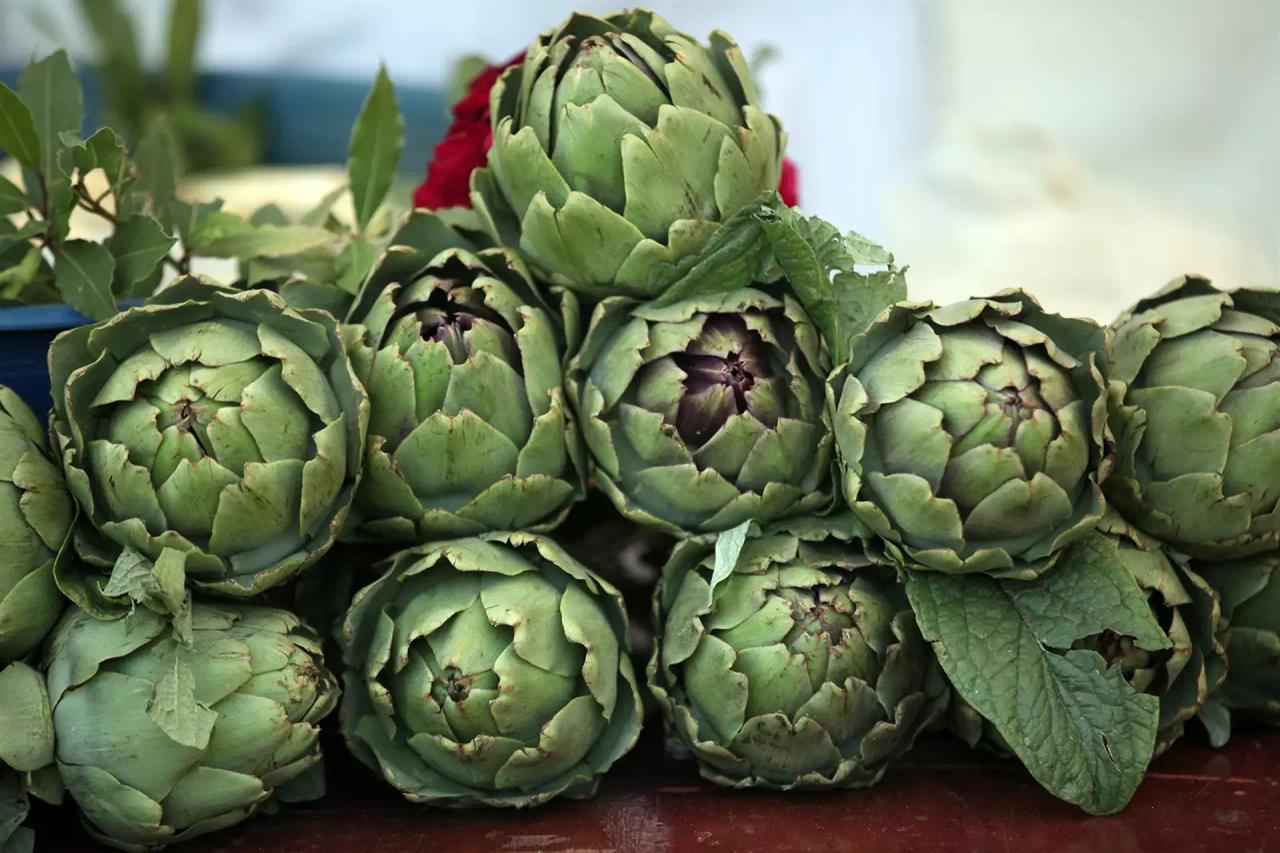
Hasanağa Artichoke
Registration Number | 533 | ||||||||
|---|---|---|---|---|---|---|---|---|---|
Registration Date | 11.09.2020 | ||||||||
Application Number | C2017/248 | ||||||||
Application Date | 25.12.2017 | ||||||||
Name of the Geographical Indication | Hasanağa Enginarı | ||||||||
Product / Product Group | Enginar / Processed and Unprocessed Fruits, Vegetables and Mushrooms | ||||||||
Type of Geographical Indication | Place of Origin | ||||||||
Applicant / Registrant | Bursa Nilüfer Municipality | ||||||||
Address of the Registrant | İzmir Road Alaaddinbey Additional Service Building 611. Street Nilüfer BURSA | ||||||||
Bursa Hasanağa Artichoke is a variety of artichoke unique to Bursa Province in Türkiye, cultivated from the Bayrampaşa variety and officially registered under its place of origin. The Bursa Hasanağa artichoke is known for its large, flattened head structure, broad flower base, and high sugar and fat content; these characteristics determine both its flavor intensity and its preferred status in canning production. Harvested in April and May, the product is marketed fresh, frozen, and canned. This artichoke, propagated vegetatively using traditional production methods, is a clearly geographically defined agricultural product limited to several districts of Bursa, with all processes from production to processing conducted according to specific standards.
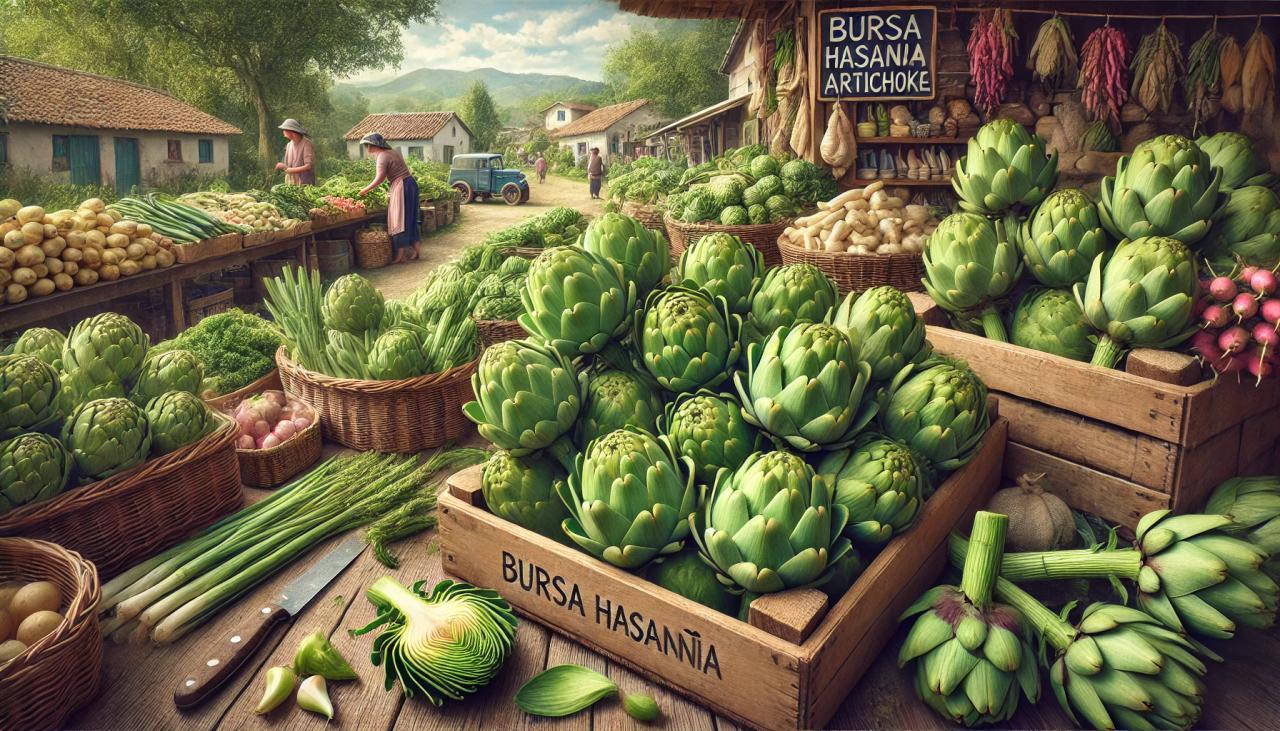
Bursa Hasanağa Enginarı (Yapay zeka ile oluşturulmuştur.)
Bursa Hasanağa Artichoke is a variety of artichoke grown in Bursa Province, Türkiye, and officially registered as a geographical indication on 11 September 2020. The product, registered under number 533, is produced from the Bayrampaşa artichoke (Cynara scolymus L. cv. Bayrampaşa) variety. The registration application was submitted on 25 December 2017, and the registration rights were granted to the Nilüfer Municipality of Bursa. The product has been registered under the category of processed and unprocessed fruits and vegetables and mushrooms, with the status of a geographical indication.
The geographical boundary of the Bursa Hasanağa artichoke encompasses various districts and neighborhoods within Bursa Province. These areas include Nilüfer (e.g. Hasanağa, Görükle, Kayapa), Mudanya (e.g. Zeytinbağı, Hançerli), Orhangazi (e.g. Orhangazi, Yeniköy), Karacabey (e.g. Sultaniye, İsmetpaşa), and Mustafakemalpaşa (e.g. Kömürcükadı, Karaorman). The purpose of this geographical limitation is to ensure the product is cultivated under specific environmental and cultural conditions and to preserve its distinctive characteristics.
The history of the artichoke in the Bursa region dates back many centuries. Archaeological excavations around Lake Uluabat have uncovered coins dating to approximately 350 BCE bearing depictions of artichokes and crayfish, indicating the deep-rooted presence of the artichoke in the region’s culture. Within Bursa’s culinary tradition, the artichoke holds significant historical and economic importance.
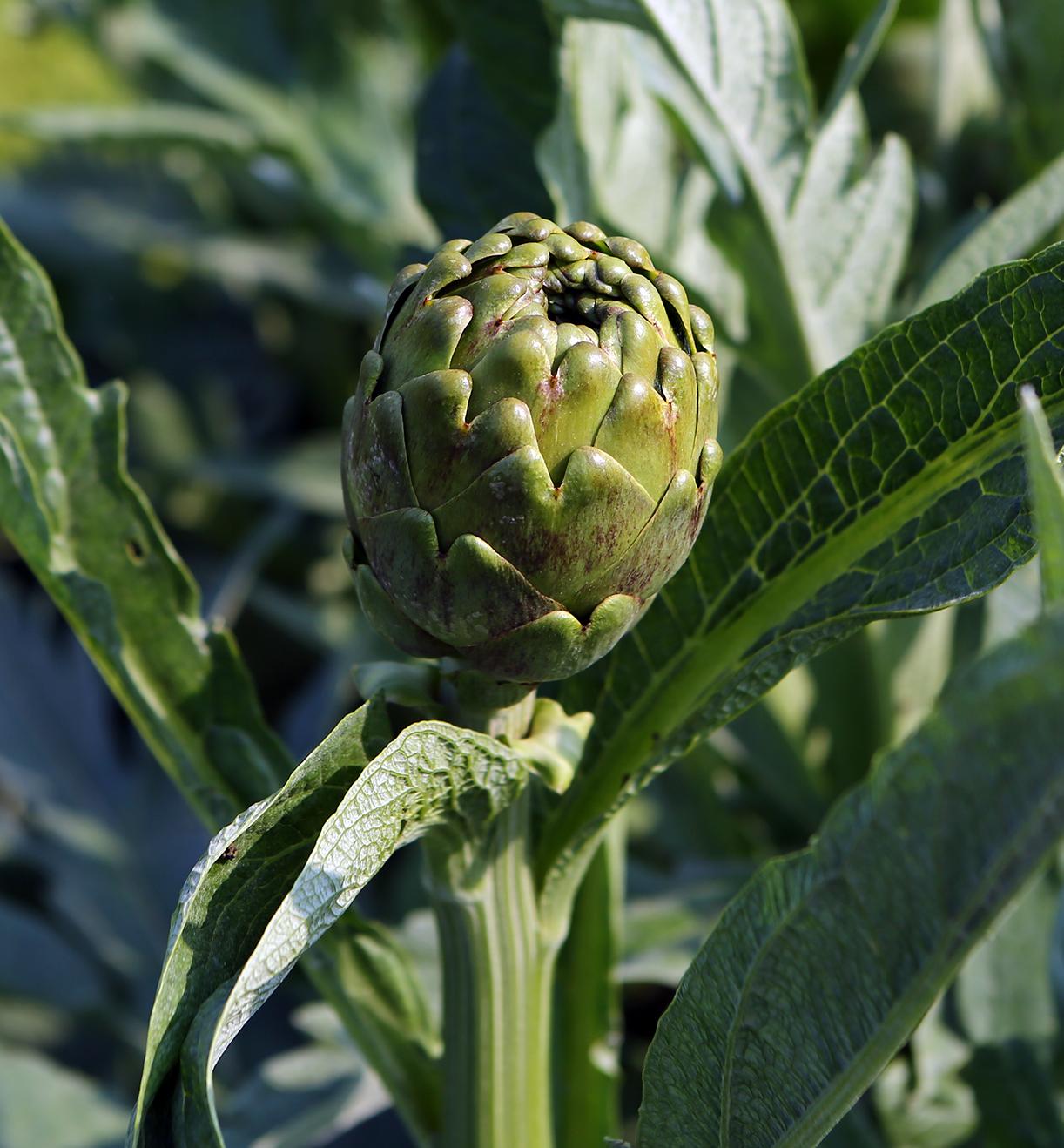
Hasanağa Enginarı (Bursa Nilüfer Belediyesi)
The Bursa Hasanağa artichoke has a large, flattened head structure. Its broad flower base makes it particularly preferred in canning production. The product differs from artichokes of the same variety grown in other regions due to its relatively high sugar content (2–2.5%) and fat content (0.80–1.80%). Harvesting of the Bursa Hasanağa artichoke takes place in April and May.
The peeled and unprocessed fresh form of the Bursa Hasanağa artichoke has the following characteristics:
Bursa Hasanağa artichokes cooked using the Sous Vide method (60°C for 40 minutes) under vacuum packaging and then cooled to room temperature must exhibit the following sensory characteristics:
This evaluation is conducted using a five-point hedonic scale, and a minimum score of 4 must be achieved for each criterion.
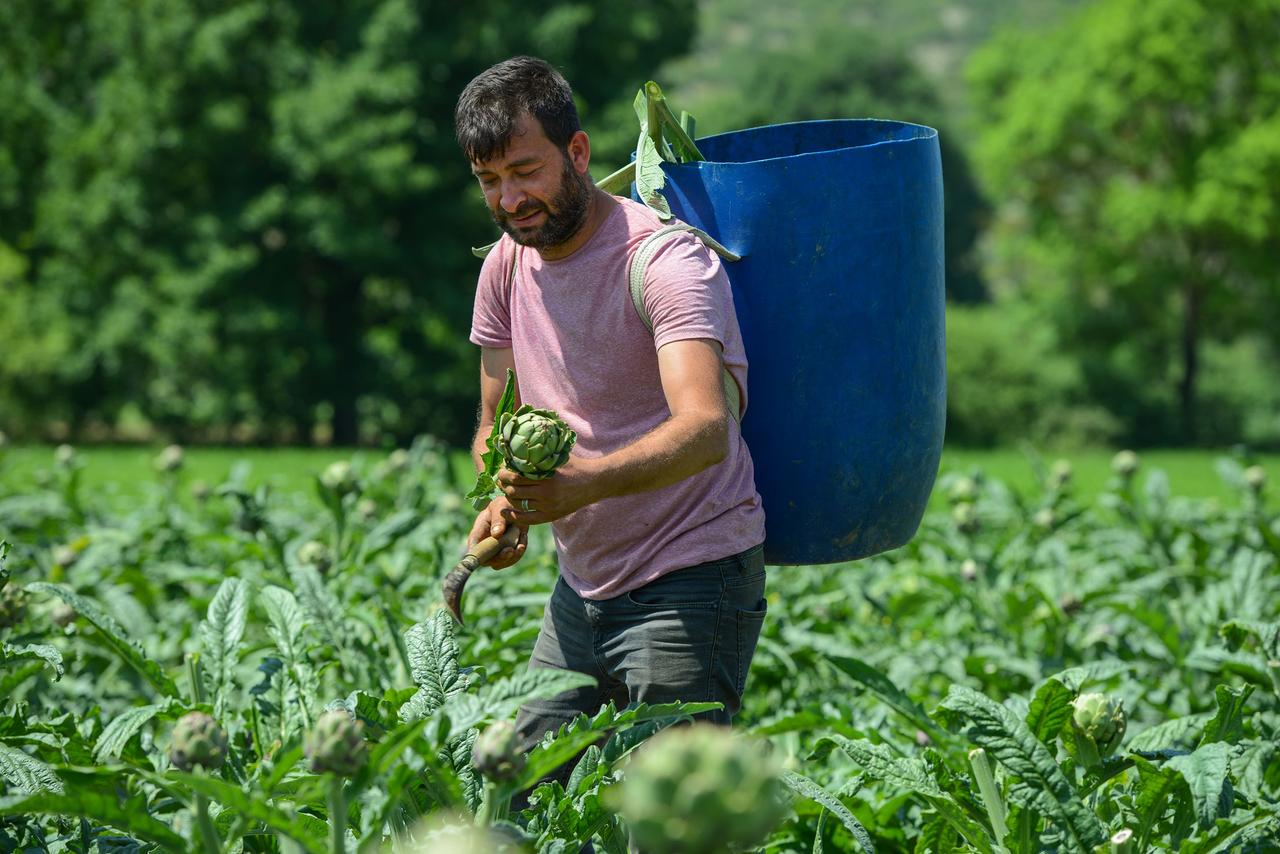
Hasanağa Enginarı (Bursa Nilüfer Belediyesi)
Production of the Bursa Hasanağa artichoke is carried out through vegetative propagation using basal shoots from uniform, unopened artichoke plants. Soil preparation involves tilling the land to a depth of 50–80 cm, followed by several days of aeration and refinement using a disk-harrow. Planting areas are prepared after these operations. In March and April, the surrounding soil of selected plants is excavated to a depth of approximately 10–12 cm, and basal shoots are carefully cut using a sharp tool. These shoots undergo light leaf cleaning and are separated by diameter before being planted in the field at intervals of 30x10 cm. After planting, irrigation is essential. A root neck diameter of 2.0–2.5 cm enhances successful root establishment.
Regular irrigation is critical during the rooting process of the basal shoots. After planting in March, irrigation, weeding, and fertilization as needed are carried out until the end of June. From mid-June onward, water supply to the plot is halted to allow the plants to enter a resting period. In early August, an awakening irrigation is applied, activating the buds and prompting shoots to emerge from the soil. These shoots are carefully dug up and transplanted to the main planting areas, typically spaced at 100x60–70 cm intervals.
In autumn, underground stems are inspected, and only the two or three strongest basal shoots are retained; the rest are removed and cleared. In prepared planting fields, trenches are dug at one-meter intervals, and holes are excavated to match the depth of shoot removal. The shoots are planted, followed by another irrigation.
During the growth period, weeds growing between and on the rows are removed, and the soil is hoed two to three times to promote aeration. Irrigation begins in early August with awakening water; during winter months, irrigation is generally provided by rainfall. If rainfall is insufficient during the harvest period, additional irrigation is applied.
Harvesting occurs when the artichoke heads reach an appropriate size. Harvesting is performed in April and May by cutting the heads approximately 15–20 cm below the stem along with the stem.
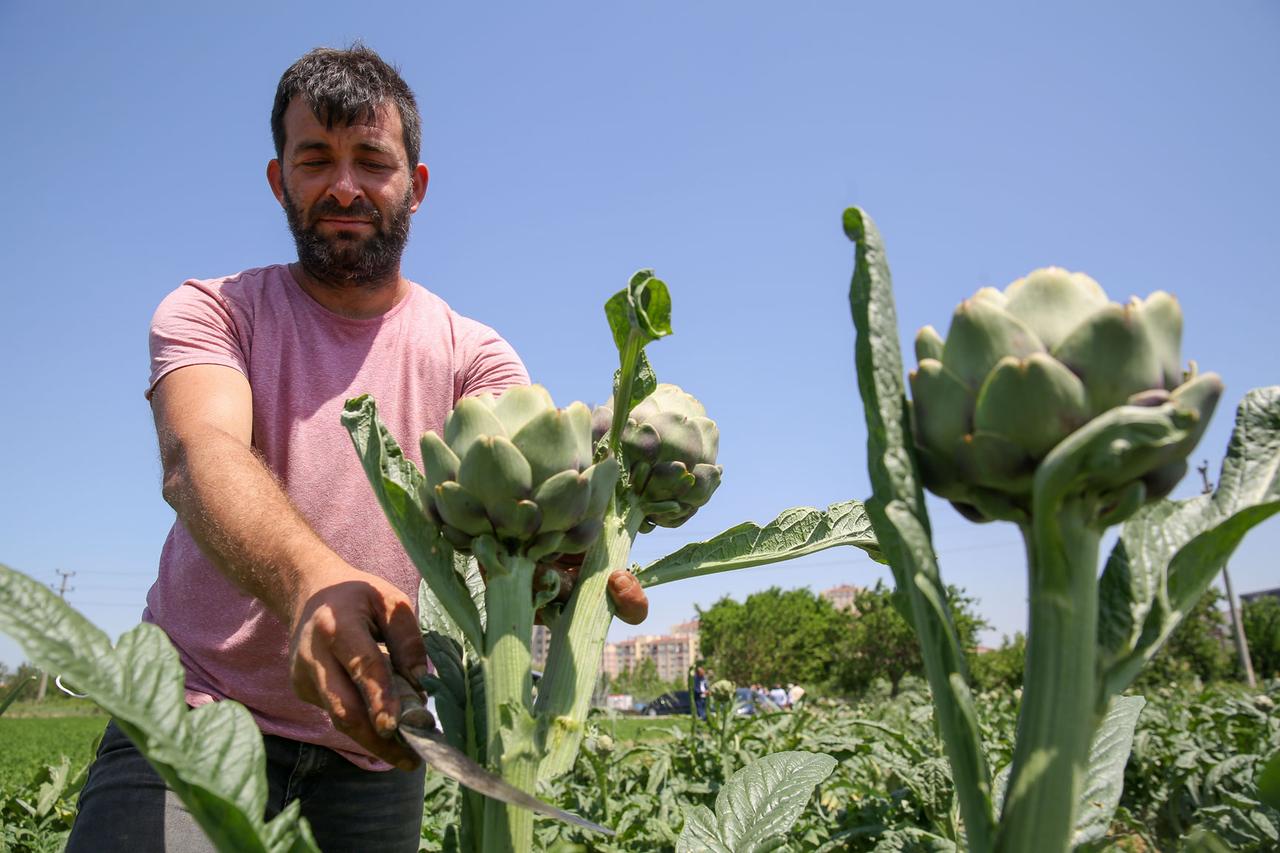
Hasanağa Enginarı (Bursa Nilüfer Belediyesi)
The product is offered to consumers in fresh, frozen, or canned forms. Fresh products do not require specific shape or size standards; however, artichokes intended for canning are sorted by size. In canning preparation, artichoke bases are rapidly peeled and immersed in boiling water containing 1% lemon juice and 2% salt. The bases are held in this solution for 1–2 minutes, then removed, and the blanching water is cooled and prepared for addition to jars. Immediately after removal from boiling water, the artichokes are transferred to cold water at 15–25°C and cooled to room temperature. They are then placed into glass jars according to size, covered with cooled blanching water, and tightly sealed. The jars are kept in boiling water for approximately 10 minutes to ensure complete sealing. Afterward, the jars are removed and cooled, then stored in a cool, dark environment for up to one year.
Inspections of the Bursa Hasanağa artichoke are conducted under the coordination of the Nilüfer Municipality of Bursa. The inspection team includes experts from the Nilüfer Municipality of Bursa, the Faculty of Agriculture at Uludağ University, the Bursa Provincial Directorate of Agriculture and Forestry, and the Bursa Chamber of Agriculture. Inspection activities begin at the end of April, coinciding with the harvest period. Two inspections are carried out annually: one during harvest and another on fresh produce after harvest. During production process inspections, the practices carried out by producers up to harvest are reviewed. Inspections may also be conducted in response to any complaints.
Frozen products are evaluated for the same quality attributes as fresh products; however, canned products, which contain salt and lemon juice, differ only in sensory analysis and are excluded from such analyses. Inspections are conducted in two main stages:
In this stage, it is verified whether planting, propagation, irrigation, fertilization, and agricultural protection practices conform to the established production method. Additionally, the proper preparation of harvested products—whether fresh, frozen, or canned—is assessed.
Inspections of fresh products examine physical, chemical, and sensory characteristics:
Dry matter and color analyses are conducted only when a claim of infringement of the geographical indication rights is brought before the court under Article 53 of Law No. 6769 on Industrial Property.
Samples for inspection are randomly collected from products sold at retail points labeled as “Hasanağa Artichoke.” The number of samples to be collected is determined by the inspection authority based on the size of the inspection area. Support or services may be obtained from public or private institutions or from experts employed by such institutions during inspection processes. The registered entity is responsible for managing legal proceedings.
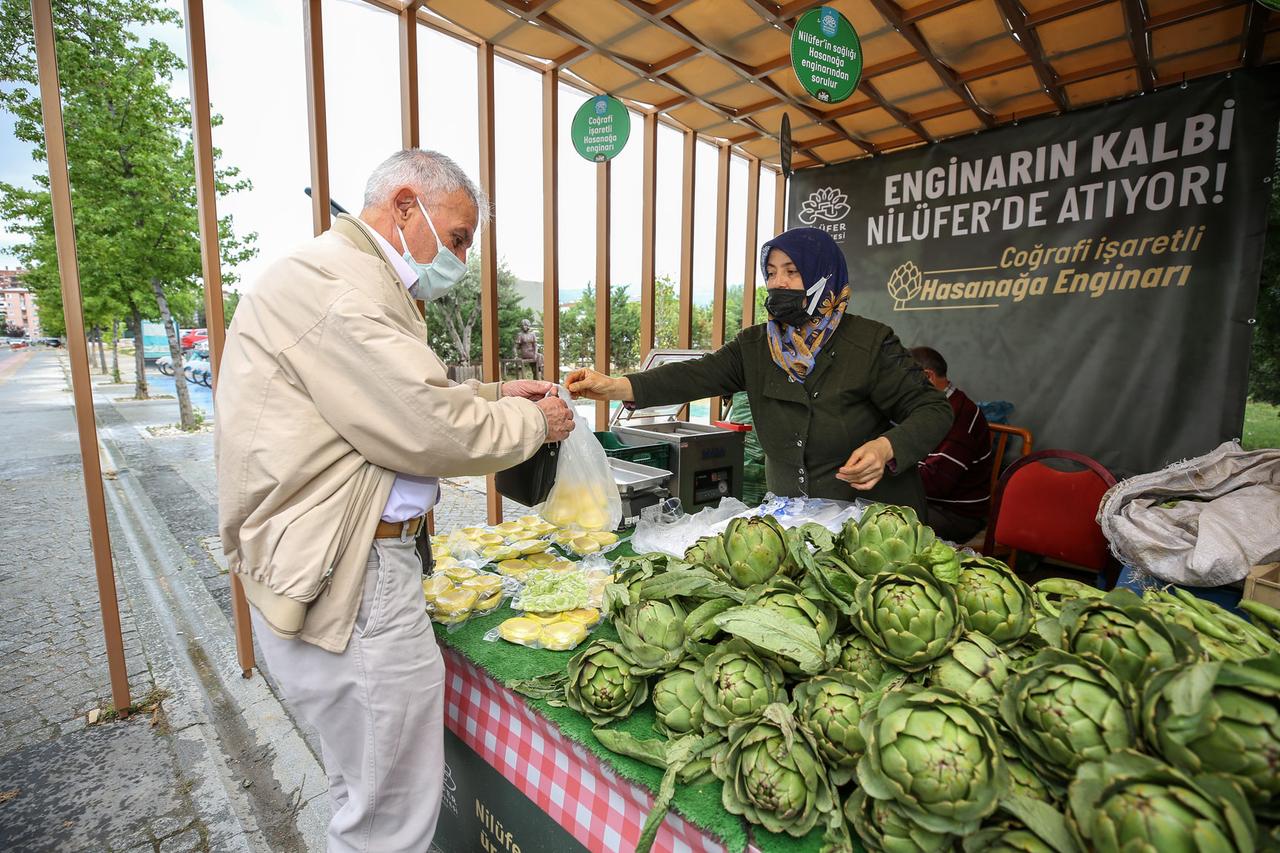
Hasanağa Enginarı (Bursa Nilüfer Belediyesi)
Nilüfer Belediyesi. "Başkan Erdem: Hasanağa Enginarı Marka Oldu." Accessed May 29, 2025.https://www.nilufer.bel.tr/haber/baskan-erdem-hasanaga-enginari-marka-oldu.
Nilüfer Belediyesi. "Hasanağa Enginarı Coğrafi İşaret Tescili Aldı." Accessed May 29, 2025.https://www.nilufer.bel.tr/haber/hasanaga-enginari-cografi-isaret-tescili-aldi
Nilüfer Belediyesi. "Hasanağa Enginarına Ulaşmak Artık Çok Kolay." Accessed May 29, 2025.https://www.nilufer.bel.tr/haber/hasanaga-enginarina-ulasmak-artik-cok-kolayRLG39.
Turk Patent and Trademark Office. "Coğrafi İşaretler Detay Sayfası." Accessed May 29, 2025.https://ci.turkpatent.gov.tr/cografi-isaretler/detay/38469.
Turkish Patent and Trademark Office. "Hasanağa Enginarı Coğrafi İşaret Belgesi (PDF)." Accessed May 29, 2025.https://ci.turkpatent.gov.tr/Files/GeographicalSigns/c8df8716-c855-460f-bada-28286b182818.pdf

Hasanağa Artichoke
Registration Number | 533 | ||||||||
|---|---|---|---|---|---|---|---|---|---|
Registration Date | 11.09.2020 | ||||||||
Application Number | C2017/248 | ||||||||
Application Date | 25.12.2017 | ||||||||
Name of the Geographical Indication | Hasanağa Enginarı | ||||||||
Product / Product Group | Enginar / Processed and Unprocessed Fruits, Vegetables and Mushrooms | ||||||||
Type of Geographical Indication | Place of Origin | ||||||||
Applicant / Registrant | Bursa Nilüfer Municipality | ||||||||
Address of the Registrant | İzmir Road Alaaddinbey Additional Service Building 611. Street Nilüfer BURSA | ||||||||
Geographical Indication Information
Geographical Boundary and Distribution
Historical and Cultural Context
Distinctive Characteristics
Chemical and Physical Characteristics
Sensory Characteristics
Production Method
Processing and Preservation
Inspection
Production Process Inspection
Fresh Product Inspection