This article was automatically translated from the original Turkish version.
Author of the Work | Şeyhi | ||||||||
|---|---|---|---|---|---|---|---|---|---|
Prepared by | Mehmet Özdemir | ||||||||
Importance | The First Fable Example in Turkish Literature | ||||||||
Century Written | 15th Century | ||||||||
Literary Genre | Mesnevi, Fable, Satire | ||||||||
Poetic Features | Beyit / Mesnevi | ||||||||
Number of Couplets | 126 | ||||||||
Aruz Meter | Feilâtün Mefâilün Feilün | ||||||||
ISBN | 9786054322497 | ||||||||
Page | 110 | ||||||||
First Edition | 24.03.2011 | ||||||||
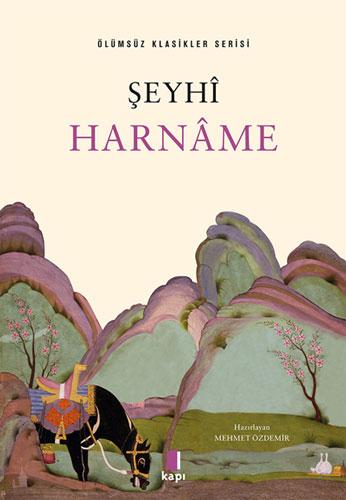
Harnâme is a short mesnevi composed of 126 couplets, regarded as the first example of fable in Turkish literature, written by Şeyhî in the 15th century. This allegorical and satirical work expresses the poet’s personal grievance while simultaneously drawing attention to the social injustices of his time. The text was prepared for publication in Ottoman Turkish by Mehmet Özdemir and published by Kapı Yayınları.
Harnâme is an allegorical mesnevi intended as social criticism. Through animal characters, it satirizes hiciv the structural flaws, class disparities, injustices, and oppression of the weak by the powerful in a humorous tone. Şeyhî adopted an indirect critique method by having animals voice thoughts that humans could not express directly. Through the central character of the donkey, the poet symbolically and mockingly reflects his own suffering and the injustices within society. In this regard, Harnâme represents the transition between humor and satire and is recognized as one of the earliest examples of social criticism in Turkish literature using the fable form.
According to the most widely accepted view, Şeyhî wrote the work after being attacked, robbed, and beaten by former owners of the village of Tokuzlar, which had been granted to him as a tımar following his treatment of Çelebi Mehmed’s eye. He composed the piece to convey his injustice to the sultan in a witty style. Another view holds that he composed this satire after failing to receive the expected reward for presenting his mesnevi Hüsrev ü Şîrî to Sultan Murad II. In this sense, Harnâme is a literary text that combines a personal claim for justice with social criticism directed at the ruling authority. Şeyhî’s Harnâme mesnevi centers on an allegorical narrative in which a weary, emaciated donkey burdened by heavy labor, envious of the fat, comfortable oxen who possess horns, desires to acquire horns for himself and consequently loses his ears and tail due to this obsession.
The story begins with the pitiful condition of a donkey forced to carry firewood and water without respite, reduced to a broken, wounded, and emaciated state. Those who see him mistake him for a walking skeleton; when the load is removed from his back, they compare him to dog dung. One day, his owner takes pity on him and lets him rest in a pasture. There, the donkey sees oxen, their horns like crowns, wandering contentedly, fat and healthy, and is struck by astonishment, beginning to contrast his own poverty with their ease.
Believing that he and the oxen are similar in nature, the donkey questions why he lives in poverty without horns. This questioning forms an allegorical foundation for criticizing the social injustices and status disparities of the era. To resolve this troubling question, he decides to consult an old, wise, and experienced donkey revered as the leader of donkeys. The old donkey warns him that oxen have earned their status because they cultivate wheat and provide sustenance to humans, whereas donkeys are assigned the lowly task of carrying firewood, and that in fact, even their ears and tails are more than they deserve. However, the ambitious donkey disregards this advice and becomes consumed by the fantasy of cultivating wheat like the oxen to gain their respect.
The donkey enters a lush green field, believing he has found a solution to his suffering, and greedily devours the crops, chewing and trampling them until the once-vibrant field is reduced to a dark ruin. Satiated, he rolls about in delight and begins braying loudly with his ugly voice. The sound reaches the ears of the field’s owner. Enraged by the destruction of his field, the owner beats the donkey; and when his anger does not subside, he draws his knife and cuts off the donkey’s ears and tail. The wounded donkey flees with his last breath and encounters the old donkey again, summarizing his fate with the words: Bâtıl isteyü haktan ayrıldım, Boynuz umdum kulaktan ayrıldım.
This final couplet underscores the central message of the work: that one must be content with what one has, and that excessive ambition leads to disaster. At the end of the work, Şeyhî identifies himself with the donkey, presenting his personal misfortune and the social injustices of his time to the sultan in a humorous and allegorical manner, while calling for justice. The work delivers social criticism through individual suffering, highlighting the consequences of ambition and defiance of fate, the brutality of those in power, and the difficulty of changing one’s social status.
Harnâme is not merely the narration of a personal incident but a multilayered text drawing from diverse literary and cultural sources. Its subject and plot are believed to be based on the Arabic proverb “to lose one’s ears while seeking horns.” In addition, the donkey tale in Emîr Hüseynî’s Zâdü’l-Müsâfirîn, the animal fables in Kelîle ve Dimne, allegorical tales from Hebrew tradition, and similar variants in Aesop’s fables are cited as sources of inspiration for Harnâme. Furthermore, thematic structures in Ferdowsi’s Şehnâme and Fahrî’s Hüsrev ü Şîrîn mesnevi are also thought to have influenced Şeyhî’s narrative. This multifaceted interaction demonstrates the work’s connection to both Eastern and Western storytelling traditions.
Harnâme is a short mesnevi written in the allegorical fable and satire genres within the framework of Divan literature. Composed in the 15th century, it consists of approximately 126 couplets written in the aruz meter “feilâtün mefâilün feilün.” Despite its small size, it contains all the conventional sections found in classical mesneviler: tevhid, naat, praise of the sultan, reason for composition, and prayer. In this sense, it is a complete and well-structured mesnevi both in content and form:
Moreover, as the first known example of fable in Turkish literature, it possesses a unique and innovative structural quality. It presents a multilayered narrative combining humor, satire, and didactic function. Harnâme is one of the rare examples where the genres of fable, mesnevi, and satire intersect both in form and content.
Harnâme employs its allegorical structure to explore social roles, class distinctions, and individual weaknesses through symbolic characters. The central figure, the donkey, represents both the poet Şeyhî and the common people, symbolizing the hardworking yet undervalued lower strata of society. The oxen represent powerful, comfortable, privileged, but often ignorant rulers or the elite class, while the old donkey embodies the wise figure who upholds traditional knowledge and contentment. The field owner serves as the allegorical counterpart of the sultan or authority figure. This system of representation through animals strengthens the work’s implicit messages and elevates its social critique to a more universal plane. This structure enables Şeyhî to express criticisms that could not be voiced directly to human audiences.
Harnâme explores social, moral, and philosophical themes beginning from a personal grievance. The most prominent themes in the work are:
Harnâme employs humor not merely for amusement but as a tool for reflection and critique. Şeyhî favors indirect humor (witticisms and subtle irony), avoiding direct criticism and instead ridiculing societal flaws through animal characters. The humor is grounded in contrasts and absurd situations, such as the donkey comparing his own frailty to the robustness of the oxen. This structure aligns with the modern humor theory known as incongruity theory, which holds that humor arises from the violation of expectations and the breakdown of conventional logic.
Elements such as the donkey’s inability to carry even a fly, yet aspiring to be like an ox; its joyous braying after destroying the field; and its grotesque satisfaction after its own mutilation are both comical and critical. In this sense, Harnâme is regarded not only as one of the earliest examples of Turkish humor but also as a significant example of universal humor.
Harnâme is composed in 15th-century Ottoman Turkish and stands out for its simple, fluent, and accessible language. Although Şeyhî was proficient in Arabic and Persian, he predominantly used Turkish in the work, particularly adopting the sehl-i mümteni style—apparently simple yet rich in meaning—in the narrative section. The style is humorous, subtly ironic, and symbolic. Indirect and implicit expression is preferred over direct criticism. This feature enhances the literary quality of the work and also enabled the poet to protect himself within the political climate of the time. The work employs various narrative techniques:
Additionally, the work incorporates classical literary devices such as teşbih (simile), teşhis (personification), intak (giving speech to non-human entities), mübalağa (hyperbole), and telmih (allusion).
Harnâme has been regarded since its composition in the 15th century as the pioneer of satire and fable in Turkish literature. It is a significant work in Turkish literary history both as one of the earliest examples of Turkish humor and for preserving the linguistic features of its era. According to Faruk Kadri Timurtaş, "In the valley of satire and humor, where even powerful artists like Nef’î remained powerless, Harnâme remained the greatest monument in this field for four and a half centuries until Ziya Paşa’s Zafernâme was written”.【1】 The universal themes addressed in the work—social justice, ambition, contentment, and class differences—have retained their relevance over time, leading to repeated readings, analyses, and evaluations across different periods.
In the 16th century, Hüsâm-ı Sahrâvî’s another Har-nâme demonstrates that the influence of Harnâme extended beyond literary circles into folk narratives and anecdotal traditions. Moreover, modern scholarly studies have revealed that Harnâme possesses the depth required for analysis using modern story and novel interpretation techniques. Additionally, Harnâme has been examined comparatively alongside other Turkish satirical and humorous works. It has left a lasting mark through its literary content and intergeneric interactions, generating enduring resonance in Turkish literature.
Harnâme is a text that attracts attention not only within Turkish literature but also within the framework of comparative literature. Its shared themes with fables, mesel, and animal tales from other cultures reveal its universality. The donkey tale in the work bears resemblance to Arabic darbımesellers, Aesop’s fables, Kelîle ve Dimne, Hebrew tales, and certain mesnevi examples from Iranian literature.
Similar to Fuzûlî’s Şikâyetnâme, it initiates social criticism from a personal grievance. While Nef’î’s Sihâm-ı Kazâ represents a more direct and harsh form of satire, Harnâme chooses an indirect and allegorical approach. These comparisons illustrate both the evolution of satirical sensibilities across periods and emphasize the unique humorous style represented by Harnâme. The work offers a rich field of study in comparative literature, particularly regarding universal themes, symbolic narrative, and the use of humor.
Akman, Özlem Batğı. "15. Yüzyıl Mesnevîlerinin Hâtîme Bölümleri Üzerine Karşılaştırmalı Bir İnceleme." *Türklük Bilimi Araştırmaları* 54 (2023): 29–47. Accessed September 5, 2025.https://dergipark.org.tr/en/download/article-file/3347172
Bugan, Funda. "Şeyhî’nin Harnâmesinde Hicvin Mizahla Güçlendirilmesi." *International Social Research Congress*, April 20–22, 2017. Accessed September 5, 2025.https://www.academia.edu/33304031
Demirtaş, Faruk Kadri. "Harnâme." Accessed September 5, 2025.https://dergipark.org.tr/tr/download/article-file/157627
Korkmaz, Abdulkadir. “Şeyhî’nin Eserlerinde Hayvan Adları.” *Atatürk Üniversitesi Türkiyat Araştırmaları Enstitüsü Dergisi* 71 (2021): 123–162. Accessed September 5, 2025.https://dergipark.org.tr/en/download/article-file/1781782
Oğuzkan, Sezer, and Müzahir Kılıç. “Şeyhî’nin Harnâme’sinde Yapı ve İzlek.” *Ağrı İbrahim Çeçen Üniversitesi Sosyal Bilimler Enstitüsü Dergisi* 6, no. 2 (2020): 243–265. Accessed September 5, 2025.https://dergipark.org.tr/en/download/article-file/1181957
Yılmaz, Kadriye. “Klasik Türk Edebiyatında Mizah: Harnâme-Şikâyetnâme Örneği.” *Hikmet – Akademik Edebiyat Dergisi* 5 (2016): 198–203. Accessed September 5, 2025.https://dergipark.org.tr/en/download/article-file/266466
Zöhre, Armağan. “Karşılaştırmalı Edebiyat Bilimi Çerçevesinde İki Hiciv Eseri: Har-nâme ve Sihâm-ı Kazâ.” *Kilis 7 Aralık Üniversitesi Sosyal Bilimler Dergisi* 1, no. 1 (2011): 66–75. Accessed September 5, 2025.https://dergipark.org.tr/tr/download/article-file/717527
Çetin, Nihad M. “Arapça Birkaç Darb-ı Meselin ve Şeyhî’nin Har-nâme’sinde İşlediği Hikâyenin Menşei Hakkında.” *Şarkiyat Mecmuası* 7 (2011). Accessed September 5, 2025.https://dergipark.org.tr/en/download/article-file/10493
Özdemir, Mehmet. “Harnâme’nin Tahkiye Dışındaki Bölümlerine Şekil ve Muhteva Açısından Bakış.” Uşak Üniversitesi Sosyal Bilimler Dergisi 3, no. 1 (2010): 68–82. Accessed September 5, 2025.https://dergipark.org.tr/en/download/article-file/202416
Öztürk, Funda. "Harnâme ile İlgili Yapılan Çalışmalar Üzerine Bir Değerlendirme." *Türk Dili ve Edebiyatı Dergisi*. 2021. Accessed September 5, 2025.https://dergipark.org.tr/tr/download/article-file/2232719
Şeyhi. *Harnâme*. Edited by Mehmet Özdemir. Kapı Yayınları, Istanbul, 2011. Accessed December 19, 2025.https://www.kapiyayinlari.com/Kitap/harname/244563
[1]
Funda Öztürk, "Harnâme ile İlgili Yapılan Çalışmalar Üzerine Bir Değerlendirme," Recep Tayyip Erdoğan Üniversitesi Fen-Edebiyat Fakültesi Türk Dili ve Edebiyatı Dergisi 2, sy. 1 (2021): 166. https://dergipark.org.tr/tr/download/article-file/2232719

Author of the Work | Şeyhi | ||||||||
|---|---|---|---|---|---|---|---|---|---|
Prepared by | Mehmet Özdemir | ||||||||
Importance | The First Fable Example in Turkish Literature | ||||||||
Century Written | 15th Century | ||||||||
Literary Genre | Mesnevi, Fable, Satire | ||||||||
Poetic Features | Beyit / Mesnevi | ||||||||
Number of Couplets | 126 | ||||||||
Aruz Meter | Feilâtün Mefâilün Feilün | ||||||||
ISBN | 9786054322497 | ||||||||
Page | 110 | ||||||||
First Edition | 24.03.2011 | ||||||||
Subject Matter
Sources
Structural Features
Allegorical Narrative
Thematic Elements
Concept of Humor
Literary Significance and Influence