


This article was automatically translated from the original Turkish version.
Harik is a traditional shoe type native to the Bitlis region. With a history dating back approximately 600 years, harik is entirely handmade and produced using natural materials. The sole is made from hemp thread, while the upper part is woven from goat hair or sheep wool yarn. Harik is typically worn during the summer months and is known for keeping the foot cool. It is also believed to be beneficial for rheumatic conditions and foot fungus.【1】 Today, due to its inability to compete with modern shoe production techniques, the making of harik is at risk of disappearing. The number of master artisans in Bitlis who continue this art has significantly declined.
As a traditional craft, harik was widely used in the districts of Hizan and Mutki. This shoe, made from goat hair, sheep wool, and hemp thread, is considered one of the traditional footwear types commonly found across Anatolia. Although the exact origin of harik cannot be determined, it has been suggested that it shares similarities with footwear produced in Anatolia since the Hittite period. Hittite-era sandals are noted for their structural resemblance to the soles of Bitlis harik. Ottoman-era documents refer to shoes similar to harik by different names such as “çarık” and mest.
In Bitlis, harik production was passed down from father to son as a traditional craft, but today it is carried out by only a few artisans. Due to industrialization, machine-based manufacturing, and the widespread adoption of modern footwear, harik production is now endangered.
With initiatives by the Bitlis Provincial Culture and Tourism Directorate, training courses have been organized to revive the traditional craft of harik making and to ensure its sustainability. One of the last remaining master artisans in Bitlis who continues harik production is Haydar Yılmaz, who is making efforts to prevent this art from being forgotten.【2】
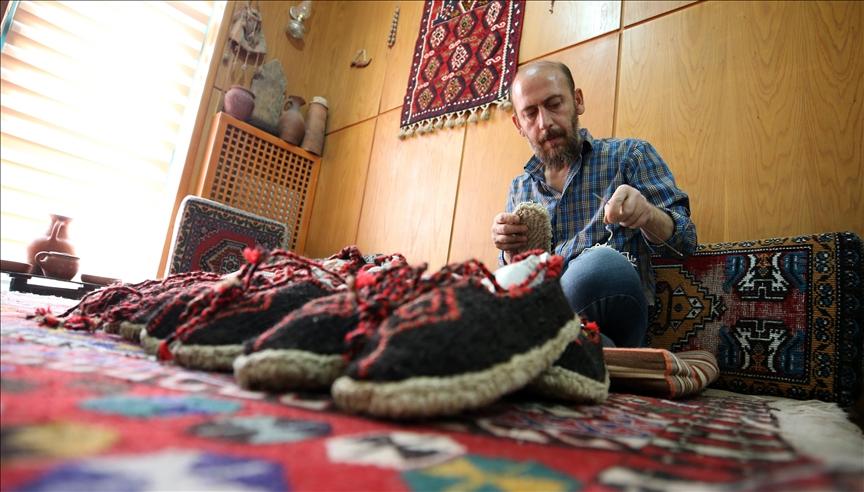
Harik artisan (Photo: Şener Toktaş, Anadolu Ajansı)
Harik production holds a special place within the traditional shoemaking craft of Bitlis. The manufacturing process is highly labor-intensive, and completing a single pair can take four to five days. The process involves several stages. First, raw materials are prepared. The primary materials used are hemp thread, goat hair, and sheep wool yarn. Initially, hemp is separated into strands and cleaned of impurities, then twisted into thread using a hand-operated device similar to a kirman. To ensure the thread is strong, it is twisted uniformly to a consistent thickness.【3】
Second, the shoe sole is formed. Wooden molds shaped like a foot are used. The wooden mold is placed in a basin filled with hot water. Goat hair and hemp thread are rubbed with hot water and soap to felt them. The felted material is then placed inside the mold, shaped, and left to dry.【4】
Once dried, the sole is covered with lining fabric to reinforce it. Then, stitches are made using burlap fabric for both inner and outer seams. The inner seam begins at the center of the sole and is tightly stitched, while the side seams are completed using cross-stitch and straight-stitch techniques. At this stage, approximately 2,500 to 3,000 stitches are made for each pair of harik.【5】
The upper part of the harik is knitted using the five-needle sock technique with goat hair or sheep wool yarn. Harik from Mutki are made from goat hair, while those from Hizan are made from sheep wool. Once the upper is completed, temporary stitches are made using cotton thread to attach it to the sole, followed by permanent reinforcing stitches.
Regional patterns can be embroidered on the toe and side sections of the harik. Decoration is typically done using brown, maroon, or dark green wool yarn. The laces are made by braiding or twisting the threads using plaiting or double-braiding techniques and are sewn onto the heel. Finished hariks are stuffed with lining fabric or hemp inside to shape them and then dried for three days. Since hemp and goat hair expand when in contact with water, the shoe takes its optimal form during this drying process and is made ready for use.【6】
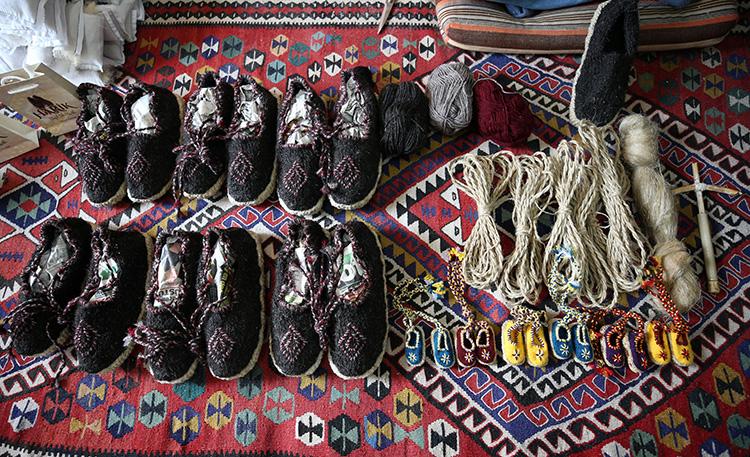
Harik (Photo: Şener Toktaş, Anadolu Ajansı)
Anadolu Ajansı. "Kaybolmaya Yüz Tutan Harik Sanatını Yaşatmaya Çalışıyor." 2022. Accessed February 21, 2025.https://www.aa.com.tr/tr/kultur-sanat/kaybolmaya-yuz-tutan-harik-sanatini-yasatmaya-calisiyor/2578521
Research Sources
Sökmen, Sultan, and Zeynep Balkanal. “BİTLİS’TE GELENEKSEL AYAKKABICILIK: ‘HARİK’ Ve SON USTA HAYDAR YILMAZ”. Trakya Üniversitesi Sosyal Bilimler Dergisi 20, no. 1 (June 2018): 383-400. https://doi.org/10.26468/trakyasobed.402982.
T.C. Kültür ve Turizm Bakanlığı. "Harik (Yöresel Ayakkabı) - Bitlis." 2022. Accessed February 21, 2025.https://www.kulturportali.gov.tr/turkiye/bitlis/nealinir/harik-yoresel-ayakkabi
T.C. Ministry of Culture and Tourism. "Bitlis İl Sanatları." Bitlis Provincial Directorate of Culture and Tourism. Accessed February 21, 2025.https://bitlis.ktb.gov.tr/TR-56213/el-sanatlari.html
Visual Sources
[JPG]. Anadolu Ajansı. Accessedhttps://www.aa.com.tr/tr/yasam/bitlisteki-son-harik-ustasi-meslegini-25-yildir-yasatmaya-calisiyor/2767322.
Şener, Toktaş (December 19, 2022). The last master craftsman of Bitlis is striving to keep the profession alive for 25 years
Şener, Toktaş (May 3, 2022). Kaybolmaya yüz tutan harik sanatını yaşatmaya çalışıyor [JPG]. Anadolu Ajansı. Accessedhttps://www.aa.com.tr/tr/kultur-sanat/kaybolmaya-yuz-tutan-harik-sanatini-yasatmaya-calisiyor/2578521
[1]
Sultan Sökmen ve Zeynep Balkanal, "Bitlis’te Geleneksel Ayakkabıcılık: 'Harik' ve Son Usta," Trakya Üniversitesi Sosyal Bilimler Dergisi 20, no. 1 (2018): 389.
[2]
Anadolu Ajansı, "Kaybolmaya Yüz Tutan Harik Sanatını Yaşatmaya Çalışıyor," 2022, https://www.aa.com.tr/tr/kultur-sanat/kaybolmaya-yuz-tutan-harik-sanatini-yasatmaya-calisiyor/2578521
[3]
Sultan Sökmen ve Zeynep Balkanal, "Bitlis’te Geleneksel Ayakkabıcılık: 'Harik' ve Son Usta," Trakya Üniversitesi Sosyal Bilimler Dergisi 20, no. 1 (2018): 390.
[4]
A.e., 391.
[5]
A.e., 392.
[6]
A.e., 396.

No Discussion Added Yet
Start discussion for "Harik (Regional Shoe)" article
History
Harik Production Process