


This article was automatically translated from the original Turkish version.
Brazing is a metallurgical joining method that achieves a permanent bond by placing a filler metal with a lower melting point between the materials to be joined and melting that metal without melting the base materials. In this process, the solidification temperature of the filler metal must be lower than the melting point of the base material but typically above 450 °C (723 K) to distinguish it from soft soldering.
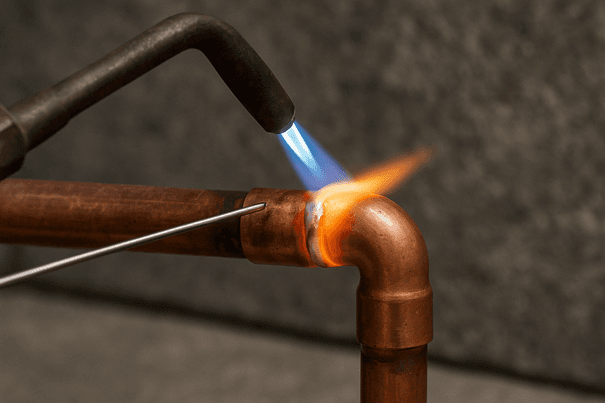
Representative Brazing Application Image (Generated by artificial intelligence.)
The brazing process occurs in three fundamental stages:
Brazing can be performed using various heating techniques including furnace brazing, induction, resistance, flame and infrared heating. Furnace brazing in particular provides high dimensional accuracy and repeatability and is widely applied across industries from automotive to aerospace.
Filler metals used in brazing are selected based on the type of base material and the service conditions. Common alloys are based on aluminum, copper, nickel, silver, gold and cobalt. Elements such as phosphorus, boron and silicon in alloy systems improve fluidity reduce surface tension and provide self-fluxing properties. Filler metals are classified according to ISO 17672:2016 and AWS A5.8 standards.
Flux is used in brazing to remove surface oxides and prevent reoxidation. However, in vacuum or reducing atmospheres flux may not be necessary. For example in vacuum environments boron-containing filler metals can act as oxide removers.
Cleaning of the surfaces to be joined is critical. Oil dirt oxides and moisture on the surface inhibit wetting and therefore capillary flow. Surfaces may be cleaned mechanically or chemically if needed and protected prior to the process.
The amount of clearance between the parts to be joined affects both fluidity and the mechanical strength of the joint. Narrower clearances provide better capillary action and higher strength. However excessively narrow gaps may prevent adequate penetration of flux and filler metal.
Brazing is used in numerous fields including automotive aerospace HVAC systems electronics nuclear reactors fusion energy systems radar systems and heat exchangers. It is preferred for components requiring high strength leak tightness and aesthetic joints. Additionally it offers advantages in applications such as metal-ceramic joining that are difficult with conventional methods.
Brazing Explained. Fractory. Accessed April 22, 2025.
Brazing Filler Metals. Encyclopedia of Materials: Science and Technology.https://doi.org/10.1016/B0-08-043152-6/01838-6.
Brazing. Encyclopedia of Materials: Science and Technology.https://doi.org/10.1016/B0-08-043152-6/02055-6.
Way, M., Willingham, J., and Goodall, R. “Brazing Filler Metals.” International Materials Reviews 65, no. 5 (2020): 257–285.https://doi.org/10.1080/09506608.2019.1613311

No Discussion Added Yet
Start discussion for "Hard Soldering (Brazing)" article
Process Mechanism
Heating Methods
Filler Metals
Fluxes and Atmosphere Control
Surface Preparation and Cleaning
Joint Clearance and Mechanical Strength
Applications