This article was automatically translated from the original Turkish version.
+1 More
Status | The restored work has held the status of 'Immovable Cultural Heritage Requiring First Group Protection' since 2003. | ||||||||
|---|---|---|---|---|---|---|---|---|---|
Location | Edirne | ||||||||
Patron | It was built by Edirne Governor Hacı Adil Bey in memory of his martyr son. | ||||||||
Year of Construction | 1904 (Hijri 1322) | ||||||||
Architectural Style(s) | The structure has a lead-covered broken roof and a metal finial. built in Baroque style with cut stone in a square form | ||||||||
Hacı Adil Bey Çeşmesi, Edirne is a structure from the Ottoman period of the 20th century located along the Karaağaç route. It was constructed in 1904 (Hijri 1322) through the personal initiative and financial contribution of Hacı Adil Bey, a governor of Edirne. As is customary, the fountain is named after its founder, and locally it is also known as "Meriç Çeşmesi" or "Köprübaşı Çeşmesi" due to its location.【1】
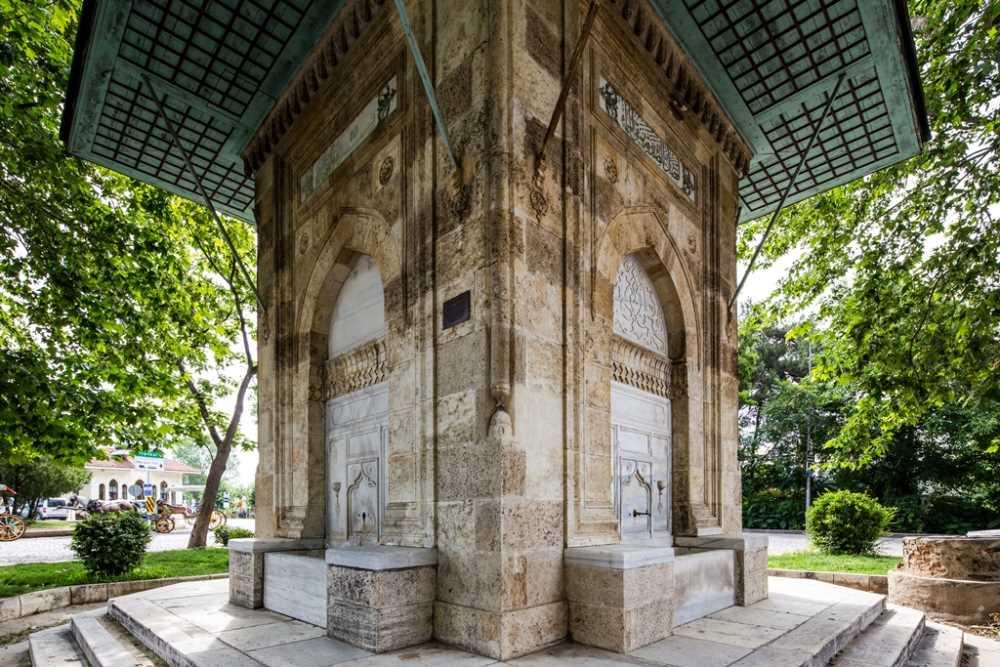
Hacı Adil Bey Çeşmesi (Edirne) (Kültür Portal)
The structure was commissioned by Hacı Adil Bey, who served as governor of Edirne during two separate periods, in memory of his son who died young in battle. The martyr’s grave is located in the cemetery of Selimiye Camii. During the period of the fountain’s construction, a branch line of the railway connected to Karaağaç Train Station extended directly to the edge of the Meriç Bridge, then known as İstasyon Meydanı, placing it immediately beside the structure.【2】
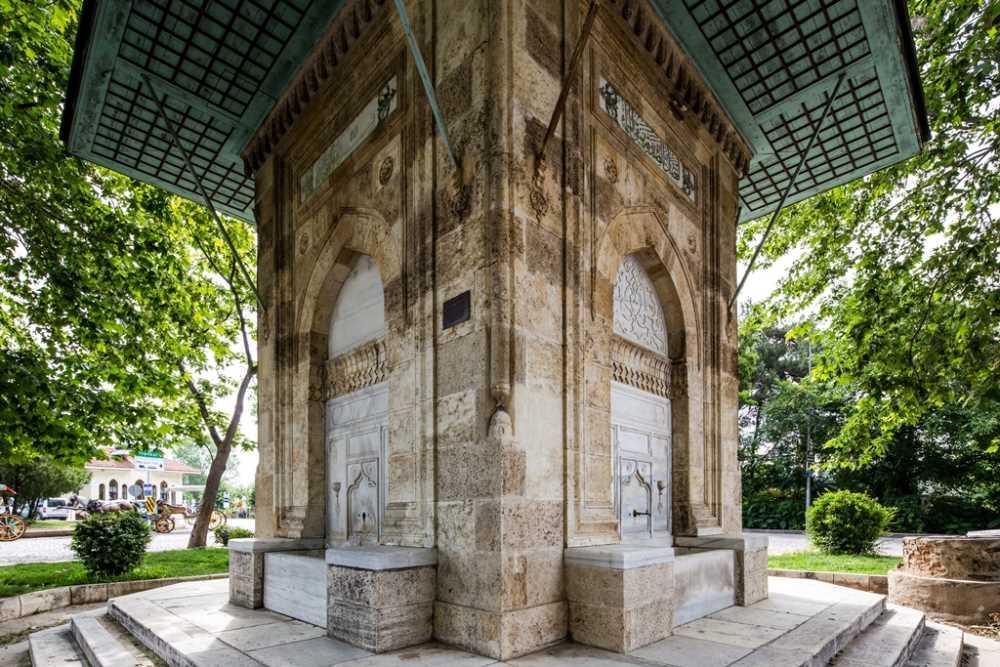
The fountain’s relief and design, reflecting Baroque stylistic elements, were jointly created by Sadrettin Bey, the Director of Waqfs in Edirne at the time, and Dr. Rıfat Osman. The main structure, built on a square mass, is placed on a platform accessible via three steps. Constructed of cut stone, the fountain stands 5.20 meters high and is 4.75 meters wide.【3】
All four facades of the fountain are architecturally identical. The roof system is designed as a lead-covered broken roof, with a metal finial placed at its highest point. Historical records indicate that a couplet composed by the Üsküdar poet Alaaddin was once inscribed on the fountain’s wall, but it is believed to have been destroyed during the Greek occupation.【4】 【5】
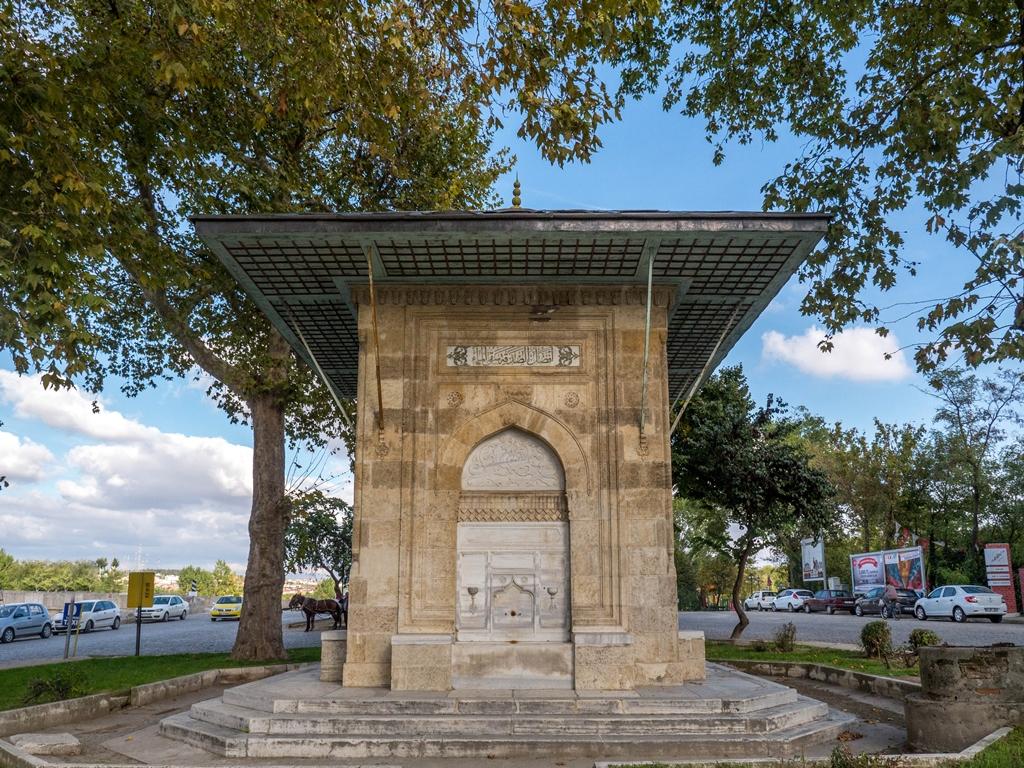
Hacı Adil Bey Çeşmesi (Edirne) (Kültür Portal)
Located along a cultural tourism route, Hacı Adil Bey Çeşmesi is currently regarded as the best-preserved historical fountain in the center of Edirne. In 1997, it underwent a comprehensive restoration and repair process carried out by the General Directorate of Waqfs. In recognition of its historical and cultural significance, it was officially placed under state protection in 2003 with the status of “Immovable Cultural Heritage Requiring First Group Protection.”【6】
Accessed November 26, 2025. https://www.aa.com.tr/tr/kultur/ahlatta-acilan-kurslarla-geleneksel-tas-isciligi-yasatiliyor/3116279.
Kültür Envanteri. "Hacı Adil Bey Çeşmesi." Accessed May 2, 2026.
Kültür Portalı. "Hacı Adil Bey Çeşmesi." Accessed May 2, 2026.
https://kulturenvanteri.com/yer/haci-adil-bey-cesmesi/
[1]
Kültür Envanteri, “Hacı Adil Bey Çeşmesi,” erişim 2 Mayıs 2026,
[2]
Kültür Envanteri, “Hacı Adil Bey Çeşmesi,” erişim 2 Mayıs 2026,
[3]
Kültür Envanteri, “Hacı Adil Bey Çeşmesi,” erişim 2 Mayıs 2026,
[4]
Kültür Portalı, “Hacı Adil Bey Çeşmesi,” erişim 2 Mayıs 2026, https://www.kulturportali.gov.tr/turkiye/edirne/gezilecekyer/haci-adil-bey-cesmesi
[5]
Kültür Envanteri, “Hacı Adil Bey Çeşmesi,” erişim 2 Mayıs 2026,
[6]
Kültür Envanteri, “Hacı Adil Bey Çeşmesi,” erişim 2 Mayıs 2026,

Status | The restored work has held the status of 'Immovable Cultural Heritage Requiring First Group Protection' since 2003. | ||||||||
|---|---|---|---|---|---|---|---|---|---|
Location | Edirne | ||||||||
Patron | It was built by Edirne Governor Hacı Adil Bey in memory of his martyr son. | ||||||||
Year of Construction | 1904 (Hijri 1322) | ||||||||
Architectural Style(s) | The structure has a lead-covered broken roof and a metal finial. built in Baroque style with cut stone in a square form | ||||||||
No Discussion Added Yet
Start discussion for "Hacı Adil Bey Çeşmesi" article
Purpose of Construction and Historical Background
Architectural Features and Design
Conservation Status and Current Condition