


This article was automatically translated from the original Turkish version.
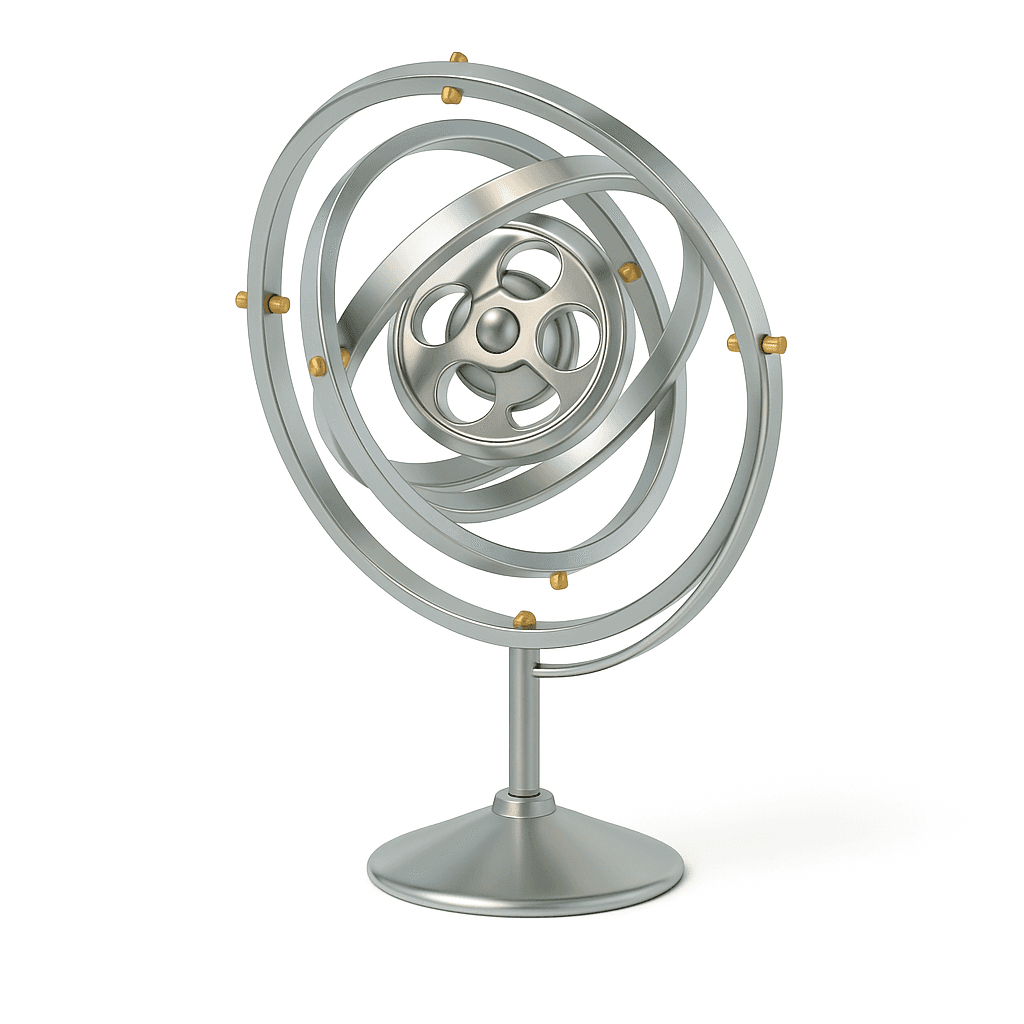
Gyroscope
Type | Inertial sensor | ||||||||
|---|---|---|---|---|---|---|---|---|---|
Initial Developer | Jean-Bernard-Léon Foucault (1852) | ||||||||
Basic Function | Angular velocity and orientation measurement | ||||||||
Principle(s) of Operation | Tendency of a rotating mass to maintain its axis of rotation (gyroscopic effect) | ||||||||
Basic Component | Microstructures (MEMS) Optical components (FOG) RLG Rotor/disc (mechanical) | ||||||||
Mathematical Foundation | C=I⋅ω (Torque, moment of inertia, angular velocity relationship) | ||||||||
Measurement Axes | Pitch, roll, yaw (3 axes) | ||||||||
Common Types | Mechanical gyroscope, optical gyroscope, MEMS gyroscope | ||||||||
Application Area(s) | smartphones automotive systems health technologies UAVs | ||||||||
Modern Technology | MEMS, fiber optic, quantum gyroscopes | ||||||||
Gyroscope is an inertial-based sensor developed to determine the angular motion and orientation of an object. This device, based on the tendency of a rotating mass to maintain its axis of rotation, is one of the fundamental components in applications such as navigation, stabilization, and motion tracking. Today, gyroscopes have been developed using various technologies including mechanical, optical, fiber optic, ring laser, and micro-electromechanical systems (MEMS).
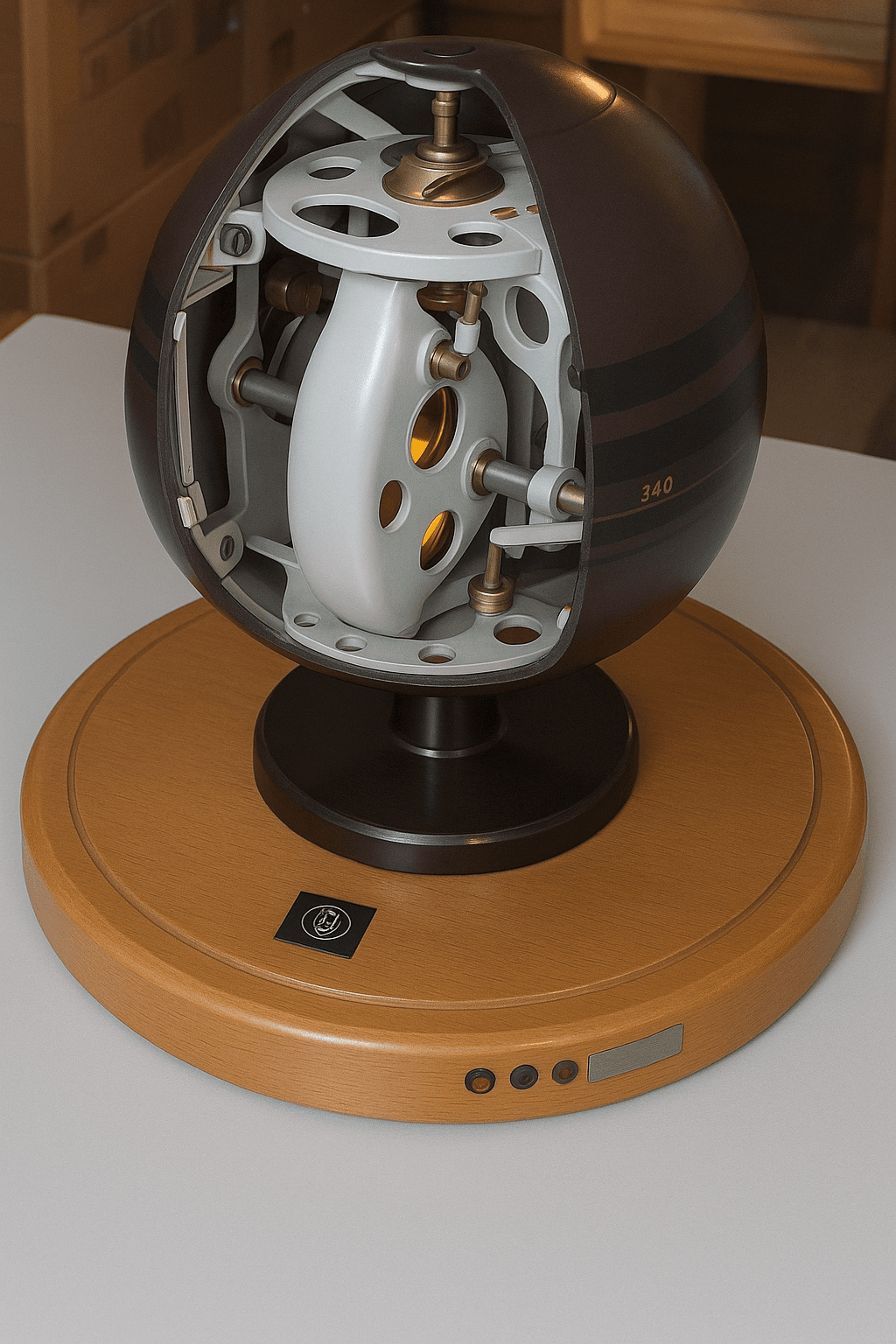
Jiroskopun Temsili Görseli (Yapay Zeka İle Oluşturulmuştur.)
The fundamental principle of the gyroscope is that when a body is given rotational motion, its axis of rotation remains fixed unless an external torque is applied. This behavior is explained by the principle of “conservation of angular momentum”. A rotating body, due to inertia, tends to maintain its axis of rotation. This principle plays a key role in navigation and stabilization applications requiring high precision.
In MEMS (Micro-Electromechanical Systems) gyroscopes, vibrating microstructures are subjected to the Coriolis force under rotational effects. This force generates a torque perpendicular to the axis of rotation, modeled as follows:
C_y = -I*\u03c9_z (1)
C_z = I*\u03c9_y (2)
Here, C represents the torque generated in the gyroscope, I is the moment of inertia, and ω (omega) denotes the angular velocity components. These equations enable precise measurement of angular motion in MEMS systems.
The theoretical foundation of gyroscope technology is based on the laws of motion developed by Isaac Newton in the 17th century. According to Newton’s principle of inertia, a body maintains its state of motion unless acted upon by an external force. This principle forms the physical basis for the gyroscope’s tendency to maintain a fixed rotational axis.
One of the earliest mechanical devices based on gyroscope principles is the gimbal system, a structure composed of nested rings used in navigation to keep objects stable in three-dimensional space. Gimbal mechanisms are among the early precursors of gyroscope technology due to their role in preserving directional stability.
The term “gyroscope” was first used in 1852 by French physicist Léon Foucault to describe a device designed to experimentally observe the Earth’s rotation around its axis. In Foucault’s system, a spinning disk maintained its orientation due to conservation of angular momentum, thereby making the Earth’s rotational motion visibly apparent.
From the early 20th century onward, gyroscopes began to find practical applications in navigation and stabilization systems. The first commercial gyroscope-based compass system, developed by German engineer Hermann Anschütz-Kaempfe, was introduced for maritime use in 1908. Subsequently, gyroscope-based autopilot systems developed by Sperry Corporation were adopted in aircraft during the 1920s.
In the 1970s, with advances in laser technology, ring laser gyroscopes (RLG) emerged. These systems determine rotational motion by measuring the phase difference created when two coherent laser beams travel in opposite directions. Due to the absence of moving parts, RLG systems are resistant to wear and have been used in defense and aviation applications requiring high accuracy.
Fiber optic gyroscopes (FOG), developed in the 1980s, operate based on the phase difference generated as light travels along a fiber optic cable. These systems also stand out for having no moving parts, low maintenance requirements, and long lifespans.
Starting in the 1990s, with the advancement of micro-electromechanical systems (MEMS) technology, gyroscopes became manufacturable at a microscale. MEMS gyroscopes detect angular velocity by sensing the Coriolis effect on vibrating microstructures. This design provides cost-effective, compact, and integrated solutions. MEMS gyroscopes are now used in a wide range of applications, from portable electronic devices to unmanned aerial vehicles.
Today, hybrid solutions integrating MEMS structures with optical systems are being developed in gyroscope technology. These advancements enable improvements in environmental resilience, energy efficiency, and sensitivity.
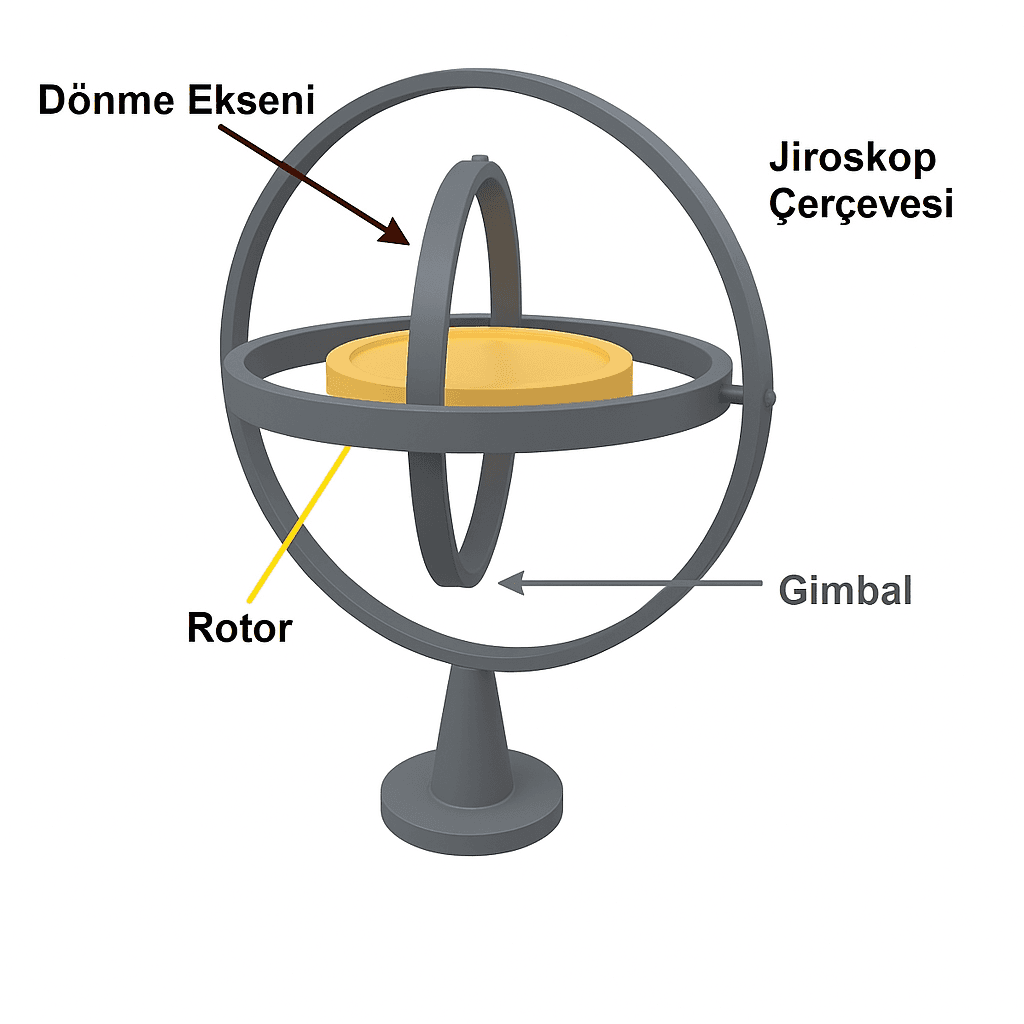
Jiroskopun Yapısına Ait Görsel (Yapay Zeka İle Oluşturulmuştur.)
Based on a spinning disk and gimbal system. Widely used in traditional marine and aviation systems. However, due to moving parts, it is susceptible to wear and easily affected by environmental factors.
Operates based on the phase difference of light traveling through a fiber optic cable. Rotation alters the travel time of light in opposite directions, and this difference correlates with angular velocity. Provides high precision and durability.
Uses two counter-propagating laser beams to perform an interferometric measurement. The path difference caused by rotation is detected as a phase shift. Preferred in military and aviation applications. However, it suffers from a phenomenon called “lock-in” at low rotation rates, which is mitigated using techniques such as dithering.
MEMS gyroscopes use vibrating microstructures. The Coriolis force, applied perpendicular to the vibration direction, is measured to determine rotational motion. Their low cost, light weight, and integrability make them widely used in applications ranging from portable devices to UAVs.
Gyroscopes serve as essential components in systems requiring measurement of angular velocity and orientation. Technological advancements have led to different gyroscope types offering distinct advantages for specific applications. These sensors are widely used in aviation, defense, space, robotics, consumer electronics, and healthcare technologies.
Gyroscopes are used in fixed-wing aircraft, helicopters, and spacecraft for attitude control, stabilization, and autopilot systems. They perform critical functions such as artificial horizon generation, horizontal and vertical axis referencing, and rate-of-turn measurement. Ring laser gyroscopes (RLG) and fiber optic gyroscopes (FOG) are preferred in military and commercial aviation applications requiring high precision.
In defense technologies, gyroscopes are used in missile guidance systems, inertial navigation systems (INS), tank and artillery stabilization systems, and similar applications. In such uses, laser and optical gyroscopes without moving parts are preferred due to their durability and resistance to environmental variations. Systems capable of accurate positioning even in low-acceleration environments provide high-precision navigation solutions.
MEMS gyroscopes are used in unmanned aerial vehicles for real-time orientation and motion control. These sensors provide data on roll, pitch, and yaw axes within PID control loops, helping maintain vehicle stability and orientation. They also enhance autonomous flight functionality by integrating with GPS data.
Gyroscopes are used in mobile devices such as smartphones, tablets, game consoles, and laptops for screen orientation detection, motion control, and user interface interaction. MEMS-based designs are widely preferred in portable devices due to their low power consumption and compact size.
MEMS gyroscopes are used in healthcare technologies for posture analysis, fall detection, musculoskeletal monitoring, and diagnosis of movement disorders. They are particularly favored for directional motion analysis in evaluating neurological conditions such as Parkinson’s disease. Additionally, they provide biomechanical feedback in athlete performance monitoring systems.
Gyroscopes provide orientation data in robotic systems for tasks such as balance control, precise maneuver planning, and motion prediction. In systems such as autonomous ground vehicles and industrial robots, they work alongside other sensors within inertial measurement units (IMUs) to support positioning and stabilization functions.
Next-generation gyroscope technologies aim to produce solutions more resilient to environmental factors such as temperature, electromagnetic interference, and vibration. Hybridization of MEMS gyroscopes with optical systems holds potential for reducing energy consumption while increasing sensitivity.
Gyroscope technology is a versatile system inspired by fundamental physical principles and widely applied in both basic sciences and applied engineering. With types ranging from mechanical to microsystems and from optical to laser technologies, gyroscopes fulfill roles in navigation, positioning, stabilization, and motion analysis.
Advanced Navigation. "The History of Gyroscopes: From Humble Beginnings to Hyper-Technology." Accessed May 25, 2025.
Kodal, Berat Buğra, Emin Konukoğlu, Görkem Aktaş, and Yücel Aydın. "MEMS Sensör Jiroskoplarının İnsansız Hava Araçlarında Kullanımı." İstanbul Teknik Üniversitesi, 2023. Accessed May 25, 2025.https://tok2023.itu.edu.tr/docs/librariesprovider68/bildiriler/116.pdf
Yıldırım, Oğuzhan, and Uğur Güdükbay. "MEMS Jiroskoplarının Dinamik Modellenmesi ve PID Kontrollü Konumlandırma Sistemi Üzerindeki Etkilerinin İncelenmesi." PeJOSS - Pehlivan Journal of Science and Systems 2, no. 1 (2023): 42–54. Accessed May 25, 2025.

Gyroscope
Type | Inertial sensor | ||||||||
|---|---|---|---|---|---|---|---|---|---|
Initial Developer | Jean-Bernard-Léon Foucault (1852) | ||||||||
Basic Function | Angular velocity and orientation measurement | ||||||||
Principle(s) of Operation | Tendency of a rotating mass to maintain its axis of rotation (gyroscopic effect) | ||||||||
Basic Component | Microstructures (MEMS) Optical components (FOG) RLG Rotor/disc (mechanical) | ||||||||
Mathematical Foundation | C=I⋅ω (Torque, moment of inertia, angular velocity relationship) | ||||||||
Measurement Axes | Pitch, roll, yaw (3 axes) | ||||||||
Common Types | Mechanical gyroscope, optical gyroscope, MEMS gyroscope | ||||||||
Application Area(s) | smartphones automotive systems health technologies UAVs | ||||||||
Modern Technology | MEMS, fiber optic, quantum gyroscopes | ||||||||
Principle of Operation
Conservation of Angular Momentum
Coriolis Effect in MEMS Gyroscopes
Historical Development
Types of Gyroscopes
Mechanical Gyroscope
Fiber Optic Gyroscope (FOG)
Ring Laser Gyroscope (RLG)
MEMS Gyroscope
Applications
Aviation and Space
Defense Systems
Unmanned Aerial Vehicles (UAVs) and Drone Systems
Consumer Electronics
Wearable Technologies and Healthcare Applications
Robotics and Autonomous Systems
Future Perspectives and Next-Generation Developments