


This article was automatically translated from the original Turkish version.
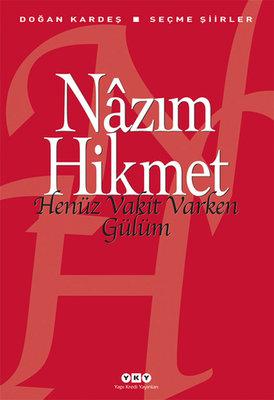
Not yet time, my love
Author(s) | Nazım Hikmet | ||||||||
|---|---|---|---|---|---|---|---|---|---|
Page | 112 | ||||||||
Category | Poetry | ||||||||
Henüz Vakit Varken Gülüm – Seçme Şiirler is an anthology compiling poems from different periods of Nazım Hikmet, one of the pioneering poets of Turkish literature. This work features a romantic lyricism infused with political consciousness, reflecting the poet’s individual and social understanding of poetry. Themes such as Love, labor, freedom, nature, and the joy of life like form the poetic unity of the work. The poems selected in this anthology also shed light on the formal transformation of Turkish poetry.
The book has been published in various editions by different publishing houses in Türkiye. It is regarded as one of the key important anthologies that have introduced Nazım Hikmet’s poetry to new generations.
Nazım Hikmet (1902–1963) is recognized as one of the pioneers of Turkish poetry. By introducing free verse to Turkish literature, he broke away from traditional poetic forms and developed a rhythmic yet free poetic language rooted in spoken Turkish. Nazım reflected his Marxist world perspective in his art, creating a poetic vision that intertwined personal emotions with social issues. Throughout his life, he was repeatedly tried for political reasons, long duration imprisoned, and ultimately exiled from his homeland. His poems consistently emphasize hope, resistance, and human love. He also contributed to literature as a game writer, novelist, and memorial writer.
Love and Human Compassion: In Nazım Hikmet’s love poems, there is not merely a personal emotion but a universal human compassion. These poems, bearing traces of letters written to the women he loved, transcend subjective experience to evolve into a social sensitivity.
Social Justice and Labor: The living conditions of the working class, justice, and the pursuit of equality occupy a central place in Nazım’s poetry. Socialist thought is one of the fundamental building stones of his poetry, and the concept of labor is powerfully represented on both aesthetic and ideological levels.
Freedom, Exile, and Resistance: In the poems written during his years of exile and imprisonment, longing, censorship, repression, and the desire for freedom are interwoven. These poems reflect the conflict between individual rights and social structures while simultaneously becoming expressions of hope and resistance literary.
Nature and Life: In poems that focus on the details of everyday life and nature, Nazım transforms even his death thought into a call for the beauty of life. Life love and human values are among the central themes of his poetry.
Nazım Hikmet’s poetic language employs Turkish with a rhythm close to spoken speech. He rejected traditional structures such as rhyme and meter in favor of free verse. His expression is direct and simple. Long lines, repetition, direct address, and sudden emotional transitions are frequently employed. This style lends a theatrical quality to his poems and enhances their accessibility.
The poem that gives the book its title is a call to elevate love, life, and together in the face of time’s limitations and life’s transience. The central phrase “yet vakit varken” serves as a warning against time while also symbolizing the desire to give meaning to life. In this sense, the poem possesses a distinctly humanistic call character at both individual and collective levels of consciousness.
Henüz Vakit Varken Gülüm – Seçme Şiirler has been published in various editions by different publishing houses in Türkiye. Although the selection of poems may vary across editions, the title poem fixed remains consistently included. The work is regarded as one of the most important anthologies that have introduced Nazım Hikmet’s poetry to new generations.
Hikmet, Nazım. Henüz Vakit Varken Gülüm – Seçme Şiirler. İstanbul: YKY.

Not yet time, my love
Author(s) | Nazım Hikmet | ||||||||
|---|---|---|---|---|---|---|---|---|---|
Page | 112 | ||||||||
Category | Poetry | ||||||||
No Discussion Added Yet
Start discussion for "Gülüm, There’s Still Time — Selected Poems (Book)" article
Thematic Structure of the Work
Formal Characteristics
Publication and Publishing Information